When Permit Expediting Delays Slide GC Start Dates
Permit expediting delays sit invisibly between owner GMP and the first mobilized crew. On mid-size GC projects, the days compound faster than the schedule shows.
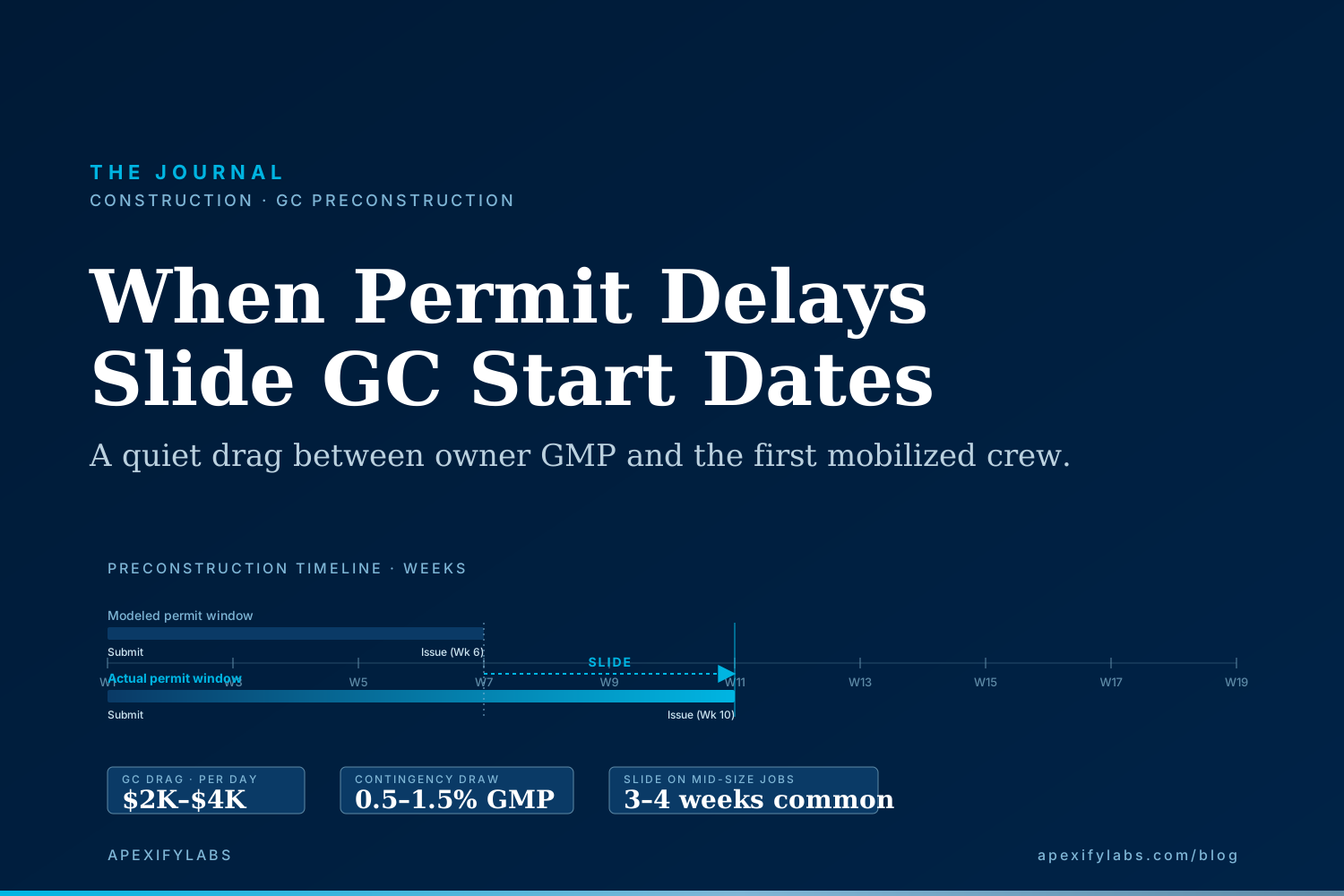
Permit expediting delays are the invisible drag between the day a GC signs the owner contract and the day trades actually start. Mid-size GCs usually absorb the gap into general conditions, but the days spent waiting on jurisdiction approvals compound quickly, slide the start date, and cost far more than the expediting fee itself.
What is permit expediting on a mid-size GC project?
Permit expediting is the coordination work between contract execution and the first mobilized crew: pulling building, foundation, MEP trades, and specialty permits from the Authority Having Jurisdiction, then chasing corrections, resubmittals, and inspector sign-offs until every prerequisite is in hand. On a mid-size commercial or multi-family job, that is typically 8 to 20 separate permit items across two to five agencies.
Most GCs run this as a shared responsibility. Preconstruction owns some, the project manager owns some, the trade contractors submit their own MEPs, and an outside expediter or a plans examiner shepherds the harder ones. There is rarely one visible board that shows where every permit currently sits.
That structure works when jurisdictions turn permits in the promised window. When they slip, the invisible math starts to run.
Why do permit timelines slide?
Jurisdiction cycle times are not what most GC schedules assume. Municipal reporting and building-industry benchmarks (NAHB annual permitting studies and ICC Digital Codes reporting) consistently show that public-agency plan-review windows are one of the most volatile line items in the preconstruction calendar. A jurisdiction that promised 15 business days may deliver in 12 on a quiet quarter and 45 in a busy one.
The delays cluster into a few recurring patterns:
- Reviewer capacity swings. Agencies staffed for baseline volume slow noticeably during permit surges. Post-storm permit rushes and calendar-year-end building code deadlines both compress reviewer availability.
- Correction cycles that stack. A first correction letter arrives, the design team revises, the resubmittal enters a fresh queue rather than the original one, and the clock effectively resets.
- Cross-agency dependencies. Fire marshal sign-off blocks building permit release. Health department blocks the foodservice tenant. A separate DOT permit blocks the driveway. Each dependency runs its own clock and the aggregate is longer than any one line item.
- Third-party review outsourcing. Some jurisdictions ship overflow to third-party plan reviewers with unpublished cycle times, and the GC has no direct visibility.
- Small paperwork gaps. A missing notarization, an outdated design professional stamp, an unpaid impact fee. Any one of these bounces the submittal without moving it forward.
Each cause is ordinary. Together they turn a modeled 6-week permit window into an actual 10-week window on a large share of projects.
How much does a start-date slide cost a GC?
The answer depends on the contract structure, but the shape is consistent across mid-size GC portfolios.
Consider a $12M ground-up commercial project with a $600,000 general conditions budget spread across a 14-month schedule. General conditions burn at roughly $43,000 per month, or about $1,400 per calendar day. Add carrying costs on any mobilized site trailer, temporary utilities, security, and the superintendent's time, and the daily hidden cost of a slid start date is typically $2,000 to $4,000 on a project of that size.
Now overlay the schedule math. A three-week permit slide on a job with tight seasonal windows pushes site work into winter, adds cold-weather protection line items, and cascades into subcontractor rescheduling fees. On a healthy project, the additional draw against the contingency reserve is usually 0.5 to 1.5 percent of contract value. On a tight-margin fixed-price job, that is the difference between finishing at forecast margin and finishing 40 percent below it.
The permit-expediting delay is not the whole reason margin compresses. It is the trigger that unlocks a chain of downstream costs the project manager will spend the next 90 days explaining to the owner.
Where do most permit-expediting operations lose visibility?
Three blind spots show up on almost every mid-size GC preconstruction desk audit.
Blind spot one: the status inbox. Permit status updates arrive by email, by portal notification, by phone call, and (in more than a few jurisdictions) by physical mail. No single view aggregates them. The team learns about a resubmittal request when someone forwards an email at 4pm on Friday.
Blind spot two: the correction-cycle clock. Once a correction letter arrives, the internal clock is design-team turnaround. Very few GCs track how long revisions sit on the architect's desk versus how long the jurisdiction sits on the revised set. Without that split, it is impossible to know where to press.
Blind spot three: the trade-permit orbit. Mechanical, electrical, plumbing, low-voltage, and fire-suppression permits are usually pulled by each trade individually. The GC assumes they are moving, and the first sign that they are not is a mobilization request without a permit number in hand.
The common theme is not a lack of skill on the desk. It is a lack of one system that watches every open permit and every open correction on every open project, and pings the right person the moment something moves.
What does a low-lag permitting operation look like?
Same project, same jurisdictions, two operations:
| Dimension | Reactive permit desk | Low-lag operation |
|---|---|---|
| Status visibility | Manually checked by PM or expediter weekly | Portal and email traffic ingested continuously, one dashboard per project |
| Correction detection | Discovered in the inbox | Flagged the moment a correction letter posts, with a routing decision within the same hour |
| Design-team ownership | Chased ad-hoc when the PM notices | Automatically routed with a soft due date and an escalation clock |
| Trade permit tracking | Trusted to the sub | Every trade permit visible on the same board as building permits |
| Owner communication | Reactive when the owner asks | Weekly permit health note with a slippage forecast |
| Data captured | Submit and issue dates only | Full timeline: submit, first correction, each resubmittal, issue, prerequisite unlock |
The AI-augmented version does not shorten what the jurisdiction takes. It shortens every hour on the GC's side of the exchange, and it surfaces slippage while there is still a chance to redirect labor or move the mobilization plan.
Which metrics matter?
Three numbers change the conversation.
- Median correction-cycle turn. How many calendar days from correction-letter posting to resubmittal. If that number is above five, the design team is the bottleneck, not the jurisdiction.
- Permit-slip start-date impact. Days from the modeled start date to the actual mobilized start, per project. When you have this by jurisdiction, the next preconstruction schedule stops being wishful.
- Percent of projects mobilized without a full permit package. The percentage of jobs where the GC put boots on site with at least one trade permit still open. If that number is above zero, the risk is real and priced into no one's contingency.
Once these three metrics exist, the preconstruction team can start pricing permit risk into schedule and contingency rather than absorbing it silently in general conditions.
Why the start-date slide is the point
Owners hire GCs to hit dates. Every dollar of general conditions burned before the first crew is on site is a dollar the owner does not see move the project forward. Permit expediting is the single most controllable variable in that window on most mid-size jobs, and it is also the least measured.
The desks that treat permitting as an ops function rather than a paperwork function tend to protect start dates the way sophisticated brokerages protect margin. It is the same instinct: watch the clock nobody else is watching, and act while there is still time.
If your preconstruction desk is quietly absorbing permit slippage into general conditions, we run a completely free automation audit for mid-size GC operations that want a second opinion before committing to anything. → Book the audit
Sami Raza
Software Developer & Technical Author
Sami Raza builds AI automation for logistics, DTC, and construction operations teams at ApexifyLabs, and writes about the operational failures that automation is actually worth pointing at.