What Unclaimed Weather Delays Cost Mid-Size GCs
Weather-day extensions are the easiest GC contract right to lose. Miss the notice window and the schedule slip stays on the P&L for the rest of the job.
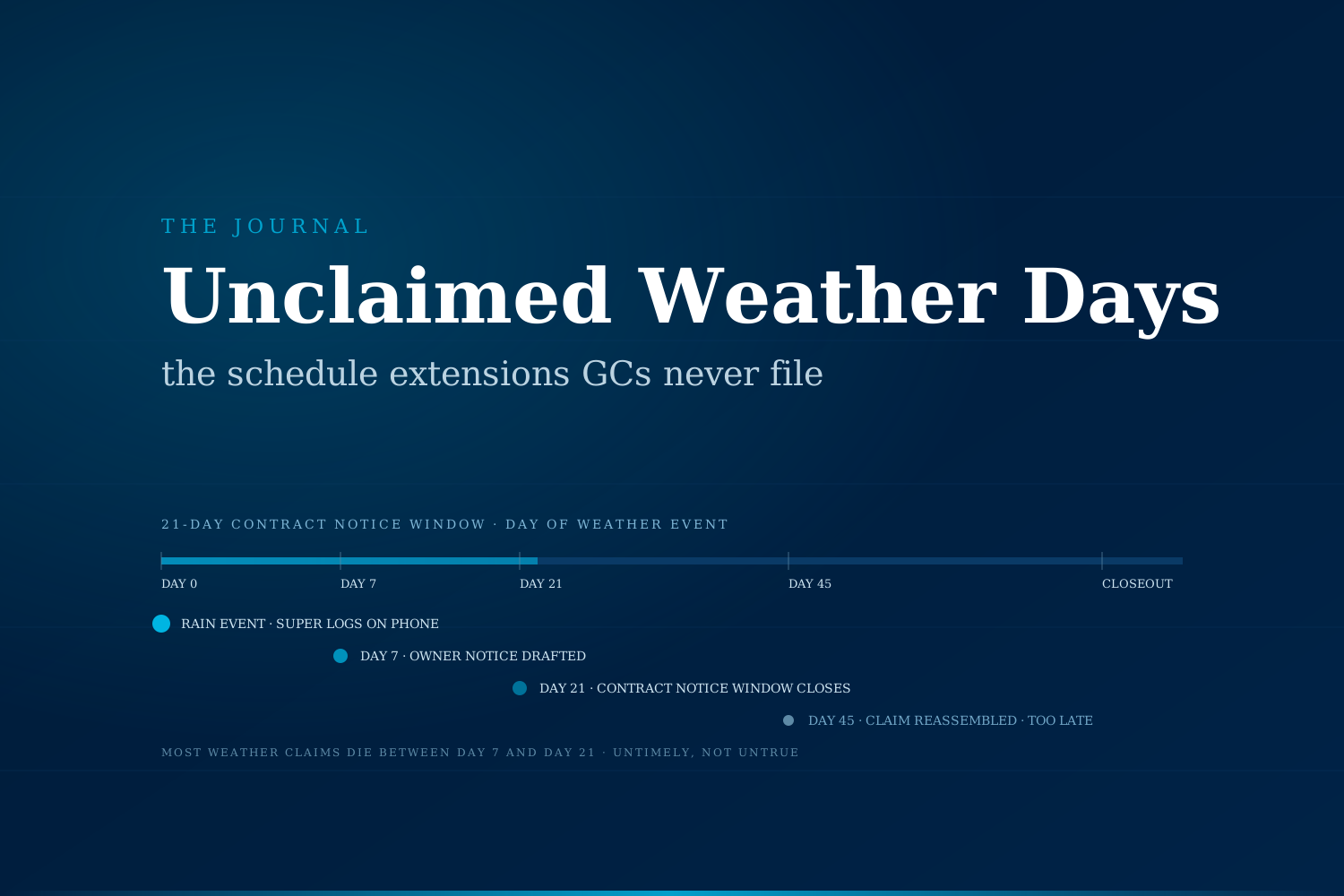
Weather-day extensions are the easiest GC contract right to lose. Most construction contracts require written notice inside a 7 to 21 day window, backed by a daily log of conditions and stopped work. Miss the window or the log, and the entitlement disappears while the schedule slip stays on the GC's P&L for the rest of the job.
Why do weather-day claims fail so often?
Weather delay claims fail for reasons that have almost nothing to do with the weather itself. They fail on paperwork rhythm.
Every mid-size GC we look at can point to at least one job where crews were legitimately shut down for two, three, sometimes five consecutive days by rain, freeze, or high wind, but the delay never made it into the final schedule reconciliation. The daily log for those days was thin. The photos lived on the super's phone and were never uploaded. The notice letter to the owner never went out.
The claim was not wrong. It was untimely.
Under the AIA A201 general conditions (the base contract for most GC work in the US), notice of a delay must be given "not more than 21 days after the event." The Federal Acquisition Regulation on federal jobs is tighter still. And most owner-drafted supplements pull that window in further, sometimes to 7 days. Each missed window is a legally clean rejection.
What does a defensible daily log actually need to prove?
A defensible weather-day claim ties four elements together, all timestamped to the day in question:
| Element | What it captures | Why it matters |
|---|---|---|
| Site conditions | Recorded temperature, precipitation, wind, humidity | Establishes that the weather event was actually adverse |
| Crew status | Which trades reported, which stood down, hours idled | Establishes that the weather impacted the critical path |
| Work stoppage | Which activities were paused and for how long | Ties the delay to a specific schedule activity |
| Notice | Written communication to owner or CM inside the contract window | Preserves entitlement |
Miss any one of the four and the claim weakens. Miss two and it usually dies.
The failure mode we see most often is the crew-status column. Supers know which crews stood down, but that information sits in text messages, phone calls to the PM, and the super's own memory. By the time a claim gets assembled at month's end, half the crew-hour context is gone.
How much does a missed weather claim actually cost?
The cost has three parts, and mid-size GCs tend to underestimate all of them.
Direct schedule impact. A day lost to weather without a formal extension pushes substantial completion by a day. On a 12-month project with a $2,500 per day liquidated damages clause, five undocumented weather days is a $12,500 exposure that lives on the balance sheet until the job closes.
General conditions creep. Every day the schedule stretches is another day of site trailer rent, supervision time, portable toilet service, temporary utilities, dumpsters, and safety personnel. Industry rules of thumb put mid-size GC general conditions in the high single digits to low double digits of contract value, prorated per day. On a $6M job over 12 months, that is roughly $1,300 to $2,000 per calendar day. Five untracked weather days becomes another $6,500 to $10,000 of GC cost the owner will not reimburse.
Downstream sub claims. When a GC cannot pass a legitimate weather day up to the owner, subs still submit their own delay claims to the GC. The GC absorbs. A season of unclaimed weather can commonly surface tens of thousands of dollars of sub-driven extension pressure that the GC ends up eating out of contingency.
Aggregate the three across a normal Northeast winter or a Gulf Coast hurricane season and the number is not small. It just never lands on any single line item.
Why do so few GCs run this well today?
Not for lack of effort. The field supers we talk to know the process. The challenge is that the process runs on the wrong medium.
Weather claims live in a fast decay window: the log is easy to write on the day, hard on day three, and effectively impossible by day fourteen. Meanwhile, the field super's day is already overloaded with subs, deliveries, inspections, and safety walks. The daily log is the first thing that gets deferred and the last thing that gets caught up.
Owner-facing notice letters make it worse. They require PM attention, cross-referencing to the contract, sometimes counsel review. The 7 to 21 day window closes silently.
What changes when the daily log runs itself?
The interesting shift is not the log software. Digital daily log apps have existed for years, and most mid-size GCs already own one. The shift is when the log gets populated without the super having to remember to open it.
A modern setup pulls the objective data automatically: an on-site weather station or the nearest NOAA station feed for conditions, the timesheet system for crew reported hours, photographic capture from the security cameras or 360-degree site cameras that many GCs now install for insurance reasons. The super's job compresses to a short daily confirmation, twenty seconds, on the phone, at the end of the day.
Once that layer runs, the notice letter can be triggered off the log itself. When the recorded conditions cross the contract-defined adverse-weather threshold, the system flags the claim window and drafts the owner notice using the contract's own template. The PM approves or edits, does not compose.
For claim recovery, the direction is measurable even if the specific rate is not universal. GCs who move from paper-and-memory daily logs to automated logs consistently report better delay claim success, more schedule extensions granted, and fewer late-in-the-job disputes with owners over what "actually happened out there."
Three questions worth asking about your current weather process
For a mid-size GC evaluating whether this is a real leak on their jobs, three quick diagnostic questions surface the answer:
- On the last three jobs that closed, what percent of weather delay days had a same-day log entry with photos and crew hours? If you cannot answer within an hour, the process is not documented enough to defend.
- What is your average time from weather event to owner notice letter across the last twelve months? Anything over 10 days is inside the danger zone for standard AIA notice windows.
- When was the last time your PM sat with the super's daily logs before the monthly owner meeting rather than during it? If the answer is "never," the logs are being reconstructed, not reviewed.
None of the three questions require a system change to answer. They only require a look back at three recent jobs. What that look usually reveals is that the field team is doing the work, and the paperwork is doing the losing.
Where does this fit in a mid-size GC's larger AI roadmap?
Weather documentation is one of a family of paperwork-rhythm problems on GC jobs that share the same failure mode. The field runs on real time. The office runs on batch. The contract mechanisms sit between them. Submittal turnaround, RFI response, T&M ticket capture, and change order tracking all belong to the same family. Each is legitimately hard to run in real time by hand. Each becomes trivial once the underlying event data is captured without human effort.
The right sequencing is not to try all of them at once. It is to pick the one where a documented month or two of leaked margin can be measured against a specific dollar figure per job, and start there. On coastal jobs and Northeast winters, weather is often that first pick.
Closing
Unclaimed weather delays are the kind of leak that never triggers an alarm because every individual missed day looks like an operational judgment call. The margin damage shows up in aggregate, at closeout, in the gap between promised substantial completion and actual substantial completion.
If your GC has not looked at how many weather days made it into a formal notice letter last season, that is the number worth pulling first.
We run a completely free automation audit for mid-size GCs that want a second opinion on where the paperwork rhythm is leaking margin they can size. No commitment, no slide deck, no sales pitch. We walk your last three closed jobs with you and identify the two or three places where an automated documentation layer would have moved a real number. → Book yours
Sami Raza
Software Developer & Technical Author
Sami Raza builds AI automation for logistics, DTC, and construction operations teams at ApexifyLabs, and writes about the operational failures that automation is actually worth pointing at.