Owner Verbal Directives That Never Become Change Orders
On mid-size GC jobs, verbal owner directives often become absorbed scope that never reaches a change order request. Where the margin actually leaks, and what the intake step looks like when it holds.
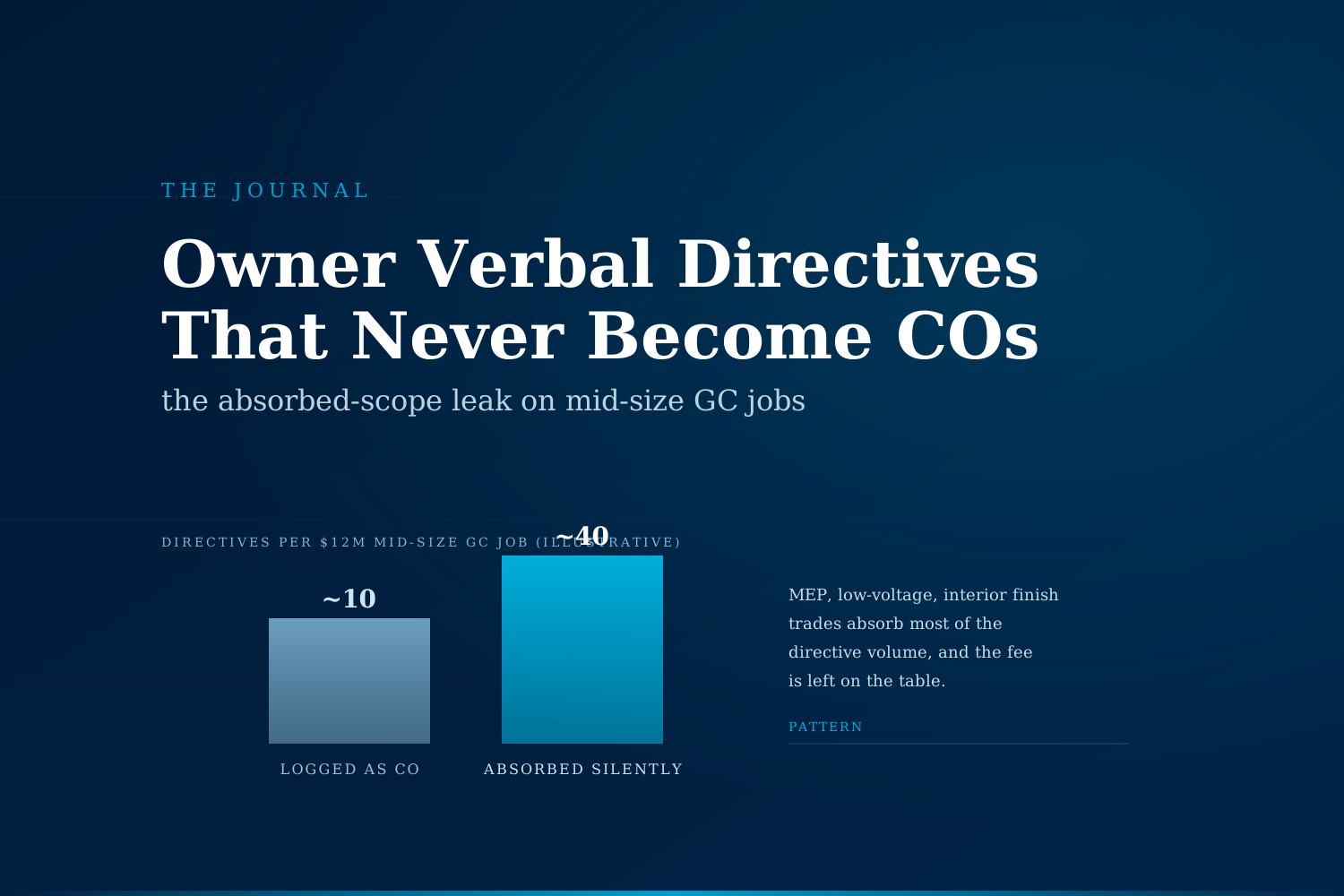
Owner verbal directives happen daily on mid-size GC jobs. A walk-through comment, a quick text after a coordination meeting, a "just make it work" moment during a punch. Many of those directives never become priced change orders, and the GC absorbs the labor and material silently. Across a fiscal year, that absorbed scope compresses job margin more than most billing disputes ever do.
What is an owner verbal directive on a construction job?
An owner verbal directive is any instruction from the owner (or the owner's rep) asking the GC to do work that was not clearly defined in the contract documents. It might be a change in finish, a relocated outlet, a re-routed duct, or a punch-list item that was never actually a defect. It arrives in an OAC meeting, in a text message, during a site walk, or over a quick phone call in the trailer.
In the contract, verbal directives should trigger a paper trail: a field notice, an RFI, or a formal change order request that gets priced and executed before the work proceeds. In practice, plenty of them skip that trail entirely and get performed on the same visit they were requested.
Why do verbal directives skip the change order log?
Directives skip the log for reasons that are rarely malicious. Field teams are trying to keep the owner happy and the job moving. When the directive is small (a few hours of a carpenter, a couple hundred dollars of material), papering it feels heavier than doing it. When the directive is larger but ambiguous ("figure out how to make that corner work"), the field decides to solve it first and price it later, and later rarely arrives.
Common patterns behind absorbed directives:
- Ambiguity about who authorized it. The owner's rep gave the directive, but only the owner can sign a change order. Nobody wants to pause the trade over a signature question.
- Small-value threshold thinking. "It's a $400 change, not worth the paperwork." Multiplied across a job, $400s add up into five figures of quiet absorption.
- Coordination pressure. The trade is on site right now. The directive resolves a coordination conflict right now. The paperwork is a next-week problem.
- Fear of the friction. Filing a formal change order request feels like it slows the job or dents a repeat-owner relationship.
- Missed handoff. The PM knows about the directive. The field super knows about the directive. Nobody wrote it down where accounting can price it.
Industry surveys of mid-size GCs consistently report unbilled change scope in the low- to mid-single-digit percentages of job value, and PMs typically underestimate the number because absorbed directives never surface in the change log they audit against. CFMA and AGC benchmark reports have repeatedly flagged the gap between directed scope and billed scope as one of the least-measured margin leaks on mid-size commercial work.
What does absorbed scope actually cost a mid-size GC?
The direct cost is easier to see than the ripple. A directive that took the electrician six hours and $180 in material at a base rate carries labor burden and small-tool overhead on top. Below is a rough shape that GCs recognize once they run the math on a closeout job.
| Component | Directive 1 (relocated outlets) | Directive 2 (added chase for a run) | Directive 3 (finish upgrade in office suite) |
|---|---|---|---|
| Direct labor | 6 hrs at loaded rate | 14 hrs at loaded rate | 22 hrs at loaded rate |
| Direct material | ~$180 | ~$620 | ~$1,900 |
| Coordination hours (super, PM) | ~1 hr | ~3 hrs | ~5 hrs |
| Overhead + fee not recovered | 0% (absorbed) | 0% (absorbed) | 0% (absorbed) |
| Rough absorbed total | $700 to $900 | $2,100 to $2,800 | $6,000 to $7,500 |
Across a $12M project, GC PMs will describe pulling 30 to 80 such directives out of memory when asked to reconstruct the year. The compounding effect matters: absorbed directives are almost always performed without the GC's contract fee attached, so every dollar of absorbed scope is a dollar of pure margin erosion, not a discount off gross.
The indirect cost is worse and less visible:
- Schedule pressure builds because absorbed scope was never rebaselined into the schedule.
- Subs get asked to price change orders informally, which produces informal (that is, non-legal) commitments.
- The owner learns that small directives are free, which reshapes their behavior on the next project.
How does a papered directive differ from an absorbed one?
The delta is not about the work. It is about the paper trail. A papered directive keeps optionality: the GC can decide to absorb it as goodwill, negotiate it, or bill it in full. An absorbed directive removes that optionality before the numbers are ever on the table.
| Dimension | Absorbed directive | Papered directive |
|---|---|---|
| Where it lives | Someone's memory, a text thread, a super's notebook | Change order log with a request number |
| Who priced it | Nobody, or someone at cost | GC accounting, at contract rates |
| Fee recovered | None | Contract fee percentage |
| Schedule impact captured | Rarely | Attached to the CO with a time impact line |
| Owner learning | Directives are free | Directives are priced, sometimes waived |
| Sub commitments | Verbal to the trade | Documented sub CO |
What patterns do GC PMs see across projects?
Talking to PMs who run the reconciliation exercise after closeout, a few observations recur:
- The 30-directive job. On mid-size commercial and light-industrial work, PMs commonly find 20 to 60 absorbed directives during closeout. Most are under $2,000 individually. Many collapse together (same trade, same day, same area) if they had been logged in the first place.
- The trade cluster. Absorbed directives cluster in trades that operate under coordination pressure: MEP, low-voltage, and interior finishes. Structural and site work absorb fewer, because they are watched more closely.
- The relationship penalty. Repeat-owner work carries more absorbed directives than one-time work, because the field team leans harder on goodwill instincts.
- The reconciliation blindspot. By the time a PM tries to bundle absorbed scope into a closeout change order, the owner has forgotten the directives and treats the ask as a surprise.
When AI helps the change-order intake step
AI is not the answer to whether a directive should be billed. That is a commercial decision that belongs with the PM, the owner, and (sometimes) legal. AI is useful one step before the decision: making sure every directive shows up in the log with enough context that a human can price it.
The pattern is straightforward in principle. Any channel where a directive might arrive (text threads, meeting notes, site-walk voice memos, email, OAC meeting recordings, RFIs, daily reports) becomes a source. An AI layer reads across those sources, flags anything that reads like an owner instruction, ties it back to the contract scope, and drafts a change-order intake record with a rough labor and material estimate for the PM to accept, edit, or reject.
What that shifts for the GC:
- Directives stop dying in the field, because the log no longer depends on any one person's memory.
- The intake record is drafted while the context is fresh, not reconstructed at closeout.
- Small directives become as easy to log as ignore, which tilts the default toward capture.
- PMs get a weekly view of pending change scope that has not yet been converted to a formal CO.
None of that decides whether to bill. It removes the "we did not remember" reason from the list of reasons the GC absorbed the scope.
Where mid-size GCs go from here
Absorbed directives are not a paperwork problem in isolation, they are a signal that intake, coordination, and pricing are living in different places. Making the intake step reliable makes the downstream billing and margin conversation possible. Making the intake step reliable is the piece where AI has real leverage without touching the commercial calls PMs are paid to make.
If you run a mid-size GC and you suspect your jobs are absorbing directives that never made it to a change order request, we offer a completely free automation audit for construction operators who want a clear read on where their intake is leaking. No slide deck, no obligation, we walk your process and share what we would automate first. → Book the audit
Sami Raza
Software Developer & Technical Author
Sami Raza builds AI automation for logistics, DTC, and construction operations teams at ApexifyLabs, and writes about the operational failures that automation is actually worth pointing at.