Weekly OAC Meeting Prep: Where GC PM Hours Go
OAC meeting prep costs 4 to 8 project manager hours per job, per week at mid-size GCs. Where the hours actually go, and what changes when the packet builds itself.
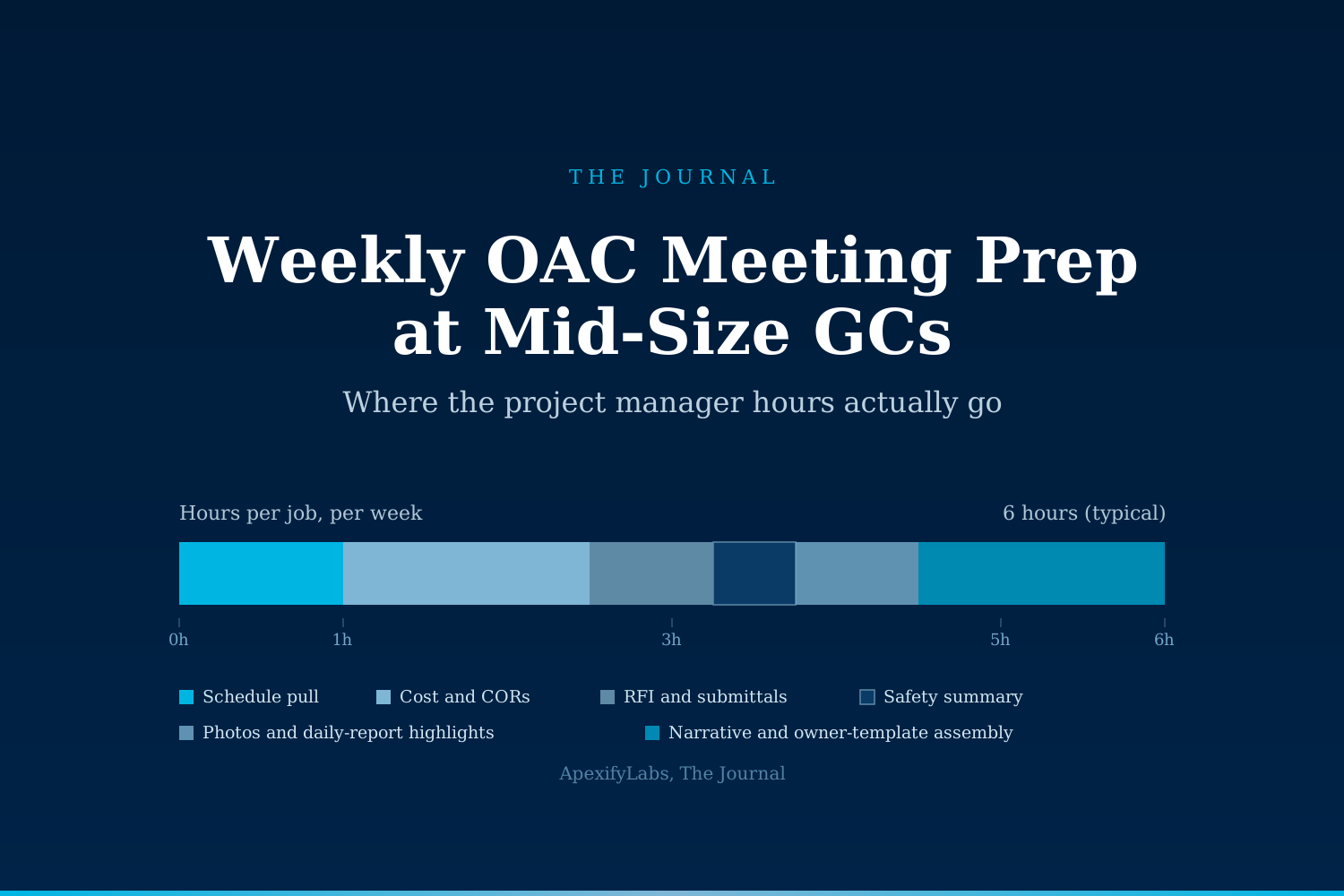
Weekly Owner-Architect-Contractor (OAC) meetings cost mid-size GC project managers 4 to 8 hours per job, per week, before the meeting even begins. Most of that time goes to rebuilding the same status packet from scheduling, cost, submittal, safety, and daily-report systems that do not connect to one another. On a portfolio of eight active jobs, the meeting prep bill is roughly a full-time role, paid in project engineering hours nobody logs.
What is an OAC meeting, and why does prep take so long?
On commercial and institutional construction jobs (schools, hospitals, higher education, mixed-use), the general contractor is contractually required to meet with the owner and the architect on a weekly cadence. Agendas vary, but the packet the GC brings almost always covers the same categories:
- Schedule progress against baseline, including two-week look-ahead
- Cost status: budget versus actual, contingency, pending change orders
- RFI log with response aging
- Submittal log with approvals and rejections
- Safety incidents, near-misses, and training completed
- Quality issues, non-conformances, punch items opened and closed
- Subcontractor coordination issues
- Long-lead procurement and material delivery risks
- Photographs from the field
- Any owner-specific items (LEED, DBE participation, community relations)
Each of those bullets lives in a different system. Primavera or MS Project for schedule, Sage or Viewpoint for cost, Procore or Newforma for RFIs and submittals, a separate safety platform, sometimes a photo app, and daily reports the superintendents fill in on tablets. The owner then hands the GC a template (spreadsheet, PDF, or shared portal) that has to be populated in the owner's preferred format, not the GC's.
That is why the prep does not shrink. It is not one report from one system. It is nine or ten exports, reformatted into an eleventh place.
What GC project managers actually rebuild each week
The mechanics of the prep are more repetitive than most PMs describe out loud. Industry surveys consistently show that field and office staff spend roughly a third of their week on non-productive administrative work. A widely cited FMI study on construction productivity places administrative rework and rekeying near the top of the drag list. OAC prep is a large slice of that third.
A typical mid-size job's weekly prep, broken down by the human doing the work:
| Task | Owner of the work | Time per week |
|---|---|---|
| Pull schedule update, mark variances | Scheduler or PM | 45 to 90 minutes |
| Export cost report, reconcile pending CORs | PM with accounting | 60 to 120 minutes |
| Copy RFI and submittal aging into owner format | Project engineer | 30 to 60 minutes |
| Assemble safety summary and training log | Safety lead or PM | 20 to 40 minutes |
| Compile daily-report highlights and photos | PM or assistant PM | 30 to 60 minutes |
| Draft narrative sections in owner template | PM | 60 to 120 minutes |
| Convert to PDF, distribute, chase last-minute edits | Project engineer | 30 to 60 minutes |
The floor is roughly 4 hours per job, per week. The ceiling on complex jobs, or jobs where the owner has an unusual template, is closer to 10 hours. And this excludes the meeting itself, which typically runs 60 to 90 minutes with two attendees from the GC side.
How the hours add up across a mid-size GC's active jobs
The prep tax scales with active job count, not with company size, which is why growing GCs feel it first. A mid-size firm running eight concurrent jobs, staffed with a PM and a project engineer each, is spending roughly:
- 8 jobs, times 6 hours average prep, equals 48 hours per week on OAC prep alone
- 48 hours per week, times 50 working weeks, equals 2,400 hours per year
- At a fully loaded rate of $85 to $120 per hour, that is $204,000 to $288,000 in annualized labor cost
That figure does not appear on a P&L as a line item. It is buried inside project engineering salaries and PM overhead. The McKinsey Global Institute has documented for years that construction runs at roughly 40 percent of its labor-productivity potential compared to other physical-work industries, with administrative rework as one of the recurring drags. The OAC prep pattern is one of the clearest examples: the work matters, the format is rigid, and the underlying data has already been captured somewhere else.
There is a second-order cost as well. The 4 to 8 hours a PM spends rebuilding the packet is time not spent forecasting cost overruns, chasing subcontractor commitments, or pricing pending change directives. In the construction economics literature, PM time on cost forecasting has one of the highest correlations with job margin. Whatever prep the PM is personally doing is displacing higher-leverage work.
What changes when the packet assembles itself
The before-and-after here is not dramatic in the way most operations pieces are. Nobody hires a robot to attend the meeting. What changes is upstream: the packet builds itself from the systems already in use.
Before. Monday afternoon and Tuesday morning are consumed reading exports, reconciling variances, copying figures into the owner's template, and drafting narrative. The PM spends the second half of Tuesday reviewing what the project engineer assembled, then walks into the meeting Wednesday morning with material they saw for the first time an hour earlier.
After. The schedule variance, cost report, RFI and submittal aging, safety summary, and daily-report highlights arrive as a draft packet by end-of-day Monday, already in the owner's template. The PM spends Tuesday morning reviewing the draft, adding narrative judgment (why a schedule slip happened, what the recovery plan is, which subcontractor is behind), and confirming the numbers. The meeting itself is unchanged. The preparation is 60 to 90 minutes of judgment work instead of six hours of copy-paste.
The judgment layer is the point. The PM's value in that room is interpretation and commitment, not data assembly. When the assembly happens on its own, the interpretation gets the time it deserves.
Three signals the OAC prep tax is worth measuring
Not every GC is losing enough hours here to justify changing anything. The prep tax matters most when a few things are true at once:
- Active job count is six or more. Below that, the total weekly burden is small enough that PMs can absorb it without much friction. Above six, the numbers start compounding.
- The owner's template is rigid and different for each job. Public-sector, healthcare, and higher-ed owners often have prescribed formats that PMs cannot standardize across the portfolio. Every job carries its own manual mapping.
- Project engineers do 60 to 80 percent of the assembly. If assistant PMs and project engineers are handling most of the packet build, the firm is training its junior bench on data entry rather than on judgment. That has a two-year retention cost few GCs measure.
If two of those three are present, the prep tax is likely the largest recoverable administrative expense on the PM side of the org chart.
What we will not cover here
We will not walk through which platforms integrate with which, or how to configure a specific reporting tool. Those choices depend on the GC's existing stack, the owner's format, and how the schedule and cost systems already exchange data. Getting it right is a project, not a template. But the shape of the problem is consistent across mid-size GCs, and the returns on solving it are visible in the first quarter.
If this description sounds like your OAC cadence, we run a completely free automation audit for ops-heavy contractors that want a second read on where the PM hours are actually going. No commitment, no slide deck. → Book the audit
Sami Raza
Software Developer & Technical Author
Sami Raza builds AI automation for logistics, DTC, and construction operations teams at ApexifyLabs, and writes about the operational failures that automation is actually worth pointing at.