Certified Payroll at GCs: Spreadsheets vs AI Reporting
Weekly certified payroll on public-works jobs is one of the largest recurring compliance burdens on a mid-size GC's desk. AI changes where the risk lives.
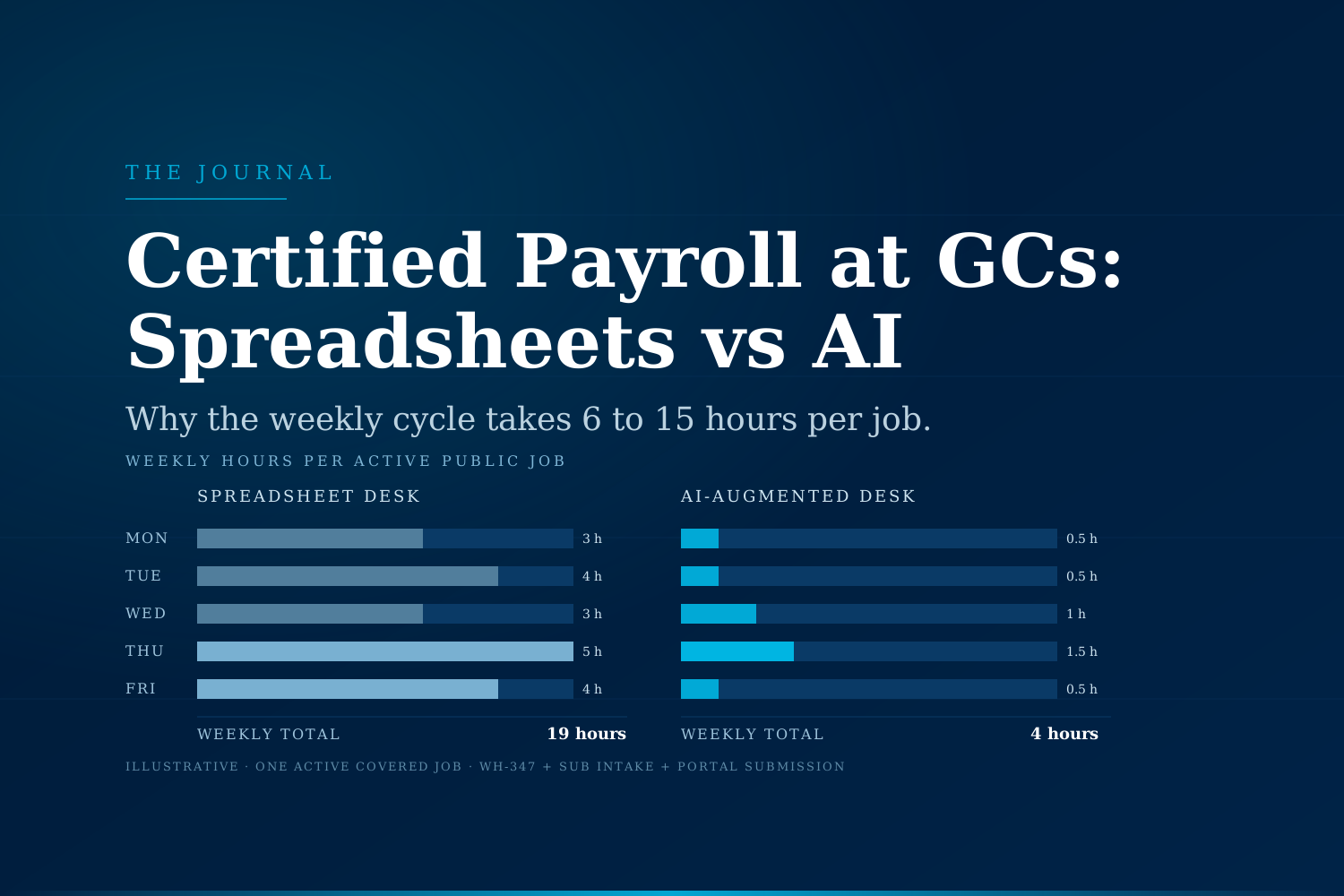
Certified payroll reporting on public-works projects requires a weekly, worker-by-worker submission for every job a GC runs. On a mid-size GC's desk, that means hours of spreadsheet reconciliation, wage-class lookups, and subcontractor chasing. AI-augmented workflows compress the cycle, surface exceptions early, and change where the compliance risk actually lives.
For a GC running three to ten active covered jobs, the weekly certified payroll cycle is often the single largest recurring admin burden the front office carries. It does not always show up as a line item on the P&L. It shows up in audit penalties, in retention held by the owner, and in salaried hours that vanish into formatting submissions instead of running the business.
What is certified payroll, and why is it admin-heavy for GCs?
Certified payroll is the weekly compliance report that contractors on federally funded, and most state and municipally funded, construction projects file under the Davis-Bacon Act and parallel state prevailing wage laws. The federal form, WH-347, asks for every worker's name, work classification, hours by day, gross pay, deductions, and fringe benefit breakdown, alongside a signed statement of compliance from a responsible officer.
The Davis-Bacon Act, originally passed in 1931, applies to federal construction contracts above $2,000, and roughly thirty states maintain their own little Davis-Bacon prevailing wage statutes covering state-funded work, according to the Department of Labor's compliance materials. For a GC building public schools, transportation projects, or federally backed housing, that means a weekly certified payroll filing is not optional, and not negotiable. It is also not where most contractors built their estimating or field-operations IP.
Where does the manual workflow actually break?
Wage classifications drift across active jobs
The same carpenter, on the same payroll register, can be classified as Carpenter Group 1 on one job and Carpenter Group 2 on another, depending on which trade tasks they performed and which prevailing wage determination governs that contract. Spreadsheet workflows tend to copy last week's classification forward as a default and rely on the foreman's note in the margin to surface the change. The note is sometimes missed. By the time an auditor reviews the file, the underpayment math is already built into months of submitted reports.
Apprentice ratios and fringe splits sit off-paper
Davis-Bacon and state prevailing wage rules typically require a registered apprenticeship program for any apprentices counted against the worker mix, and the ratio of journeyworkers to apprentices on the wage sheet is governed by that program's documented terms, according to the Department of Labor's apprenticeship guidance. Fringe contributions, whether paid in cash or to an approved benefits plan, have to be allocated correctly per worker per hour. On a manual desk, the fringe split is often a separate spreadsheet, maintained by a different person, reconciled against the main report at the eleventh hour on a Thursday night.
Subcontractor reports arrive late, in inconsistent formats
The GC is responsible for the certified payroll of every subcontractor on a covered project. In practice, that means chasing PDFs, faxed forms, and emails from five to twenty subs per job per week, normalizing them into one submission package, and absorbing the slack when a sub misses the cutoff. Owners increasingly require submission through a portal such as LCPtracker, eMars, or a state DOT intake system. Each portal has its own format. Late or incorrect filings can trigger pay-application holds against the GC, regardless of who actually missed the deadline.
How much does manual certified payroll actually cost?
Industry estimates from AGC of America and from prevailing wage consultancies typically peg the weekly certified payroll burden on a mid-size GC at six to fifteen hours per active public job, depending on subcontractor count and portal complexity. On a desk running eight active covered jobs, that is comfortably one to two full-time equivalents absorbed into a single recurring compliance task.
The other half of the cost is enforcement exposure. The Department of Labor's Wage and Hour Division has consistently reported that prevailing wage and Davis-Bacon back wage recoveries in the construction industry reach tens of millions of dollars annually. Civil penalties for willful or repeated violations can reach roughly two thousand to three thousand dollars per violation per worker, and the federal debarment list bars firms from federal contracts for up to three years. For a GC whose pipeline includes public work, debarment is an existential outcome, not a line item.
Manual vs AI-augmented certified payroll, side by side
| Dimension | Spreadsheet desk | AI-augmented workflow |
|---|---|---|
| Weekly cycle time per active job | 6 to 15 hours | 1 to 3 hours, mostly exception review |
| Wage classification accuracy | Depends on foreman notes carrying forward | Cross-checked against assigned task codes and active wage determinations |
| Subcontractor sub-report intake | Email and PDF chasing | Automated intake and normalization, with chase escalations only on misses |
| Fringe and apprentice ratio reconciliation | Off-paper or in a side sheet | Tracked per worker per hour, surfaced when off-program |
| Portal submission (WH-347, LCPtracker, state DOT) | Hand-keyed per portal | Generated in the required format per project |
| Audit response readiness | Reconstructed under deadline | Always current, indexed by week and worker |
The shape of the change is not a single faster step. It is a different distribution of where the work actually happens, and which work the firm's compliance staff get to focus on.
What changes when an AI workflow handles the weekly cycle?
The substitution is not the report itself. The report is the easy part once the data is clean. The substitution is at the intake layer, where a model joins the time clock, the work classification assigned by the foreman, the active wage determination on that project, the fringe contribution method, and each subcontractor's submitted weekly report into one normalized data set. A compliance officer reviews exceptions and signs off. The portal submission generates from the clean data, not from a hand reconciliation done at 9 p.m. on a Thursday.
The interesting part of the change is not the time saved. It is what the time saved gets spent on. A compliance team that no longer loses Wednesdays through Fridays to formatting weekly reports has the bandwidth to actually audit the workforce against the wage determinations, catch classification drift before it compounds, and respond to wage and hour questions from the field while the field can still remember what happened on the deck.
Where the line stays: what we do not give to the model
Wage classification calls on ambiguous task mixes still belong to the compliance officer. Apprenticeship program interpretation still belongs to the program coordinator. The signed statement of compliance is still signed by a human officer who is personally on the hook for accuracy. What the AI workflow takes off the desk is the data plumbing, the format normalization, and the deadline chase. The judgment calls that protect the firm's license to bid public work do not move.
Three signs the certified payroll workflow needs a second look
- Thursday and Friday are dominated by subcontractor chasing. When two of every five working days at the front office go to certified payroll formatting, the desk is not running the business, it is running compliance.
- A past audit surfaced classification drift. A single audit finding usually means the data path that produced the finding has been producing the same error across other reports, just unflagged.
- Pay-app cycles get held because of sub-payroll misses. When the GC's draw is delayed because a sub missed its certified payroll, the workflow is no longer about compliance alone. It is also about cash flow.
If two of those fit, the certified payroll cycle is the first place to look.
A free audit of your certified payroll workflow
A completely free automation audit looks specifically at how certified payroll moves across your desks: where the weekly cycle breaks, where subcontractor reports stall, and how much exposure is hidden in the gap between the field's classification and the report's classification. No commitment, no slide deck. We map the workflow and tell you what we see.
Sami Raza
Software Developer & Technical Author
Sami Raza builds AI automation for logistics, DTC, and construction operations teams at ApexifyLabs, and writes about the operational failures that automation is actually worth pointing at.