Backorder Delays Cost DTC Brands the Next Order
DTC backorders don't just delay one shipment. They reprice the next order. What actually determines whether the customer returns for round two.
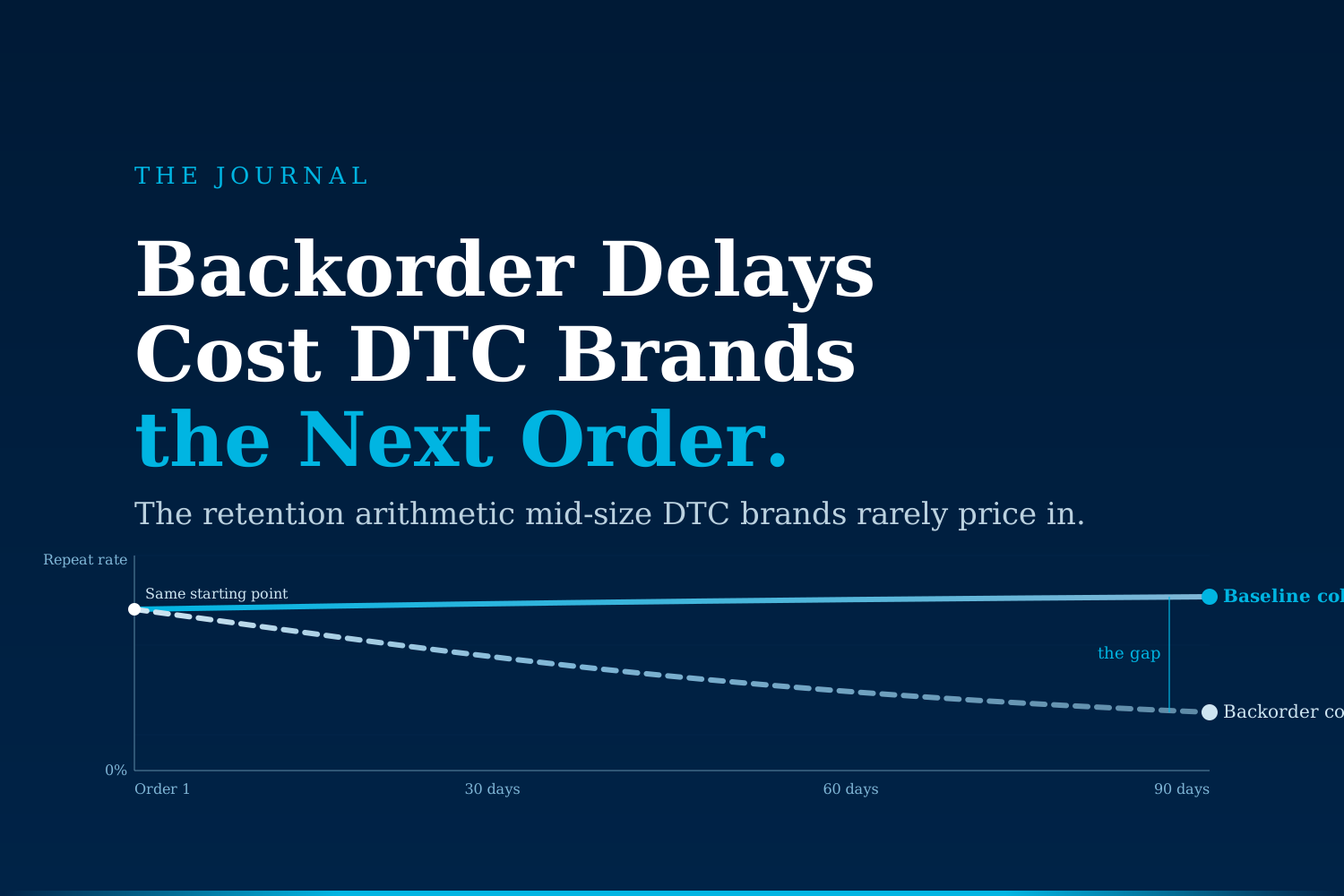
When a DTC customer's order flips to backorder, the money is already in the till. The real cost shows up a few weeks later, when that customer skips the next launch. Generic or slow backorder communication predicts churn more reliably than the delay itself. Fixing the message consistently outperforms fixing the stock, and it costs less.
What actually happens when a DTC order goes to backorder?
A backorder is not a canceled sale. The customer has already paid, chosen a shipping method, and mentally moved on. Then a subset of the SKUs in that order go out of stock, either because inbound receipts slip or because forecast demand was undercounted at the last drop. Fulfillment stalls, the order sits in a hold state, and someone (or no one) has to explain what changed.
At most mid-size DTC brands ($2M to $30M in revenue), that explanation is late, thin, or missing entirely. The customer service inbox catches the confused ones. The customers who do not write in silently reweigh their options. Some accept the wait. Many do not.
Why does the second order matter more than the first?
DTC unit economics run on repeat purchase, not first-order profit. Independent research on the category consistently shows that acquiring a first-time buyer is a break-even or loss-leading event once ad spend, discounting, and shipping are absorbed. The margin sits in orders two, three, and four. Baymard Institute has tracked the compounding effect of post-purchase communication on repeat intent for years, and Klaviyo's own subscription benchmarks routinely show a wide gap between brands that treat post-purchase as a retention surface versus those that treat it as a transactional notification.
So when a backorder disrupts order one, the loss is not the shipping delay. It is the probability shift on order two. A customer who felt informed and cared for during the wait tends to come back. A customer who felt ignored either refunds, disputes, or (worse for the brand) simply drops off the list without a word.
What the customer sees on a manual backorder desk vs a live one
Two brands can be running identical stockouts and get very different outcomes based on what the customer experiences.
| Signal | Manual backorder desk | AI-augmented backorder desk |
|---|---|---|
| First notification | 2 to 5 days after order goes to hold | Within hours of hold state, often automatic |
| Message content | Generic "your order is delayed" template | Named SKU, real ETA range, options offered |
| Customer choices | Wait or write in to cancel | Wait, swap for in-stock alternative, split ship, cancel |
| Support queue impact | Backorder tickets spike 3x to 5x normal | Fewer than 1 in 10 orders opens a ticket |
| Cadence of updates | One notification, then silence | Weekly delta if the ETA changes |
| Refund / dispute rate | Elevated for 30 to 60 days after event | Roughly baseline |
| Second-order rate | Notably suppressed post-event | Returns to baseline within 90 days |
The difference is not the delay itself. Both operations shipped late. The difference is whether the customer felt like a name or a queue position.
Where does backorder churn show up (and where does it hide)?
The obvious signals are chargebacks and refund requests during the backorder window. These get attention because they touch payment ops. What is harder to see:
- Slower next-order latency. A cohort of customers who had a backorder in month one takes longer to place their next order, and a meaningful share never do. This shows up in cohort-level LTV, not on any single order.
- Silent unsubscribes. Not from the email list (though that happens too), but from the mental list of "brands I buy from without thinking." That relationship is fragile and rarely rebuilds without an intentional moment.
- Review sentiment drift. Public review platforms show a compounding drop when backorder friction goes unaddressed. Trustpilot and Reviews.io category data for DTC consistently correlate backorder complaints with lower repeat-review sentiment across the following six months.
- Support ticket displacement. Every backorder ticket in the queue displaces a pre-sale question. The lost sale from an unanswered pre-sale inquiry rarely gets attributed back to the backorder event that created the queue.
What operators change first
Ops teams that have quietly reworked this typically move in a predictable sequence. What tends to change:
- Detection. They stop relying on WMS lag or CS complaints to know an order is stuck. Something watches inbound receiving, allocation logic, and hold states in near real time and flags orders as soon as they enter the backorder bucket, not days later.
- Segmentation. They stop treating every backordered order the same. VIP customers, subscribers, and first-time buyers get differentiated handling. The message reads differently based on order history and value.
- Options at the moment of communication. They stop asking the customer to write in for choices. The notification itself surfaces the alternatives: wait, swap, split ship, cancel with credit. Fewer decisions bounce back to a human.
- Cadence. They stop sending one notification and hoping. If the ETA moves, the customer hears about it in a way that acknowledges the change rather than resetting the countdown in silence.
- Attribution. They start measuring second-order rate on backorder cohorts explicitly, so the payoff of better communication is visible in the metric that actually moves the P&L.
Notice what is not on that list: fixing the stockout. Every operator wants to. Few can, at least not fast enough to matter for the orders already on hold. The lever that actually moves is the communication surface, because that is what determines whether the customer stays in the flywheel.
The audit worth running before touching your ESP
Before changing a single email template or wiring a new automation, one number is worth pulling: for orders that hit backorder in the last 90 days, what percentage of those customers placed a subsequent order within 60 days, compared to a matched cohort that did not experience a backorder? If the gap is wider than about ten points, backorder handling is a P&L problem, not a customer service one.
A related pull: median time from order-to-hold-state to first customer-facing communication about it. Under 24 hours is healthy. Multi-day is the norm at brands that have not yet automated the detection.
Neither number requires a new tool. Both require a query and an afternoon. The gap between those numbers and what the brand thinks is happening is usually the surprising part.
What changes once the desk is running well
The visible improvement is a quieter support inbox during stockout events. The compounding improvement is a second-order rate on backorder cohorts that returns to near baseline instead of trailing it for a quarter. On a $10M DTC brand shipping 40,000 orders a year, a five-point retention improvement on the roughly 8 to 12% of orders that see any backorder friction typically pays for the intervention several times over in the first year, before any secondary benefit from better inventory forecasting shows up.
The customer never sees the machinery behind it. They see a brand that noticed, told them, gave them choices, and kept them informed. That is what earns the next order.
If your backorder events are quiet inside the org but loud in your churn data, we run a completely free automation audit for DTC ops teams to map exactly where the leakage is happening and what to change first. No commitment, no pitch deck. → Book the audit
Sami Raza
Software Developer & Technical Author
Sami Raza builds AI automation for logistics, DTC, and construction operations teams at ApexifyLabs, and writes about the operational failures that automation is actually worth pointing at.