Sub Manpower Shortfalls Nobody Sees Until Friday
A sub commits four crews and sends two. Most GCs learn it on Friday, and the gap between promised and delivered manpower never becomes a number anyone owns.
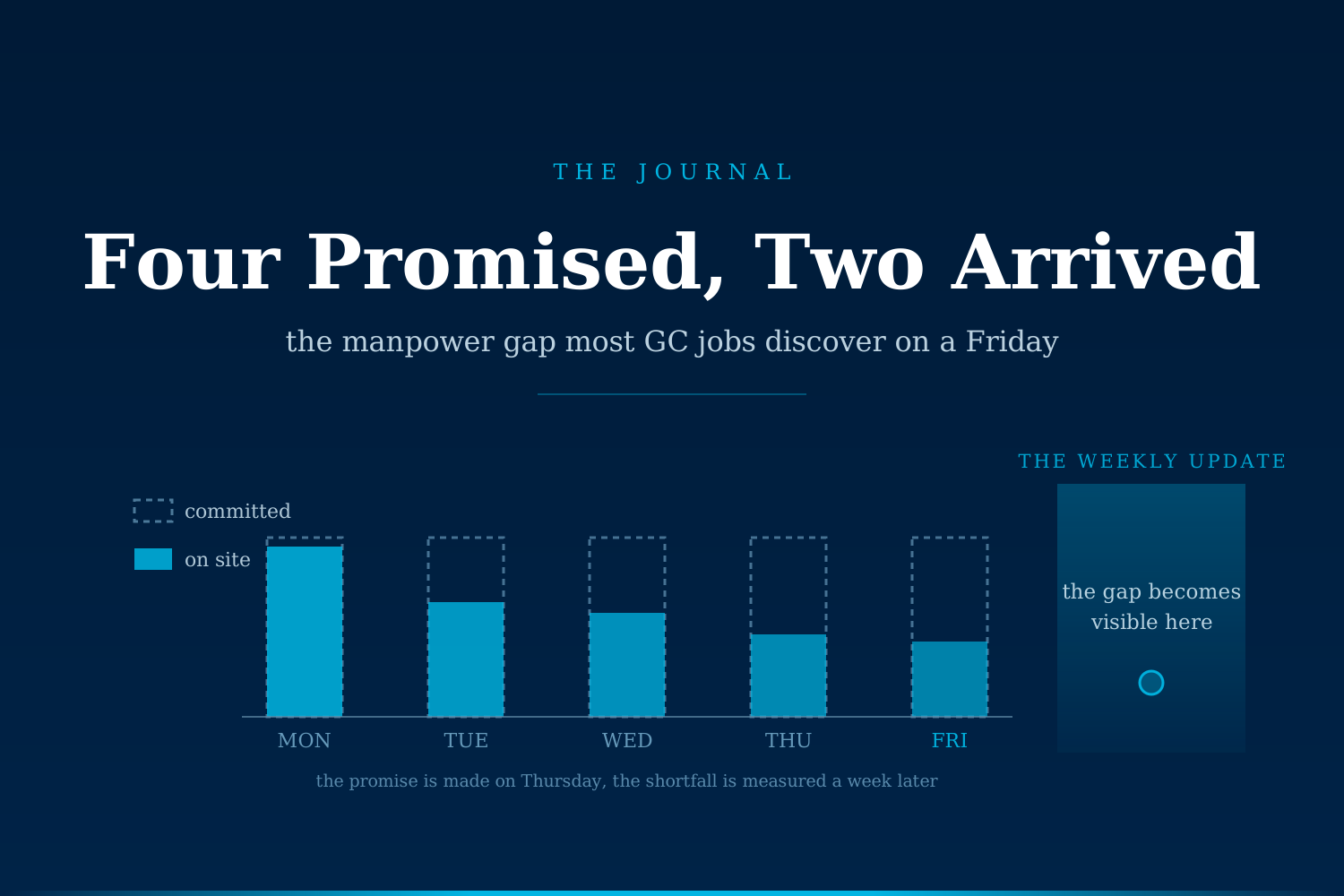
A subcontractor commits four crews to next week's lookahead and sends two. Most general contractors find out on Friday, when the work in place does not match the plan. The gap between promised manpower and delivered manpower is rarely recorded anywhere, so it never becomes a number anyone manages.
Why do manpower commitments come up short without warning?
Not because a subcontractor set out to mislead anyone. The commitment was usually made in good faith on Thursday and became unrealistic by Monday, for reasons that repeat across mid-size general contractors regardless of how disciplined the scheduling practice is.
- The commitment is a number, not a roster. "Four guys on level three" is what gets written down. Which four, coming off which job, and what they are leaving behind to get there is not.
- Your job competes with three others. A promise made to you on Thursday runs into somebody else's emergency on Monday morning. Whoever escalates loudest gets the bodies, and that is rarely the job that is running smoothly.
- Nobody records the delta. Actual headcount shows up in the daily report. Promised headcount lives in a lookahead, a text thread, or a foreman's memory. Two numbers that are never subtracted from each other are not a measurement.
- The superintendent absorbs it before it becomes a report. A good super resequences around a short crew, and the save is real. It also erases the evidence that the crew was ever short.
- Progress curves hide it for weeks. A trade running at 70 percent of its planned manpower still shows progress every week. The curve bends slowly, and by the time the divergence is obvious the cheap recovery window has closed.
- The conversation happens at the wrong altitude. Manpower surfaces at the OAC meeting as a general concern about a sub, not as a dated record of what was committed and what arrived. General concerns do not survive contact with a busy owner's agenda.
None of this is a discipline failure. It is what happens when the most consequential number on a weekly plan is the only one nobody keeps score on.
What does a short week actually cost a GC?
The bill depends almost entirely on where the shortfall surfaces, and the curve is steep in a familiar way.
| Where the shortfall surfaces | What recovery takes | Who absorbs it |
|---|---|---|
| Monday huddle | Resequence the crew you have, slide one scope right | The superintendent's day |
| Midweek, at a handoff | The following trade idles or partially mobilises | The next sub, then a backcharge conversation |
| Friday, at the weekly update | A week of float consumed, recovery pushed into the next lookahead | GC schedule |
| Monthly schedule update | Acceleration to hold a milestone, usually overtime or added crews | GC margin, sometimes the owner |
| At substantial completion | Liquidated damages exposure, or an extension negotiated from a weak position | GC, almost entirely |
| At the next prequal cycle | A sub who chronically underdelivers stays on the bid list because nothing was written down | Every future job |
Only the first two rows look like field problems while they are happening. The rest get logged as schedule slip, as acceleration cost, or as a sub relationship that "got difficult," which is exactly why the underlying pattern almost never appears as a line on a job cost report.
The industry evidence points the same direction. Glenn Ballard's foundational research on the Last Planner System, and the Lean Construction Institute work that followed it, has consistently found that weekly work plans on conventionally managed projects complete only around half to two thirds of their committed tasks, with Percent Plan Complete typically reported in the 50 to 60 percent range before structured commitment planning is introduced. McKinsey Global Institute's Reinventing Construction study put large projects at roughly 20 percent longer than scheduled on average. Neither figure is yours. The useful version is the one your last three jobs would produce, and most GCs have never been able to calculate it because the promised side of the equation was never captured in a form you can subtract from.
Is the problem the schedule or the promise?
Worth separating, because GCs who conflate the two buy the wrong fix and then conclude the fix did not work.
Scheduling is largely solved at this size. Mid-size GCs run a CPM schedule, maintain a two or three week lookahead, and hold a weekly coordination meeting. The schedule says what should happen. The lookahead says what is planned to happen.
The promise is the missing layer. A specific person, on a specific date, committed a specific quantity of labor to a specific scope. Whether that promise held is the single most predictive signal you have about the next four weeks, and on most jobs it exists only as impressions carried around in the heads of two or three people.
That distinction matters because the two failures need different responses. A scheduling problem is fixed by resequencing. A commitment problem is fixed by changing who you buy from, how you buy, and what you escalate, none of which you can do from memory or from a feeling that a sub has been "light lately."
What does the same week look like when commitments carry data?
The pattern GCs describe after closing this loop is that manpower stops being a Friday discovery and becomes a Monday exception affecting a small number of scopes.
| Dimension | How it usually runs | How it runs when commitments are tracked |
|---|---|---|
| The commitment itself | A verbal number in a coordination meeting | A dated, attributed quantity against a named scope |
| When a shortfall is known | Friday, from work in place | Monday morning, from the gate or the sign-in |
| Who hears about it | The super, then eventually the PM | The super and the PM, with the affected downstream trade flagged |
| What gets escalated | Whichever sub is annoying people this week | The scopes where the shortfall threatens a handoff inside the lookahead |
| Sub performance history | Impressions, plus whatever a PM remembers at prequal | A record of committed versus delivered across jobs and quarters |
| The buyout conversation | Price, schedule, and references | Price, schedule, references, and this sub's own delivery record with you |
| Recovery cost | Discovered as acceleration in the monthly update | Priced as a decision while the cheap options still exist |
The last two rows are where the money actually is. Once committed versus delivered manpower is a number with a history, it becomes an input to buyout and prequal rather than a grievance raised after the fact. That is a permanent change to how you select subs, not a weekly reporting improvement.
The part that takes real design work sits in the middle of that table: deciding what counts as a material shortfall worth interrupting someone over, and capturing the commitment without adding a form for a foreman to fill in at 6:30 a.m. Get that wrong in the permissive direction and you have built an alert nobody reads by week three. Get it wrong in the restrictive direction and you have a confident dashboard that is silent on the week that mattered. That judgment depends on your trade mix, your self-perform scope, and how your subs actually staff, and it is the reason this is not a template anyone can hand you.
Where does this stop working?
It will not create labor that does not exist. Associated Builders and Contractors' workforce model estimated the industry needed to attract roughly 439,000 net new workers in 2025 on top of normal hiring. Visibility into a shortfall does not staff it.
It will not fix a subcontractor who is underwater financially and pulling crews to chase cash on other jobs. It will tell you that is happening early enough to act, which is worth a great deal, but the conversation that follows is a commercial one.
And it will not replace the relationship between a superintendent and a foreman. That relationship is how most of this gets solved in the moment. The point is to stop spending it on discovery.
A short diagnostic on your current lookahead
Four questions, one afternoon, no consultant:
- For last week's lookahead, can you state the committed headcount by sub without asking anyone? If not, that number was never captured.
- Pull the last three schedule recovery decisions you made. For each, how many days passed between the first short week and the decision to accelerate?
- Take your last completed job. Which subs delivered the manpower they committed, and what evidence supports the answer?
- Of the subs on your current bid list, how many are there partly because nobody documented the last time they came up short?
If those answers are uncomfortable, the exposure is real and it is measurable, which is a better position than most GCs occupy. The cost here is usually invisible rather than absent.
Where we come in
We work with mid-size general contractors who suspect their acceleration line has a manpower commitment problem inside it but have never had the record to prove it. The first thing we do is look at how commitments are made and where they go, on your jobs, with your subs. Whether automation earns its keep depends on how your lookahead is maintained, how much you self-perform, and what already gets captured at the gate.
If any of those four questions landed badly, a completely free automation audit is a reasonable hour to spend. We map where commitments are being lost, what the pattern is plausibly costing per job, and what would have to change for a short week to be a Monday conversation instead of a Friday one. No commitment, no slide deck. → Book the audit
Sami Raza
Software Developer & Technical Author
Sami Raza builds AI automation for logistics, DTC, and construction operations teams at ApexifyLabs, and writes about the operational failures that automation is actually worth pointing at.