OFCI Delivery Slips Are Extending GC Turnover Windows
Owner-furnished, contractor-installed equipment is one of the least-tracked risks on a GC schedule. When it slips, the general contractor absorbs the sequencing damage and the substantial-completion exposure.
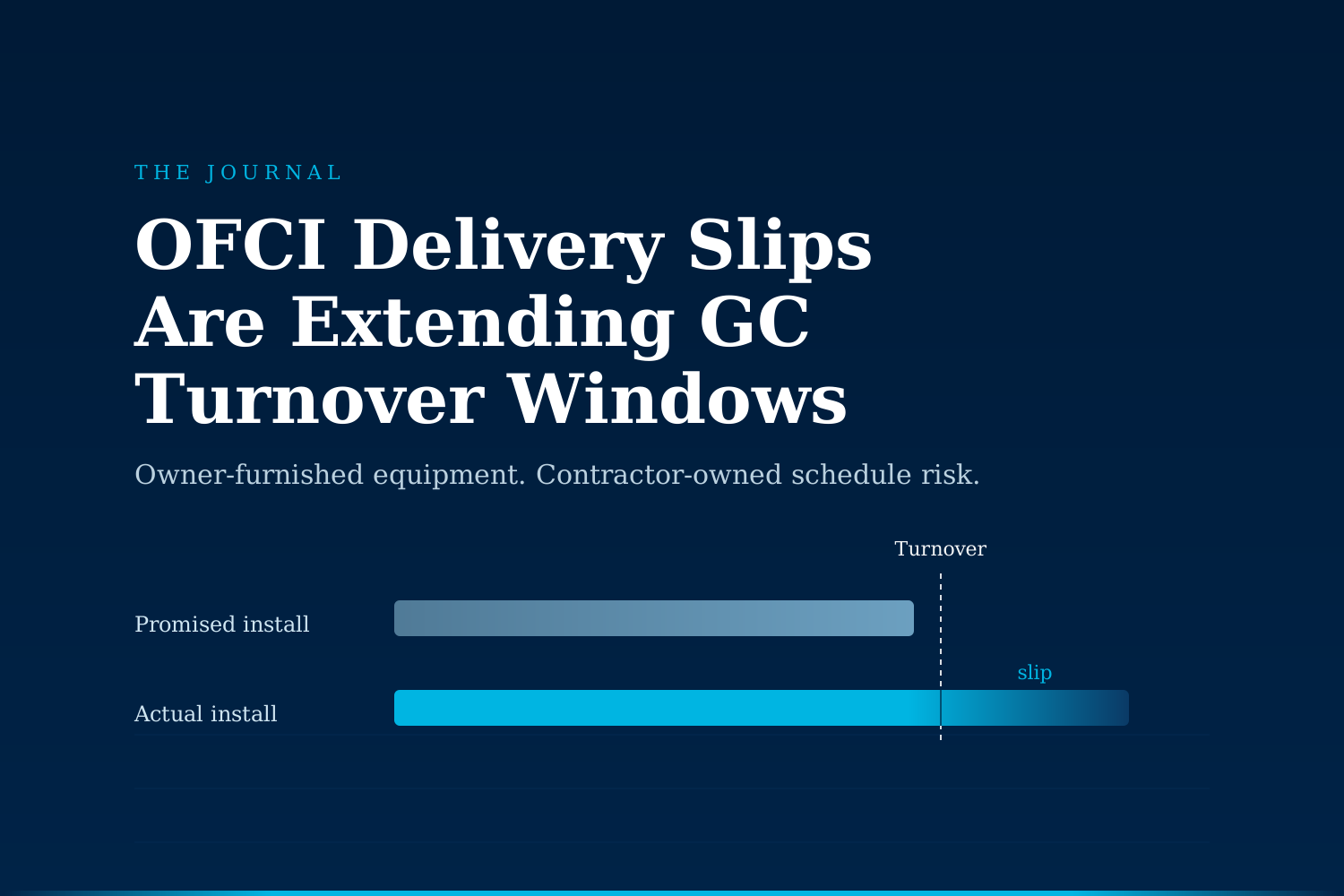
Owner-furnished, contractor-installed (OFCI) items are one of the most under-tracked risks on a general contractor's schedule. When a piece of owner-purchased equipment slips past its install window, the GC absorbs the sequencing damage, the labor idle time, and the delayed substantial completion, even though the scope was never theirs to begin with.
What is OFCI, and why does it show up on so many GC schedules?
OFCI (owner-furnished, contractor-installed) items are pieces of equipment or fixtures the owner buys directly from a vendor and then hands to the GC to install and integrate. It is standard practice on healthcare, hospitality, higher-education, corporate-interiors, and quick-serve restaurant work. Owners keep the purchase in-house for warranty leverage, group-buying discounts, standardized specifications across a portfolio, or grant and tax reasons. On some hospital projects, owner-supplied equipment represents a meaningful share of the cost basis, and industry press has flagged it as one of the top schedule-risk categories in healthcare construction (see ENR and FMI reporting on healthcare project delays).
Typical OFCI scopes include MRI and CT imaging suites, sterile-processing equipment, kitchen line packages, walk-in cold rooms, AV control racks, IT racks, security devices, patient-lift systems, laboratory casework, dock levelers, and specialty owner-selected finishes. In every one of those cases, the vendor answers to the owner, the invoice sits with the owner, and the physical delivery lands on the GC's site.
How does an OFCI slip actually reach the turnover date?
The chain is short and it moves fast. The install date the GC has in the schedule was baked in around a vendor promise the GC never negotiated. When the OFCI slips two, three, or six weeks, three things happen in parallel:
- The trades sequenced around the install (MEP rough-ins, framing tie-ins, ceiling grid, flooring, casework) either idle on site, get partial demobilized, or leapfrog and create rework windows.
- The commissioning agent and third-party inspectors pushing their date lose their slot in a busy calendar and slide by weeks rather than days.
- The certificate of occupancy path and the substantial-completion milestone move with them, and liquidated-damages exposure begins accumulating on a scope the GC does not control.
None of that shows up as an OFCI issue on the daily report. It shows up as trade delays, punch-list overruns, and turnover slippage, and the GC is the party wearing it in the owner's eyes.
Why does OFCI coordination fall on the GC even though the scope isn't theirs?
Because nobody else is holding it. The owner's procurement team placed the purchase order and moved on to the next project. The vendor is shipping when their production window opens. The design team's job ended at spec. The GC is the only party physically on site the day a truck arrives, so the GC is the party fielding the change in factory ship date, coordinating rigging and protection, sourcing lay-down space, and reworking the four-week look-ahead when something moves.
Most standard AIA and ConsensusDocs contract families give the GC "coordination" responsibility for OFCI without giving the GC contractual leverage over the vendor. The result is a schedule dependency the GC owns operationally but not commercially.
What OFCI coordination looks like on a typical GC desk today
The tracking system for a $30M to $80M project with a meaningful OFCI package is usually some combination of:
- A spreadsheet a project engineer updates from weekly emails.
- Vendor promise dates that were current at buyout and haven't been re-confirmed since.
- A Procore or ProjectMates submittal log that stopped when the item shipped, not when it arrived.
- A superintendent who calls three vendors on a Friday morning to re-baseline the next two weeks.
Nothing in that stack proactively surfaces a slip until the vendor sends the "we're pushing two weeks" email, usually on a Thursday afternoon, after the next-week schedule has already been published.
OFCI coordination on a manual desk vs an AI-assisted one
The comparison below is not about replacing the project engineer. It is about what changes when the tracking layer stops depending on manual polling.
| Coordination step | Manual OFCI workflow | AI-assisted OFCI workflow |
|---|---|---|
| Vendor delivery-date monitoring | Weekly email pull, updated by a PE | Continuous parsing of vendor emails, portals, and status webhooks |
| Slip detection | Surfaced when the vendor volunteers the update | Surfaced the day the promise date shifts, with a diff against the last confirmed date |
| Schedule impact analysis | Superintendent redraws the look-ahead by hand | Impacted successor activities and float consumption flagged before the schedule rebuild |
| Trade re-sequencing communication | Ad-hoc emails and phone calls to affected subs | Draft notices staged for the PM's review, with the affected scope pulled from the schedule |
| Owner notification | Delayed until the PM has "the whole picture" | Structured status update ready inside 24 hours of the slip, in the owner's preferred format |
| Rigging and protection windows | Booked once, rebooked manually when dates move | Riggers, cranes, and protection windows re-proposed the moment a date moves |
| Substantial-completion exposure | Tracked implicitly, argued about at monthly OAC | Explicit running total of days added by OFCI slips, per item, per package |
The change is not that a human stops touching the workflow. The change is that the human intervenes on the exception with full context, instead of manufacturing the context from scratch every Friday.
Signs OFCI slippage is silently draining GC turnover
Every construction operator we talk to recognizes at least two of these patterns:
- Substantial completion has slipped on the last two owner-heavy projects, and the root-cause conversation lands on "owner-supplied equipment" without a hard day count anyone can defend.
- The project engineer assigned to a healthcare or hospitality job spends a visible share of the week chasing vendor status updates by phone and email.
- Liquidated-damages conversations at closeout include phrases like "but that was OFCI" without documentation the owner accepts.
- Weekly OAC meetings routinely open with the OFCI status page, and the numbers on it are three to seven days stale.
- The look-ahead published Monday morning is rebuilt Wednesday afternoon because two OFCI vendors moved dates over the weekend.
None of these are a failure of the desk. They are the natural output of a coordination burden that has outgrown a spreadsheet.
What a coordinated OFCI workflow can unlock for a mid-size GC
When the tracking layer stops leaking, three things become possible that were not before. Turnover dates stop absorbing invisible OFCI drift, because the drift surfaces in days rather than weeks. Substantial-completion exposure gets defensible documentation, which changes the tone of the LD conversation. Project engineers stop losing a full day a week to vendor status polling, and that hour bank goes back into scope that actually belongs to the GC.
None of that requires a new ERP, a new schedule tool, or a rip-and-replace of the systems the team already trusts. It requires the tracking layer to stop being manual.
Curious what OFCI slippage is actually costing your last three jobs?
If your last few owner-heavy projects landed late and the postmortem kept landing on owner-supplied equipment, we run a completely free automation audit for construction operators who want a defensible day-count before their next OAC. No slide deck, no pitch, no commitment. → Book yours here
Sami Raza
Software Developer & Technical Author
Sami Raza builds AI automation for logistics, DTC, and construction operations teams at ApexifyLabs, and writes about the operational failures that automation is actually worth pointing at.