How Incomplete Safety Records Cost GCs Their Next Bid List
Safe jobs and complete safety files are not the same thing. On mid-size GCs, the difference surfaces later, in EMR, insurance renewals, and prequalification.
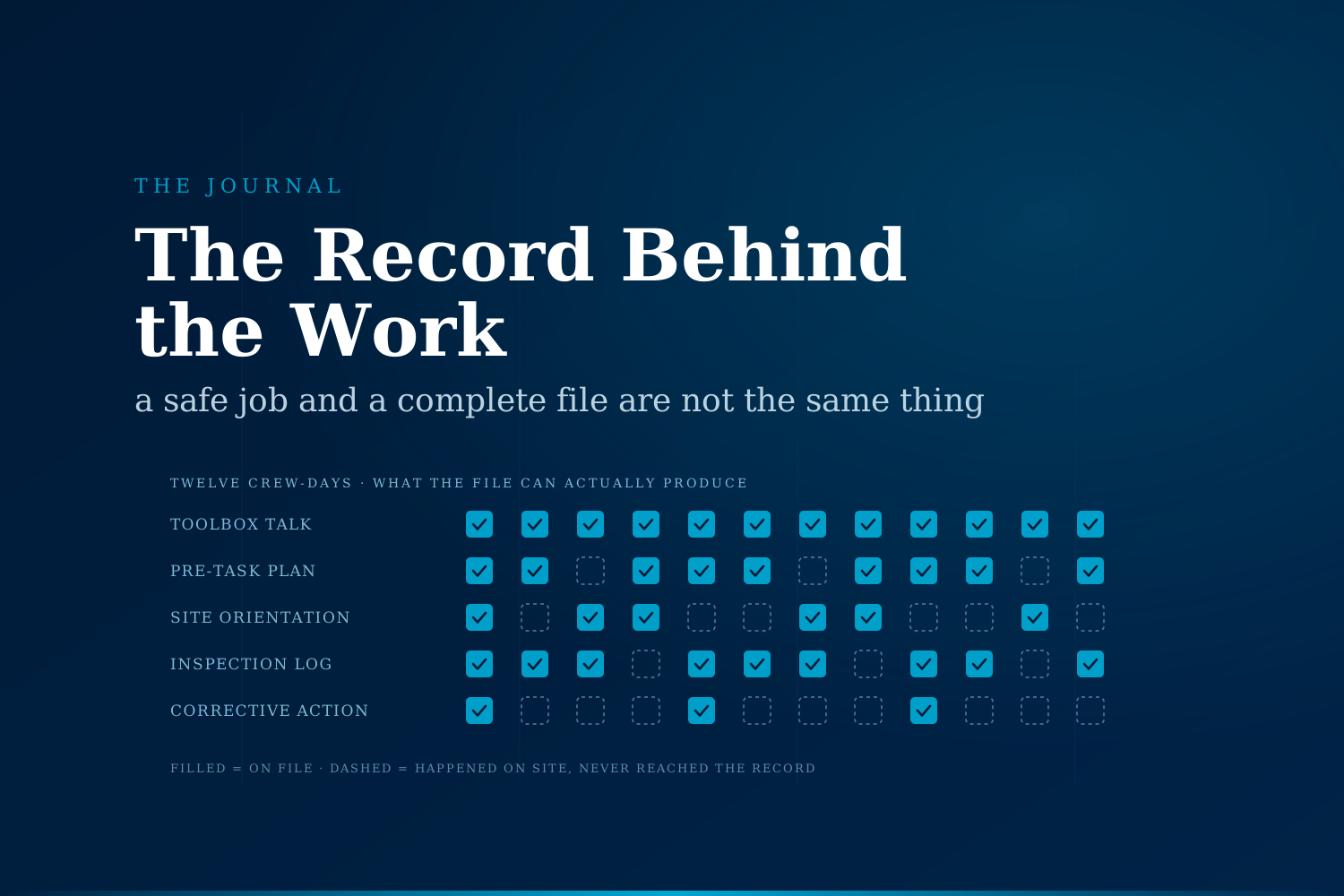
A general contractor can run a genuinely safe job and still carry a safety file that fails an owner's prequalification. Field documentation is captured by people whose first priority is production, so the record thins out under schedule pressure. The cost arrives later: a higher experience modification rate, a harder insurance renewal, and fewer bid invitations.
What actually gets scored when an owner prequalifies a GC?
Almost none of it is a site visit. Owner-side prequalification, whether it runs through a program like ISN, Avetta, or ComplyWorks or through the owner's own packet, scores a set of documents you submit.
The usual inputs are your experience modification rate, your recordable and DART rates calculated off OSHA 300 logs, three to five years of citation history, written programs (fall protection, silica, confined space, hazard communication), and evidence that training actually happened for the people on the job. Many owner and prequalification programs treat a mod above 1.0 as a flag, and some treat it as a hard stop on the invitation list.
Two things about that scoring matter more than most GCs price in.
First, the experience modification factor is a lagging indicator by design. NCCI, which calculates the mod in most states, builds it from three years of loss history and excludes the most recent policy year. A claim your team is handling today does not price your insurance today. It prices it two to three years from now, usually in the same quarter you are trying to get onto a new owner's approved list.
Second, the scoring reads the record, not the jobsite. A crew that ran a flawless week and a crew that ran a flawless week with a signed pre-task plan on file look identical in the field and completely different in a prequalification packet. Construction is a high-consequence trade to be sloppy in on this front: Bureau of Labor Statistics data has put construction at close to one in five of all US workplace fatalities for years running, and fall protection has led OSHA's annual Top 10 most-cited standards list for more than a decade. Owners know this, which is why their prequalification questions have gotten sharper, not softer.
Why does the record thin out on a busy job?
Not because anyone decided documentation was optional. It thins in patterns that repeat across every mid-size GC we look at.
- The talk happened, the sheet did not travel. A superintendent runs the toolbox talk at 6:45 a.m., photographs the sign-in sheet, and the photo stays on the phone. Three weeks later nobody can produce it for the week in question.
- The pre-task plan covers the plan, not the change. A JHA gets written for the scope as scheduled. The scope changes at 10 a.m. because a delivery landed early, and the second version of the day is verbal.
- Crews swap mid-week. A sub rotates two new people onto the site Wednesday. The orientation happened at the gate in four minutes. There is no record that it happened at all.
- Near misses go unwritten. Nobody got hurt, so nobody opened a form. The leading indicator that would have justified a corrective action never enters the system.
- Corrective actions close verbally. An inspection notes an unguarded edge, the super has it fixed inside an hour, and the closure is a text message rather than a dated entry against the original finding.
- Subcontractor records live in the sub's system. Their training certs, their equipment inspections, their own toolbox talks. The GC is accountable for the site and holds maybe half of what happened on it.
None of these are failures of intent. They are the predictable result of asking the busiest people on the project to be the primary data-entry layer for a compliance record. An FMI and PlanGrid study of US construction professionals found roughly 14 hours a week per worker going to non-optimal activities, including looking for project information and dealing with mistakes and rework. Field documentation lands squarely inside that number.
What does a thin file actually cost, and when?
The bill arrives at four separate moments, and only one of them feels like a safety problem at the time.
| When it surfaces | What the incomplete record does | Who feels it |
|---|---|---|
| A recordable injury | Weakens the defensible position on causation and training; a claim that could have been contested gets accepted and enters the loss run | Risk manager, carrier |
| An OSHA inspection | Missing training and program records turn a coachable finding into a citable one. OSHA's 2025 schedule set the maximum at $16,550 per serious violation and $165,514 for willful or repeat violations, adjusted for inflation annually | CFO, safety director |
| Insurance renewal | Loss history from two and three years ago drives the mod and the premium. Nothing you do this month moves it | CFO |
| Prequalification and bid invitations | A mod above threshold or an incomplete packet removes the firm from consideration before any number is priced | Owner, president, business development |
The fourth line is the one that gets underweighted. A fine is a number you can see and argue with. Losing a place on an approved bidder list is invisible: no letter arrives, the invitation simply does not. For a GC whose pipeline depends on repeat institutional or public work, that is the most expensive of the four by a wide margin, and it never appears on a job cost report.
The claims cost sitting behind the mod is not small either. The National Safety Council's Injury Facts puts the average cost of a medically consulted work injury in the tens of thousands of dollars, with total US work-injury costs above $160 billion a year. Every one of those claims prices someone's insurance for three years.
Is this a safety problem or a documentation problem?
Worth separating, because conflating them leads GCs to the wrong fix.
A thick file does not make a job safe. Plenty of firms with immaculate binders have had bad years. And a genuinely safe operation with a thin file is not a safety failure, it is a record-keeping failure that will be scored as a safety failure by every party who was not standing on the site.
The distinction matters because the two problems have different owners. Making the work safer belongs to a safety director, a competent-person program, and a culture that lets a foreman stop a task. That is not an automation problem and nobody should sell it as one.
Keeping the record complete, current, and reconcilable is a different animal. It is a high-volume, deadline-driven, exception-heavy documentation workflow, which is exactly the category where the ops-automation work of the last two years has moved fastest.
What changes when the record keeps up with the work?
The pattern operators describe after they change it is that the safety file stops being something you assemble and starts being something that already exists.
| Dimension | Documentation as it usually runs | Documentation that keeps up |
|---|---|---|
| Where records live | Phones, email threads, a shared drive, the sub's system | One reconciled record per crew-day, per job |
| Finding what is missing | Discovered during an audit or a prequal deadline | Known the same day the form did not arrive |
| Subcontractor currency | Certs collected at mobilization, rarely re-checked | Expirations and crew changes tracked against who is actually on site |
| Corrective actions | Closed verbally, sometimes logged | Every finding carries a dated closure against the original item |
| OSHA 300 log accuracy | Reconstructed at year end | Accurate continuously, because the inputs were captured when they happened |
| Prequal packet assembly | Two to three weeks of scramble per owner | Pulled from a record that is already current |
| Superintendent admin time | Meaningful daily minutes on forms and follow-up | Confirmation, not compilation |
The important change is not that forms get digitized. Most GCs digitized forms years ago and still have thin files, because a digital form nobody filled out is exactly as empty as a paper one. The change is that something is reconciling what should exist against what does exist, crew by crew and day by day, and surfacing only the difference. The superintendent stops being the system of record and becomes the person who confirms an exception.
That reconciliation logic, deciding which documents a given crew-day on a given scope should have produced and how to escalate the ones that are missing without burying a super in notifications, is the part that takes real design work and real knowledge of how GCs run. It is not a form builder and it is not a template pack.
Five checks worth running against your last closed job
A short diagnostic that does not require a consultant:
- Pick three random dates from the middle of the job. Can you produce the toolbox talk sign-in sheet for each, in under five minutes?
- For every subcontractor employee who badged onto the site in the final month, do you hold evidence of site-specific orientation?
- How many near misses were logged over the life of the job? If the answer is zero on a job of any size, the reporting channel is not working.
- How many inspection findings have a dated closure entry against the original item, rather than a memory that it got handled?
- How long did it take to assemble the last owner prequalification packet, in staff hours?
If those answers are uncomfortable, the record is behind the work. That is a fixable problem, and it is a cheaper one to fix before a renewal or a prequalification deadline than during one.
What this will not fix
It will not make an unsafe job safe. It will not rewrite loss history already baked into your mod, and any firm promising to move a mod quickly is describing something you should decline. It does not replace a safety director, and on any job of consequence it should not try to.
What it changes is whether the work your people actually did shows up in the record that owners, carriers, and inspectors read.
Where we come in
We work with mid-size general contractors who already know the field documentation is behind and have not been able to justify a specific fix, usually because the last three vendors sold a form app and the files stayed thin. What we do first is measure the actual pattern on your recent jobs. Where automation earns its keep here depends on your sub mix, your trade stack, and how much of the record already lives in your project management system.
If any of the five checks above landed badly, a completely free automation audit is a reasonable hour to spend. We map where the record is breaking, which of the four cost moments you are most exposed to, and what would have to be true to fix it. No commitment, no slide deck. → Book yours
Sami Raza
Software Developer & Technical Author
Sami Raza builds AI automation for logistics, DTC, and construction operations teams at ApexifyLabs, and writes about the operational failures that automation is actually worth pointing at.