Manual Credit Reviews Delay Broker First-Load Bookings
When credit clearance takes 48 hours, the first-load window has already closed. Here is what that intake lag actually costs a mid-size freight brokerage.
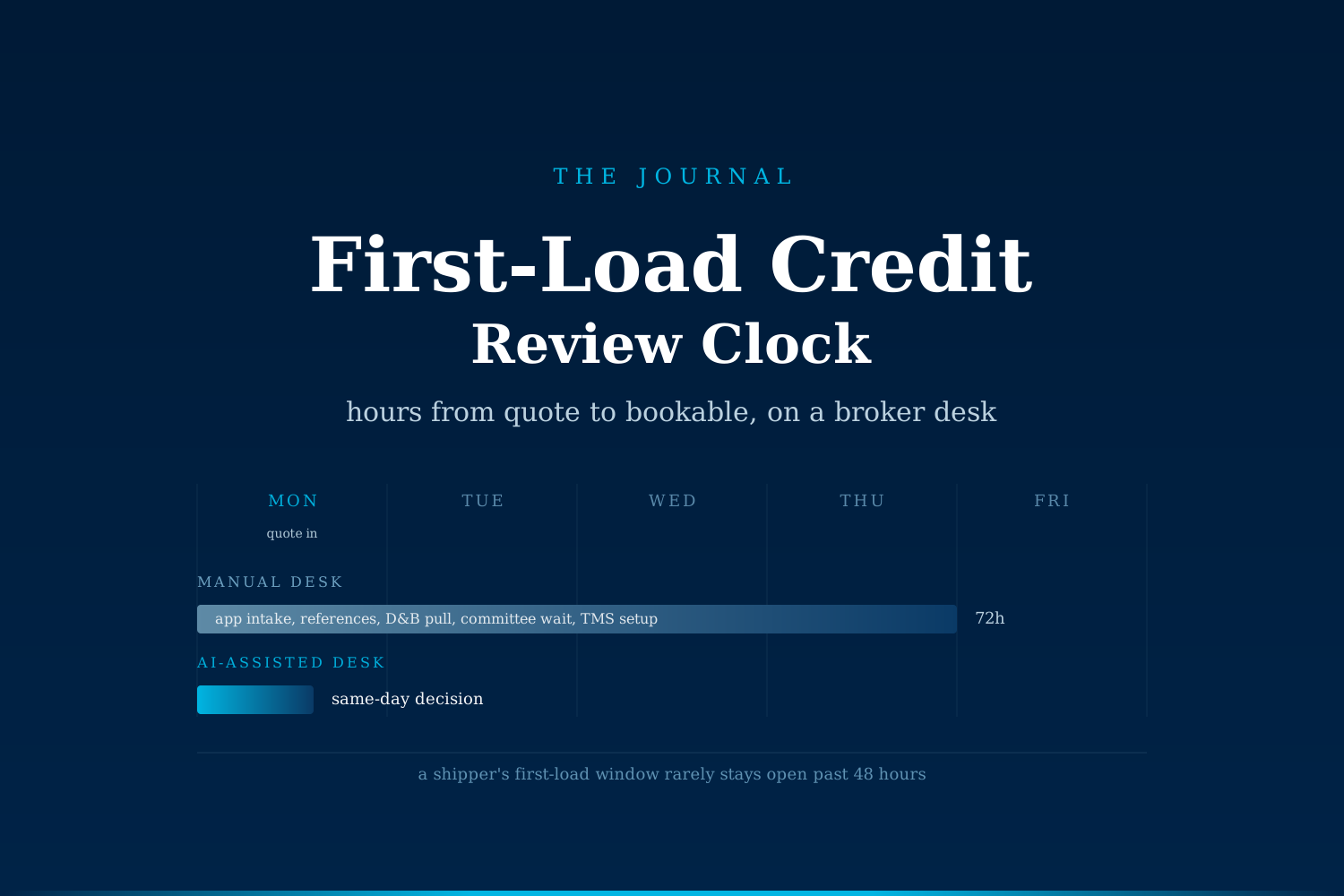
A shipper who calls a mid-size brokerage for the first time is not shopping for a lifetime relationship. They are trying to move a load this week. When credit review takes two to three business days, the first-load window closes before the broker can quote firm capacity, and the account walks.
What is a shipper credit review at a freight brokerage?
A shipper credit review is the risk assessment a brokerage runs before it will book a new shipper's freight on standard payment terms. Because the broker pays the carrier in 15 to 30 days but does not collect from the shipper for 30 to 60 days, every load is short-term working capital sitting on the broker's balance sheet. Credit sizing is what protects that exposure.
A standard review typically includes a Dun & Bradstreet or Experian Business pull, a trade reference check across two or three other carriers or brokers the shipper has paid, a scan of public records (federal tax liens, judgments, bankruptcy filings), and a credit committee review for exposure above a set dollar threshold. Once cleared, the shipper gets a credit limit and payment terms coded into the TMS.
On a manual desk, that end-to-end cycle usually runs 24 to 72 business hours. Industry references including the Transportation Intermediaries Association and NACM's National Trade Credit Report cite similar ranges for first-time shipper vetting at brokerages under $100M in annual revenue.
Why does a first-load booking depend on credit clearance?
Because the broker's payment obligation to the carrier is unconditional. Once a rate confirmation is signed, the broker owes the carrier when the load delivers, whether the shipper eventually pays or not.
That structural fact is why credit review is not a paperwork step; it is a capital allocation decision. A $4,500 gross rate on a 1,200-mile dry van run represents roughly $4,000 in payable exposure to the carrier and 30 to 60 days of float before the shipper covers it. Approving a shipper for that exposure is the point of the review.
Some brokerages work around the constraint on first loads with a "test load" carve-out: dispatch the first small load on very short terms (net 7), or on a factor-guaranteed basis. That workaround exists precisely because the standard credit cycle is too slow to catch first-load momentum.
How long does the first-load window actually stay open?
Not long. A shipper who calls Monday morning with a Tuesday pickup is not going to wait until Thursday afternoon for a quote. Freightwaves reporting and independent broker operating surveys consistently note that a freight prospect contacts three to five brokerages on average when sourcing new capacity, and the first broker to combine a firm rate with a bookable carrier tends to win the account.
Two things happen when the credit review outruns the window. The desk quotes a soft rate and hopes the shipper waits (they usually do not). Or the sales rep pushes to skip the credit step and dispatch on a promise (an exception the compliance side is right to resist). Either way, first-load conversion suffers.
What does a manual credit review cycle look like?
For a typical mid-size brokerage, the sequence usually looks like this:
- Sales rep sends a credit application, waits for the shipper to sign and return it. Round trip: 4 to 24 hours.
- Analyst keys the completed application into the credit workflow and requests trade references. Reference callbacks: 24 to 48 hours.
- Analyst pulls D&B or Experian Business, reviews payment index (PAYDEX or Intelliscore). Same day if the analyst has capacity.
- Public records scan: bankruptcies, active federal tax liens, civil judgments over a set threshold. Manual searches across state databases. Half a day.
- Case sent to credit committee if exposure exceeds the analyst's discretion (often $10K to $25K per shipper). Committee reviews weekly or on-call. Zero to five business days.
- Approval notice back to sales; credit limit and terms coded into TMS; sales rep re-quotes.
Cumulative elapsed time on a straightforward file: 24 to 72 hours. On a file that hits committee or needs a reference re-request, easily five to seven business days.
Manual credit reviews vs AI-assisted intake
The point of automation here is not to remove the credit committee. It is to compress the parts of the cycle that are pure data movement, so the committee (and the credit manager's judgment) get applied faster and to more files.
| Step | Typical manual desk | AI-assisted desk |
|---|---|---|
| Credit app intake | Emailed PDF, re-keyed into the workflow | Digital form or auto-parsed PDF, populated on submit |
| D&B / Experian pull | Analyst logs in, pulls report, saves to file | API call, key figures pulled into the shipper record |
| Trade reference outreach | Manual emails and voicemails, follow-up loops | Auto-emailed reference forms with structured responses and cadence |
| Public records scan | Analyst runs manual searches across databases | Batch check, exceptions flagged for analyst review |
| Committee pre-work | Analyst preps case memo for a weekly meeting | System pre-scores the file, committee sees only exceptions |
| Credit limit setup in TMS | Manual entry, sales notified by email | Auto-provisioned in TMS on approval, sales notified in the load board |
| Typical time to decision | 24 to 72 hours (longer if committee needed) | Same day for straightforward files, hours to committee for the rest |
The compliance value of the review does not change. The clock in front of the sales rep does.
Three signals credit lag is capping first-load conversion
If a brokerage owner or head of sales wants to check quickly whether this is happening on their desk, three signals are usually enough.
- First-load conversion rate. Of new shippers who received a quote in the last 90 days, what share booked a first load? Conversion below half is common on manual desks and usually points to some combination of credit lag, rate misalignment, or both. Isolate credit by looking only at prospects who accepted the quoted rate.
- Time from quote to first tender. Pull a sample of first-load bookings and measure the median hours between quote acceptance and the shipper's first load tender. If that median is measured in days rather than hours, credit review is on the critical path.
- Frequency of the test-load workaround. How often does sales dispatch a first load without full credit clearance? Every occurrence is a small policy exception the desk is running to keep the account warm. Repeat exceptions are a sign the standard process is out of step with prospect momentum.
Any single signal can have other explanations. Together, they usually point at the credit intake cycle.
What changes when the credit process compresses?
The most visible change is that the desk stops losing first-load bookings to elapsed time. Prospects who quoted on Monday get a booked load on Tuesday, not the following week. Marketing spend converts at a higher rate because the sales team is not fighting a clock they cannot control.
Downstream, three quieter shifts show up. The credit analyst spends more time on judgment (reviewing borderline files, negotiating references, sizing exposure) and less on data movement (re-keying applications, chasing callbacks, keying limits into TMS). The credit committee sees a cleaner queue with the routine files already pre-scored. And the sales team stops burning cycles on prospects who ghost during a two-day wait, which changes the shape of the pipeline as much as the shape of the win rate.
None of this shows up as a single headline number. It shows up as a higher first-load conversion, a shorter quote-to-tender window, and a credit desk that is less often the reason a good account walked.
The pitch
If a mid-size brokerage is quoting more new shippers than it is booking, or watching first loads consistently slip to competing brokers on rates that were fully quoted, the credit intake cycle is worth a hard look. We map where the calendar time actually goes on a first-load review and identify the parts that are pure data movement, without asking the compliance side to loosen a single standard.
If this pattern sounds familiar on your desk, we run a completely free automation audit for freight brokerages. No slide deck, no commitment. → Book the audit
Sami Raza
Software Developer & Technical Author
Sami Raza builds AI automation for logistics, DTC, and construction operations teams at ApexifyLabs, and writes about the operational failures that automation is actually worth pointing at.