Why Cold Chain Claims Stall on Freight Brokerage Desks
Reefer telematics, BOL exceptions, and consignee chargebacks live in three different systems. Cold chain claim files stall because the broker becomes the integration layer.
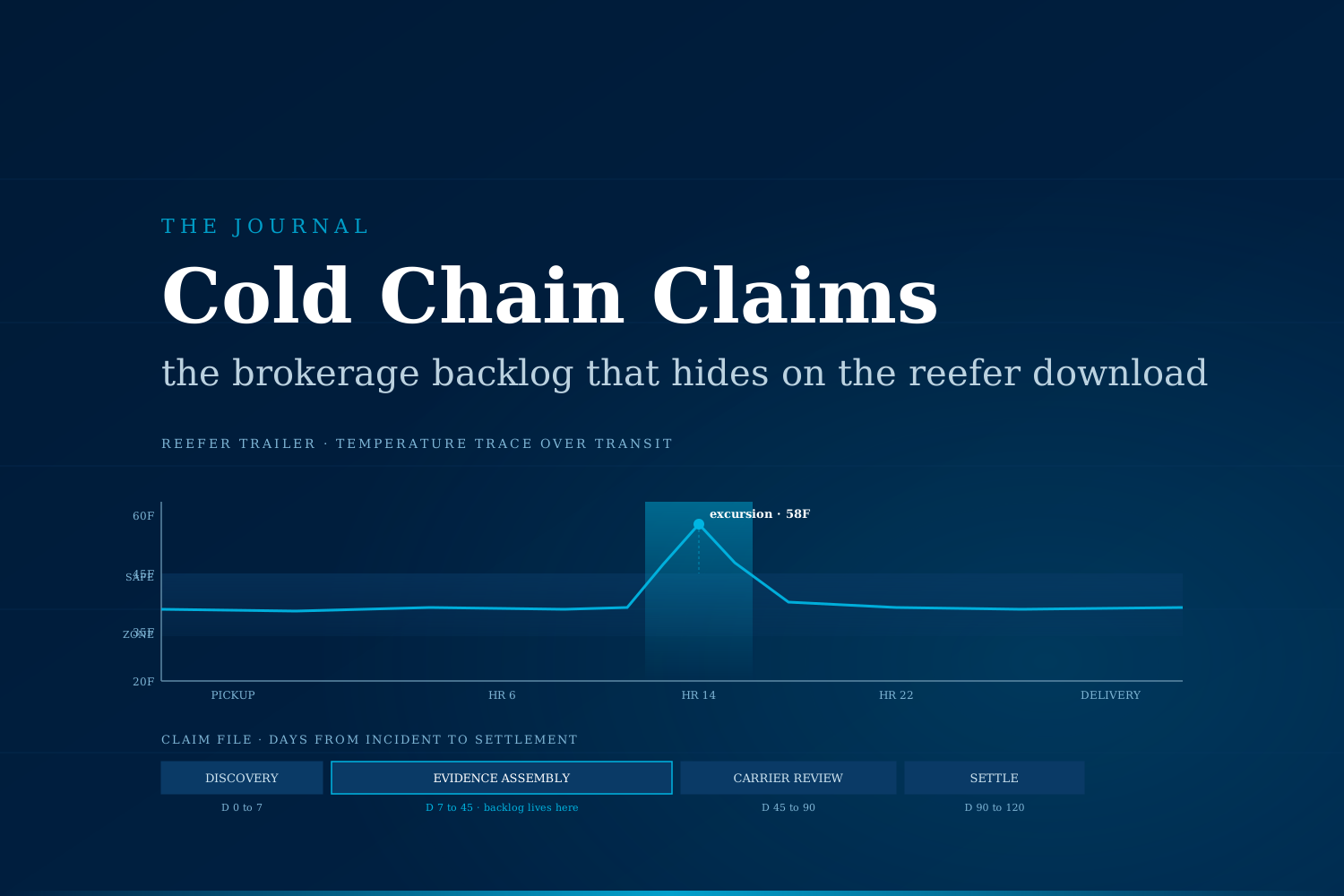
Cold chain freight claims stall on brokerage desks because the proof a shipper wants lives in three places: the reefer telematics download, the BOL and delivery exceptions, and the consignee's chargeback file. Brokers regularly spend 60 to 90 days assembling evidence on claims a connected system could settle in 14.
What is a cold chain claim, exactly?
A cold chain claim is filed when a refrigerated load arrives outside its required temperature range, and a portion (or all) of the shipment is rejected, downgraded, or recalled. On a truckload of frozen poultry, salmon, vaccine product, or fresh produce, the claim can range from a few thousand dollars on a partial downgrade to a full-load total loss in the tens of thousands.
Two pieces shape how the claim moves. The FDA's Sanitary Transportation of Human and Animal Food rule, finalized under FSMA in 2016 and progressively enforced since, requires shippers, carriers, and brokers to document the time and temperature controls for any load that qualifies as a covered food product. The Carmack Amendment, the federal carrier-liability statute that has governed interstate freight loss and damage since 1906, sets the rule that the carrier is generally liable for actual loss to the cargo unless a defined defense applies.
For the broker, that combined framework means the claim usually moves with the broker holding the documentation chain together: pulling reefer download data from the carrier, the BOL and POD from the driver or the shipper, and the chargeback debit memo from the consignee.
Why does a single excursion turn into a 60-day file?
The root cause is not difficulty. It is that the evidence required to settle a claim sits in three or four systems, owned by different people, written in different formats.
- Reefer telematics download. The carrier's tractor or trailer telematics platform records the unit's setpoint, supply air, return air, and door event log at intervals of one to five minutes. The download is usually a CSV or PDF and is requested manually, often days after the excursion.
- BOL, POD, and exception notes. The bill of lading carries the temperature instructions. The POD records what arrived and what was rejected. Driver exception notes, when present at all, sit in a dispatch portal or a paper folder.
- Consignee chargeback. The shipper or consignee files the dollar amount. The chargeback usually arrives 7 to 30 days after delivery, often as a deduction from a future invoice rather than a clean claim packet.
- Carrier denial or counter. The carrier's claims department responds with its own version of events, usually 30 to 60 days after the claim is filed.
Each of those four parties pulls from a different system, on a different cadence, with no shared timeline. The broker's claims clerk, often a single person sitting between dispatch and accounting, becomes the integration layer. That is where the file stalls.
How much margin actually sits in the backlog?
For mid-size brokerages running 50 to 200 reefer loads a month, the per-claim arithmetic is rarely shocking. The cumulative arithmetic almost always is.
| Claim component | Typical range (per filed claim) |
|---|---|
| Cargo claim amount | $1,500 to $35,000 |
| Days from incident to first carrier response | 30 to 60 |
| Days from claim filed to settlement or denial | 60 to 120 |
| Claims clerk time per file | 4 to 12 hours |
| Net recovery rate (industry surveys) | 50% to 75% of filed amount |
The Transportation Intermediaries Association and freight trade press have consistently reported that cold chain claims close at a lower recovery rate than dry van damage claims, in large part because the evidence chain is harder to assemble after the fact. A brokerage with 5 to 8 open reefer claims at any given time often has $40,000 to $120,000 of working-capital margin sitting in the backlog, plus a clerk burning 15 to 20 hours a week chasing data.
The second-order cost is the customer. A shipper whose claim recovery takes 90 days does not always rebid the freight when the contract renews. They rarely cite the claim file as the reason. They cite "service" and quote a competitor.
What does the claim desk look like before automation?
A typical mid-size brokerage runs reefer claims through a shared spreadsheet and an email thread. The claims clerk opens a new file when a chargeback arrives, requests the reefer download from the carrier, waits five to ten business days for the file, screenshots the relevant minutes of temperature data into a Word document, attaches the BOL and POD, and submits a packet to the carrier's claims department.
Then the file waits. Carrier claims departments are typically backlogged 30 to 60 days. The clerk follows up every two weeks. If the carrier denies, the clerk pulls a second look at the telematics to argue the temperature setpoint was met for most of the transit time. If the carrier counters with partial settlement, the clerk takes it to the shipper, who then debits the difference from a future invoice anyway.
The pattern that operators eventually notice is that the clerk spends almost all of their week on three or four files, while another twelve files sit in "awaiting download" status. The backlog is not a productivity issue. It is a sequencing problem the desk cannot solve with more hours.
What changes when an AI-augmented system runs the claim file?
The shift is not about removing the claims clerk. It is about removing the part of the job that is data assembly, so the clerk works on negotiation and recovery instead.
- Reefer telematics stream continuously into the claim record, so the temperature trace is available the moment a chargeback is filed, not five business days later.
- Excursions are detected at the time they happen, not at the time a consignee complains. The claim file can be opened with photo evidence requested from the driver before the trailer leaves the dock.
- BOL temperature instructions, POD exception notes, and reefer downloads land in one timeline keyed to the load number, so the assembled packet is ready before the chargeback arrives.
- Chargeback debits are matched to existing claim files automatically, so the consignee's accounting move does not create a second, disconnected paper trail.
- Carrier response timelines are tracked against the deadlines that determine leverage, with the clerk surfaced the files that are about to age past a recoverable point.
The KPI most claims desks watch is days-to-close on filed claims. Operators that move to a connected system regularly compress that number from the high 60s into the high 20s within a quarter, and lift net recovery rate by 10 to 15 percentage points. The clerk does not work more hours. The clerk works on the files where negotiation, not data assembly, is the constraint.
How does this compare to "hire another claims clerk"?
The traditional path is headcount. The comparison most brokerages eventually run looks like this:
| Approach | Files closed per month per clerk | Average days to close | Net recovery rate | Capacity ceiling |
|---|---|---|---|---|
| Manual desk, shared spreadsheet | 8 to 12 | 70 to 110 | 50% to 60% | Hard ceiling at one clerk's bandwidth |
| Manual desk, two clerks | 18 to 24 | 60 to 90 | 55% to 65% | Headcount must double to double throughput |
| AI-augmented claim desk | 35 to 60 | 25 to 40 | 65% to 80% | Scales with load volume, not clerk count |
The trade-off is not labor cost. It is the leverage ratio. A spreadsheet desk scales linearly with headcount and is capped by how fast a human can request and reformat telematics data. A connected desk scales with reefer-load volume.
There is also a quieter benefit. The clerk who is no longer assembling evidence becomes the person who renegotiates the carrier panel on the back of a recovery-rate trend, the person who flags lanes where chargeback density predicts the next customer churn, and the person who actually answers the shipper's quarterly business review with claim data. That is a different role than the role of the spreadsheet clerk.
When is it worth looking at this seriously?
Three signals usually appear before the leak shows on the P&L:
- Claims-clerk time on reefer files exceeds 15 hours per week, including night and weekend follow-up.
- Average days from incident to settlement crosses 75 days on the trailing quarter.
- More than one food-grade shipper in the last two quarters cited claim cycle time during a renewal call.
Any one of these is a working brokerage. Two or three together usually means the desk is closing 30 percent fewer claim files at a 10 to 15 point lower recovery rate than is structurally available, and the recovery is in the data flow, not in the carrier panel.
A note on what we do not put in a tutorial
The telematics ingestion patterns, the matching logic that pairs reefer trace to BOL temperature spec, and the carrier-side claim handoff design are where this work actually lives. Each brokerage's TMS, carrier mix, and shipper book bends the integration differently, and the design choices that determine whether the system actually moves the days-to-close number are the parts a generic playbook cannot give you. Our role is to ship that connected desk and hand the claims team a tool that pays for itself in recovery rate, not in headcount.
If reefer claims are sitting open longer than your shipper book is comfortable with, we run a completely free automation audit for brokerages handling cold chain freight. We look at one quarter of your claim files, the time-to-settle pattern, and the telematics gaps that explain it, then map where the recoverable margin sits. No commitment, no slide deck. → Book the audit
Sami Raza
Software Developer & Technical Author
Sami Raza builds AI automation for logistics, DTC, and construction operations teams at ApexifyLabs, and writes about the operational failures that automation is actually worth pointing at.