Why Warranty Callbacks Pile Up Six Months After Handover
Most GCs treat the post-handover warranty queue as an afterthought, then watch six-month callback volume spike. Here is why the queue grows and what tracked intake actually changes.
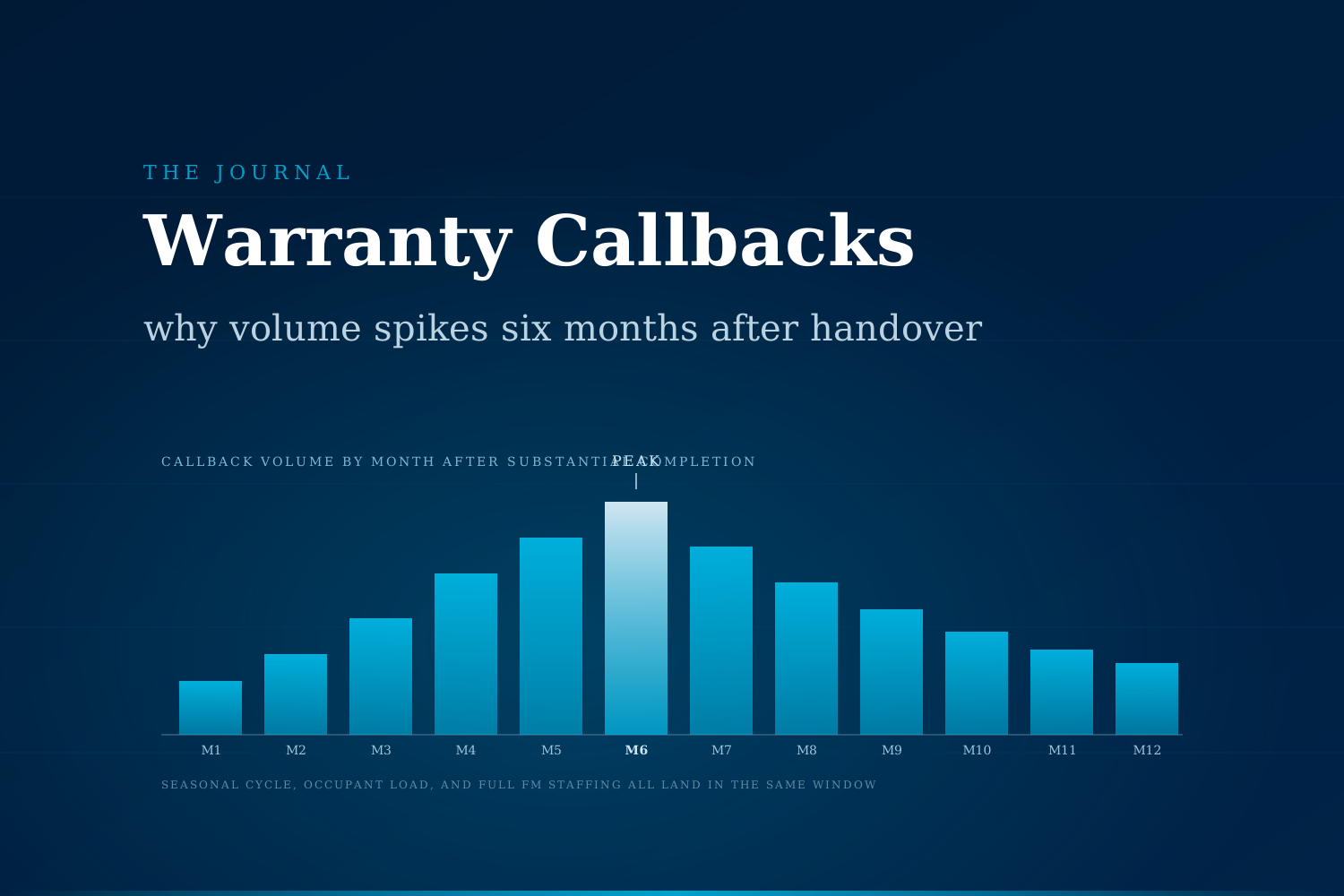
Warranty callbacks pile up six months after handover because handover paperwork rarely captures the detail crews need to triage requests fast, and because most GCs route post-occupancy issues through email instead of a tracked queue. The result is the same defect reported twice, weeks of follow-up, and a close that gets tarnished long after the project is "done."
What counts as a warranty callback (and what does not)?
A warranty callback is a defect report raised after substantial completion, inside the contractual warranty window. The standard window is one year for general work and longer for MEP equipment and specialty assemblies, often two to ten years depending on the manufacturer warranty pulled through. Punch list items, by contrast, are work the GC owes the owner before substantial completion. The two often blur in the field, which is part of the problem.
Statutory periods vary by state. Many states impose implied warranties of habitability and workmanship that extend past the contractual window, and most owners do not realize that until they call counsel. None of that is the GC's choice. What the GC controls is how the callback queue is run.
Why does the queue spike around month six?
The six-month bulge is not random. Several factors pile in at the same time:
- Occupant load reveals. Mechanical systems sized to design occupancy get tested by reality only after the owner moves in and staffs up. Undersized return air, hot-and-cold complaints, and zoning issues surface a few months in, not at temporary certificate of occupancy.
- Seasonal turnover. Most handovers happen in summer or year-end. Six months later the building has cycled through one cooling and one heating season, which is when seal failures, condensate drips, and equipment startups under load show up.
- Caulking and sealant failures. Sealants begin moving with thermal cycles. Joints that looked clean at handover open up by month four through six.
- Facilities team finally staffed. Owners rarely have a full FM team on day one. By month six the facility manager is in place, walking the building, and logging every issue at once.
- Late punch leakage. Items that were quietly carried as "we will fix that during warranty" come back, except now they sit in a different queue.
Industry surveys from groups like the Construction Financial Management Association and FMI Corporation consistently flag closeout and warranty as the lowest-maturity process areas inside otherwise well-run mid-size GCs. The pattern is not specific to any one project type.
How does the average GC track warranty work today?
For most mid-size GCs, the post-handover queue lives in a project manager's inbox and a closeout spreadsheet. Owner calls go to the construction manager who ran the job, or to a generic warranty address that nobody monitors during bid week. Requests get forwarded to subs. Status lives in reply chains. Nothing is tagged by trade or by warranty period, so the same issue gets re-investigated when it comes back from a different occupant.
The contrast looks like this:
| Dimension | Typical post-handover process | Tracked intake with AI triage |
|---|---|---|
| Where requests land | PM inbox, generic warranty email | Single intake form, every channel routed in |
| Classification | Free text, no trade tag | Auto-classified by trade, system, warranty period |
| Sub assignment | Manual forward, reply chains | Auto-routed to the responsible sub with the closeout record attached |
| Duplicate detection | None | Flagged when the same issue surfaces twice |
| Status visibility | "Ask the PM" | Shared dashboard the owner can read directly |
| Closeout link | Separate from O&M binders | Each callback linked back to submittal, warranty doc, and as-built |
Neither side is exotic technology. The first column describes how the work used to be tracked when projects were smaller and PMs only ran one job at a time. As portfolios grew, the queue did not get a process.
What does the cost actually look like?
The real cost of a stale warranty queue is rarely on the GC's project P&L because by then the job is closed. It shows up in three other places:
- Direct labor for truck rolls. A single warranty callback that turns into three truck rolls (diagnose, return with parts, return again for sign-off) is common when the trade is dispatched without the closeout record. CFMA benchmarker data has long flagged warranty and rework as a multi-percent margin drag on GCs that do not track it deliberately.
- PM time on closed projects. A PM who is supposedly assigned to a new $30M build is, in practice, working a few hours a week on warranty issues from the last one. That time is not billed and not recovered.
- Repeat-bid eligibility. Owners and CMs talk. A GC who is slow on warranty response gets quietly bumped off the next prequalification list, even when the original build was clean. Reference checks at the prequal stage almost always include "how were they after handover?"
There is also a softer cost. Retainage release is sometimes contractually tied to warranty completion or to a one-year walk. A messy queue delays that walk, which delays the final retainage payment, which compounds working-capital strain. CFMA's annual financial benchmarker has tracked GC days-of-cash-on-hand for years; the firms with cleaner closeout consistently sit at the better end of that range.
What changes when intake and routing are tracked end to end?
The shift is not really about new tools. It is about new behavior at the intake. When every owner contact, FM email, and tenant complaint lands in the same place and gets classified the moment it arrives, the queue stops being a memory test.
A tracked warranty intake does a few specific things for a GC:
- Tags each request by trade, system, and remaining warranty period before a human reads it. The responsible sub is identified from the closeout record, not from PM recall.
- Flags duplicates when the same defect comes in from two different occupants, so the GC dispatches once instead of twice.
- Pulls the relevant submittal, warranty document, and as-built sheet into the work order automatically, so the sub shows up with the right parts on the first visit.
- Surfaces patterns across jobs. If a particular caulking detail is generating callbacks on three projects, that becomes visible at the portfolio level instead of three separate one-offs.
- Gives the owner a live status view they can check without phoning the PM, which removes the single most expensive interruption from the PM's week.
What does not change: the warranty obligation, the contractual window, the legal exposure. Those are the same. What changes is how much of the PM's time the queue eats while it is happening, and how the owner feels about the brand of the GC the year after handover.
When is it worth investing in a real warranty process?
A handful of signs typically mean the post-handover process is costing more than it looks:
- Project managers are working on warranty issues from closed jobs more than two hours a week.
- The same callback type (caulking, door hardware, VRF flow) appears on multiple recent projects without a portfolio-level fix.
- Retainage release on the last two jobs slipped past 60 days after the one-year walk.
- The owner's FM team has started copying the executive sponsor on warranty emails.
- The closeout binder and the warranty queue live in different systems with no link between them.
None of those is fatal on its own. Together they describe a GC carrying a soft cost that does not appear on any project P&L but quietly cuts into overhead and into the next prequalification cycle.
The warranty period is the last impression the owner has of the build. It is also the one most GCs put the least process around. Closing that gap is not glamorous work, but it is one of the higher-leverage operational changes a mid-size GC can make in a year.
If this sounds like your post-handover desk, we run a completely free automation audit for construction teams that want a second opinion on where warranty intake and closeout are leaking time. No commitment, no slide deck. → Book the audit
Sami Raza
Software Developer & Technical Author
Sami Raza builds AI automation for logistics, DTC, and construction operations teams at ApexifyLabs, and writes about the operational failures that automation is actually worth pointing at.