When Subcontractor Insurance Lapses on an Active Job
A subcontractor's COI can expire mid-project without anyone noticing. A look at what an unmanaged lapse exposes a GC to, and how AI keeps the file current.
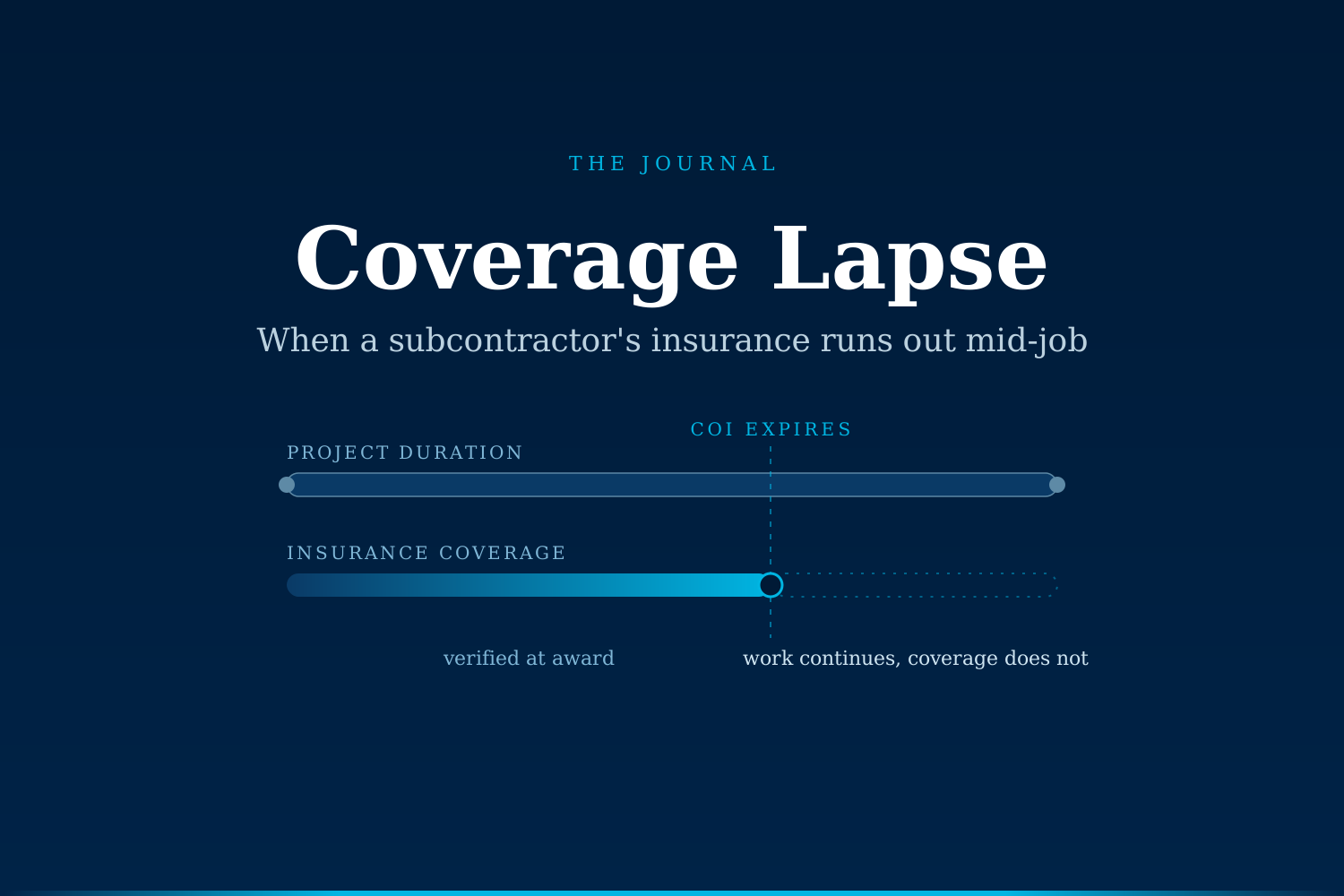
A subcontractor's certificate of insurance can expire while the crew is still on site, and the general contractor often does not learn of it until a claim, an audit, or a withheld payment forces the question. The lapse is rarely a deliberate choice. It is a tracking failure that nobody owned.
This article looks at why subcontractor insurance and compliance documents lapse without anyone noticing, what an unmanaged lapse actually exposes a general contractor to, and how the same compliance work changes once AI monitors it continuously instead of a person checking a folder.
What does subcontractor insurance compliance actually involve?
Most owner contracts and subcontract agreements require every subcontractor on site to carry general liability, workers' compensation, and often auto and umbrella coverage at stated limits, with the general contractor (and frequently the owner) named as an additional insured. The general contractor's job is not to buy that coverage. It is to verify it exists, verify it still names the right parties, and verify it has not expired, for every sub, for the full duration of the work.
That verification rests on a stack of documents larger than most desks treat it as:
- Certificates of insurance (the ACORD 25 form) for general liability, workers' comp, auto, and umbrella.
- Additional insured endorsements, which are the policy language that actually extends coverage to the GC. The certificate only reports that an endorsement exists.
- Waivers of subrogation, where the subcontract requires them.
- Lien waivers tied to each payment application.
- W-9s, business licenses, and trade licenses.
- Safety documentation, such as experience modification rate letters or site-specific safety plans, where the owner or the GC's own risk program requires them.
Each document has an issue date, an expiration, an issuing party, and a verification path. On a mid-size commercial project with twenty to forty subcontractors, that is several hundred dated documents that all need to be current at the same time.
Why does a certificate of insurance lapse without anyone noticing?
A certificate of insurance is a snapshot, not a live feed. The ACORD 25 form states, in its own header, that it is issued as a matter of information only and confers no rights on the certificate holder. It tells the general contractor that coverage was in force on the day the certificate was issued. It says nothing about month eight of a fourteen-month build.
Three structural reasons let the lapse slip through:
Policies renew on their own calendar, not the project's. Commercial policies typically run twelve-month terms. A project that lasts longer than a year, or simply crosses a subcontractor's renewal date, will outlast the certificate on file. The renewal certificate has to be requested, received, read, and filed. Nothing about the original certificate in the folder signals that it has gone stale.
The folder looks complete. The most common failure mode is not a missing document. It is a present but expired one. A compliance binder with a certificate for every sub feels finished. Whether each certificate is still in force is a question the binder cannot answer on its own, and a visual scan of forty ACORD forms for forty different expiration dates is exactly the kind of task attention skips.
The chase competes with the build. Requesting a renewal certificate from a sub's insurance agent, reading the limits and endorsement language, and confirming it matches the subcontract is administrative work with no deadline that announces itself. It loses, every week, to work that does have a loud deadline. Until something forces the question.
What does an unmanaged lapse actually cost a general contractor?
The cost is not the admin time. It is the risk that was supposed to have been transferred and was not.
Risk transfer fails at the worst moment. The entire point of requiring sub coverage is that an incident caused by the sub is paid by the sub's insurer, not the GC's. If the sub's general liability policy lapsed before the incident, that transfer collapses. The claim can fall back on the GC's own policy, which raises the GC's loss history, its experience modification rate, and its future premiums, on every job, for years.
Additional insured status only works if the policy is live. A GC named as an additional insured on an active policy has direct access to the sub's coverage. The same designation on a lapsed policy is worth nothing. The certificate in the folder will still say "additional insured." It just will not mean anything.
Owners can withhold payment or argue default. Most owner contracts make current proof of insurance for every sub on site a condition of payment. A general contractor that cannot produce current certificates during an owner audit can see a payment application held, and in the harder cases, face a contract default argument, over paperwork rather than over the work itself.
Surety and the GC's own insurer audit the file. Bonding capacity and the GC's annual insurance audit both depend on a clean subcontractor compliance record. Gaps surface at renewal, when they are most expensive to explain.
A single uninsured claim on a mid-size project can exceed the general contractor's entire fee on that job. That asymmetry is the reason this is a risk problem wearing the costume of an admin task. Insurance and surety professionals who audit contractor compliance files routinely report that expired certificates, not missing ones, are the most common finding.
How does manual compliance tracking compare to AI-monitored compliance?
| Dimension | Manual compliance tracking | AI-monitored compliance |
|---|---|---|
| Certificate on file | Filed once at award, rarely re-read | Read on arrival, limits and dates extracted |
| Expiration awareness | A person remembers, or does not | Every expiration tracked against the project calendar |
| Renewal chase | Starts after a certificate has already expired | Starts before expiration, on a standing cadence |
| Endorsement check | "Additional insured" box trusted at face value | Flagged for review where policy language is required |
| Coverage during the job | Assumed current between audits | Continuously confirmed for every active sub |
| Owner audit readiness | A scramble to assemble current proof | A current file, always assembled |
| What the GC sees | A binder that looks complete | A live status: current, expiring, lapsed |
The difference is not that the documents change. It is that "we have a certificate" stops being treated as the same thing as "coverage is in force right now."
What changes when compliance monitoring runs continuously?
A few things shift once the compliance file becomes a live status rather than a binder.
Expirations surface before they become exposures. A renewal request sent two weeks before a policy expires is a routine email. The same request sent after an incident is a problem.
The file stops being a point-in-time artifact. Instead of a binder that was accurate at award, the GC has a picture that is accurate today: which subs are current, which expire this month, which have already lapsed.
Owner audits stop being fire drills. When current proof of coverage is always assembled, an owner's request for the compliance file is a short export, not a two-day chase across forty insurance agents.
The project manager stops being the compliance department. The hours that went into chasing renewal certificates return to running the build, and compliance stops depending on one person's memory.
Risk becomes visible to the people who carry it. A risk manager, controller, or principal can see exposure across the whole portfolio rather than discovering it one claim at a time.
What does not change is the judgment. Whether a sub's limits meet the subcontract, whether an exclusion matters, whether to let a marginally compliant sub mobilize, stays with the GC's risk manager and project executives. Neither does the build itself: connecting a GC to a continuously accurate compliance picture means parsing every carrier's certificate format, reconciling endorsement language, and folding it into the project management system the GC already runs. That is the actual work, and the part a GC hands to a partner. We are not going to walk through it here.
What are three signs your compliance file is thinner than it looks?
A short diagnostic any general contractor can run this week, without talking to an automation partner.
- Pick one active project and pull the certificate for every sub on site. Check the expiration date on each one. If even one has passed, or expires before that sub finishes, the file is not doing the job it exists to do.
- Ask who owns renewal chasing. If the answer is "the PM, when they get to it," or a name attached to no other authority, compliance is running on individual memory rather than on a process.
- Time an owner audit response. If producing current proof of insurance for every sub on a project would take more than an hour, the file is not audit-ready, and the gap will show up on someone else's schedule, not yours.
None of these need software to investigate. They need one project file and an honest hour. If any of them rings true, the compliance exposure is almost certainly wider than the binder suggests.
When is the right time to look at compliance automation?
Subcontractor compliance is one of the cleaner candidates for AI augmentation on a general contractor's desk, because the work is highly structured. Every document has an issuer, a date, an expiration, and a set of required terms. The judgment calls stay human. The tracking, the reading, the renewal cadence, and the audit-readiness are where automation pays back fastest.
The right moment to look at it is usually one of three:
- A claim, an audit, or an owner request recently turned up a certificate that had expired without anyone realizing.
- The portfolio is growing and the compliance load is about to outrun whoever currently holds it in their head.
- A risk manager or controller has asked, on the record, whether the company actually knows its exposure across active projects.
If any of those is recent, the most useful next step is not to commit to a tool. It is to take one active project, map where the compliance file is current and where it is stale, and decide what that exposure is worth.
Want a clear read on your compliance exposure?
If subcontractor certificates and renewals are tracked by memory and a shared folder, we run a completely free automation audit for general contractors. We map where your compliance file is current, where it has gone stale, and what continuous monitoring would change about your risk exposure. No commitment, no slide deck, no pressure to move forward. → Book the audit
Sami Raza
Software Developer & Technical Author
Sami Raza builds AI automation for logistics, DTC, and construction operations teams at ApexifyLabs, and writes about the operational failures that automation is actually worth pointing at.