Subcontractor Bid Leveling: Manual vs AI-Assisted Review
On a mid-size GC, subcontractor bid leveling absorbs two to five days per trade package. Most of that work is mechanical normalization an AI layer can draft.
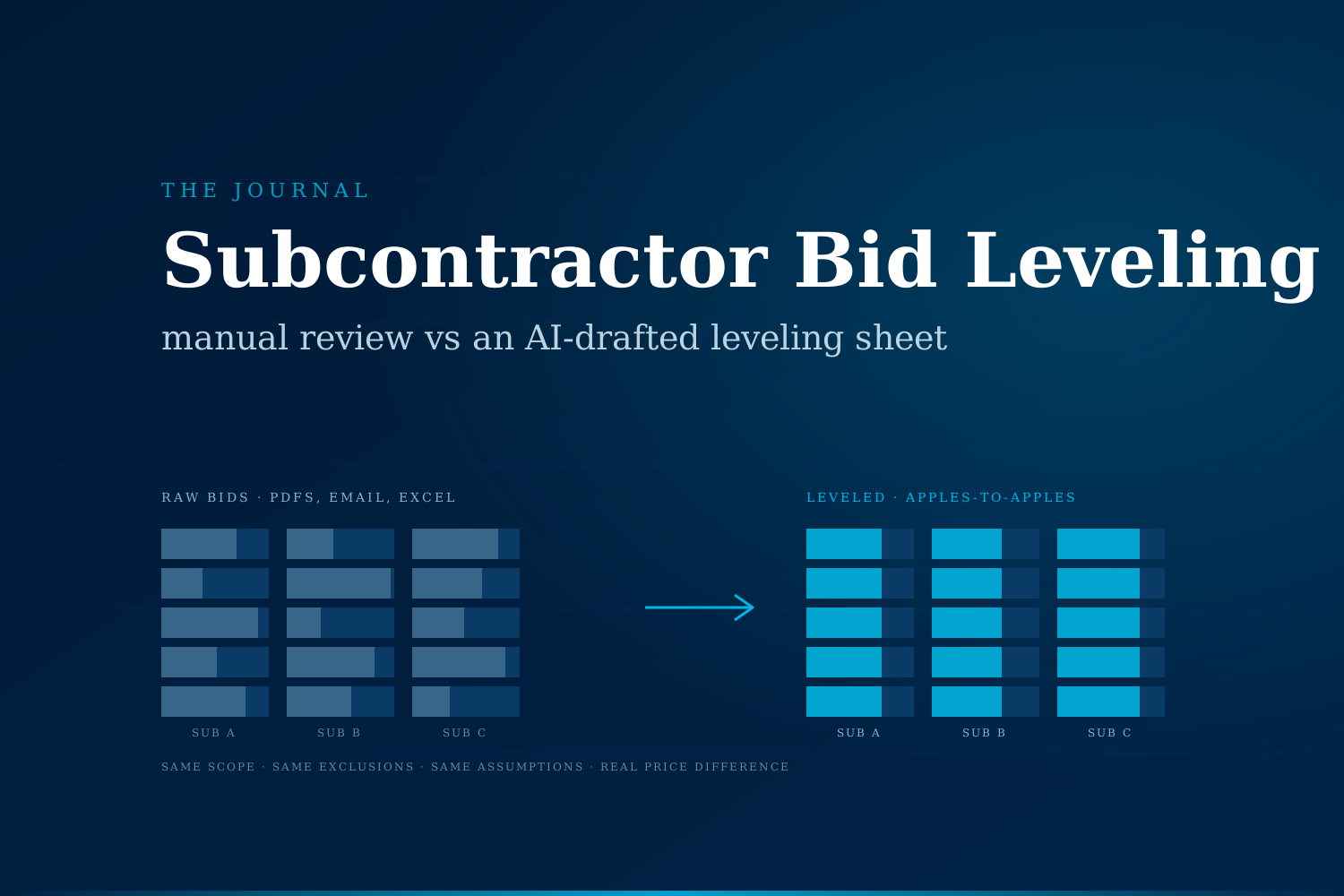
On a mid-size general contractor, subcontractor bid leveling on a complex trade package takes an estimator two to five working days per package. The work is mostly mechanical: aligning scopes, isolating exclusions, normalizing allowances, comparing alternates. AI-assisted leveling moves the mechanical layer to a draft an estimator then reviews and signs off on.
What is subcontractor bid leveling, and why does every trade package need it?
Bid leveling is the process of taking three to six subcontractor bids on the same scope and normalizing them into an apples-to-apples comparison before a GC awards the trade. The bids never arrive comparable. One sub carries the demolition, the next excludes it. One includes the temporary heat, another assumes the owner provides it. Allowances vary, unit prices vary, alternates are bundled differently, and the proposal formats are whatever PDF, spreadsheet, or email template each sub happens to use.
Without leveling, the cheapest number on a tabbed bid sheet is misleading half the time. After leveling, the estimator can defend the recommendation in front of the project executive and the owner: same scope, same exclusions, same assumptions, real price difference.
Estimating teams typically run bid leveling on every trade package over a threshold value (often $250K) and on every scope where exclusions and assumptions are likely to swing the price by 5% or more. On a $30M commercial project with 20 to 30 active trade packages, that means 15 to 25 leveling cycles in pre-construction, each absorbing real estimator hours.
Why does manual bid leveling absorb so much estimator time?
The time is not in the math. It is in the reconciliation.
The estimator opens five PDFs, three Excel workbooks, and an email thread where one bidder sent unit prices but no lump sum. They build a comparison column for each bidder, line by line, against the project scope sheet. They flag every exclusion ("temporary power by others"), every assumption ("delivery to ground floor only"), every alternate ("$8,400 add for stainless trim"). They send clarification emails to two bidders, wait two days for responses, then update the sheet.
Roughly the same shape repeats on every package. Mechanical, electrical, drywall, glazing, finishes. Each one a fresh stack of proposals that has to be normalized into the same leveled view.
Industry surveys of pre-construction productivity (FMI and Dodge Data & Analytics have both published comparable figures over the last several years) consistently put estimator time spent on bid solicitation, qualification, and leveling at 30% to 50% of total estimating bandwidth on a typical commercial project. On a five-person estimating team supporting four to six active pre-cons in parallel, the math compounds quickly.
Where do manual leveling errors actually land?
Errors in a leveled bid sheet rarely show up at award. They show up months later, on the job, as the trade contractor invoices for scope the GC assumed was included.
Five places the cost lands, none of them on the leveling sheet itself.
- Buyout variance. The number used at GMP or hard-bid pricing is not the number the trade actually performs to. The variance is typically 1% to 4% on a manually-leveled package, and most of that variance sits on the GC's margin until a change order can recover it.
- Owner change orders during construction. Scope the estimator missed at leveling time gets formalized as an owner change later. The conversation is uncomfortable because the GC has already carried the cost.
- PM reconciliation hours. The PM and superintendent rebuild the leveled summary in the field, in their heads, every time a scope question comes up. That reconciliation labor is not in pre-con's budget. It is in operations.
- Lost bidders. Subs who lose on price they thought was apples-to-apples remember. The next time the GC sends them a package, they price less aggressively, or they decline.
- Awarded-bidder claims. The awarded sub builds change-order claims around exactly the exclusions and assumptions the leveling sheet did not capture cleanly. The claim is usually defensible from their side. The GC absorbs it from theirs.
None of these costs roll up cleanly under "bid leveling" on any P&L the estimating team sees. They land in PM hours, change-order margin, and subcontractor relationship friction. Which is most of why the leveling step is hard to staff for at the volume the workload actually requires.
What changes when AI handles the mechanical layer?
The estimator still owns the recommendation. The leveling sheet still gets signed by a human. What shifts is who builds the first draft.
In an AI-assisted leveling workflow, the bids land in a shared inbox or folder. An agent layer reads each bid (PDF, Excel, email body), extracts line items, exclusions, allowances, and alternates against the project's scope sheet, and produces a draft leveled comparison with the gaps and contradictions flagged. The estimator opens the draft, reviews the flags, sends two or three clarification emails to bidders whose assumptions do not reconcile, and finalizes the sheet.
The two to five days per package compresses to roughly half a day, with the estimator's attention concentrated on judgment calls instead of data entry. The estimating team's bandwidth shifts from reconciliation labor to scope analysis, market intelligence, and the qualification work that meaningfully changes which sub wins.
What we will not lay out in this article is exactly how the agent layer is structured, what it reads, what it flags, or how it is tuned to a specific GC's scope library and bid template conventions. That is the work we do for our clients. The point of the comparison below is to make the operational difference legible, not to ship a recipe.
Comparison table: Manual leveling vs AI-assisted leveling
| Aspect | Manual bid leveling | AI-assisted leveling |
|---|---|---|
| Estimator time per package | 2 to 5 working days | About half a day, concentrated on judgment |
| First draft author | Estimator, line by line | Agent layer, reviewed by estimator |
| Format normalization | Manual re-keying from PDFs, Excel, emails | Drafted automatically against the project scope sheet |
| Exclusion and assumption capture | Estimator reads each bid and flags by hand | Drafted and flagged for estimator review |
| Clarification cycle with bidders | 2 to 3 days end to end | Same calendar window, fewer threads owned by the estimator |
| Risk of missed scope | Higher, especially under deadline pressure | Lower, with explicit flags surfaced upfront |
| Buyout variance | 1% to 4% typical | Closer to 0.5% to 2% as captured scope tightens |
| Capacity ceiling | Hard cap on trades per estimator per week | Higher cap, same team, same judgment quality |
The judgment work does not disappear. The mechanical work does.
When does AI-assisted leveling pay back for a mid-size GC?
The break-even is not in pre-con labor savings alone. It is in three lines that move together.
- Win rate on hard bids. Estimators with more bandwidth submit more leveled, defensible numbers on more pursuits.
- Buyout margin protection. Tighter capture of exclusions and assumptions at award translates directly into less margin given back during buyout and on early change orders.
- PM hours not spent reconciling scope in the field. Operations carries less hidden labor from pre-con's leveling shortcuts.
For a GC running $80M to $200M of annual revenue, those three lines together typically dwarf the cost of the leveling layer itself within the first two to three pursuits. The pre-con team's headline metric (cost per leveled package) is not where the leverage actually lives. The leverage is in what the estimating team can now defend on the next twenty pursuits without adding headcount.
The hard part was never the comparison. It is normalising forty inconsistent proposals into something comparable, and that is discovery work best done with the estimating team — the shape of a forward deployed engineering engagement. Adjacent pressure on the same desk shows up in estimating capacity limits, trade buyout overruns, and subcontractor prequal cycle time.
What to look for in an AI-assisted bid leveling workflow
Three things matter more than the underlying technology.
- Fidelity to the GC's own scope library. Generic templates do not survive contact with a specific GC's exclusions catalog or trade-package conventions. The leveling layer has to be tuned to how the team already works.
- Trust-building review surface. Estimators will not adopt a leveling tool that hides its assumptions. The flags, gaps, and contradictions need to be surfaced in plain language for the estimator to accept or override.
- Operational continuity. The output format (leveled summary, recommendation memo, file structure) should be the one the project executive already expects. Adoption stalls when the tool changes the artifact.
If your pre-con desk is running more leveling cycles than it can defend at the end of a pursuit, the bottleneck is rarely talent. It is the mechanical layer eating the talent's time.
If this sounds like your estimating desk, we run a completely free automation audit for mid-size GCs that want a second opinion on where the leveling time is actually landing. No commitment, no slide deck. → Book the audit
Sami Raza
Software Developer & Technical Author
Sami Raza builds AI automation for logistics, DTC, and construction operations teams at ApexifyLabs, and writes about the operational failures that automation is actually worth pointing at.