What Stale Product Data Does to DTC Marketplace Rankings
Product data drift on Amazon, Walmart, and Target slowly costs DTC brands ranking and conversion. Here is what changes when catalog ops stop running on spreadsheets.
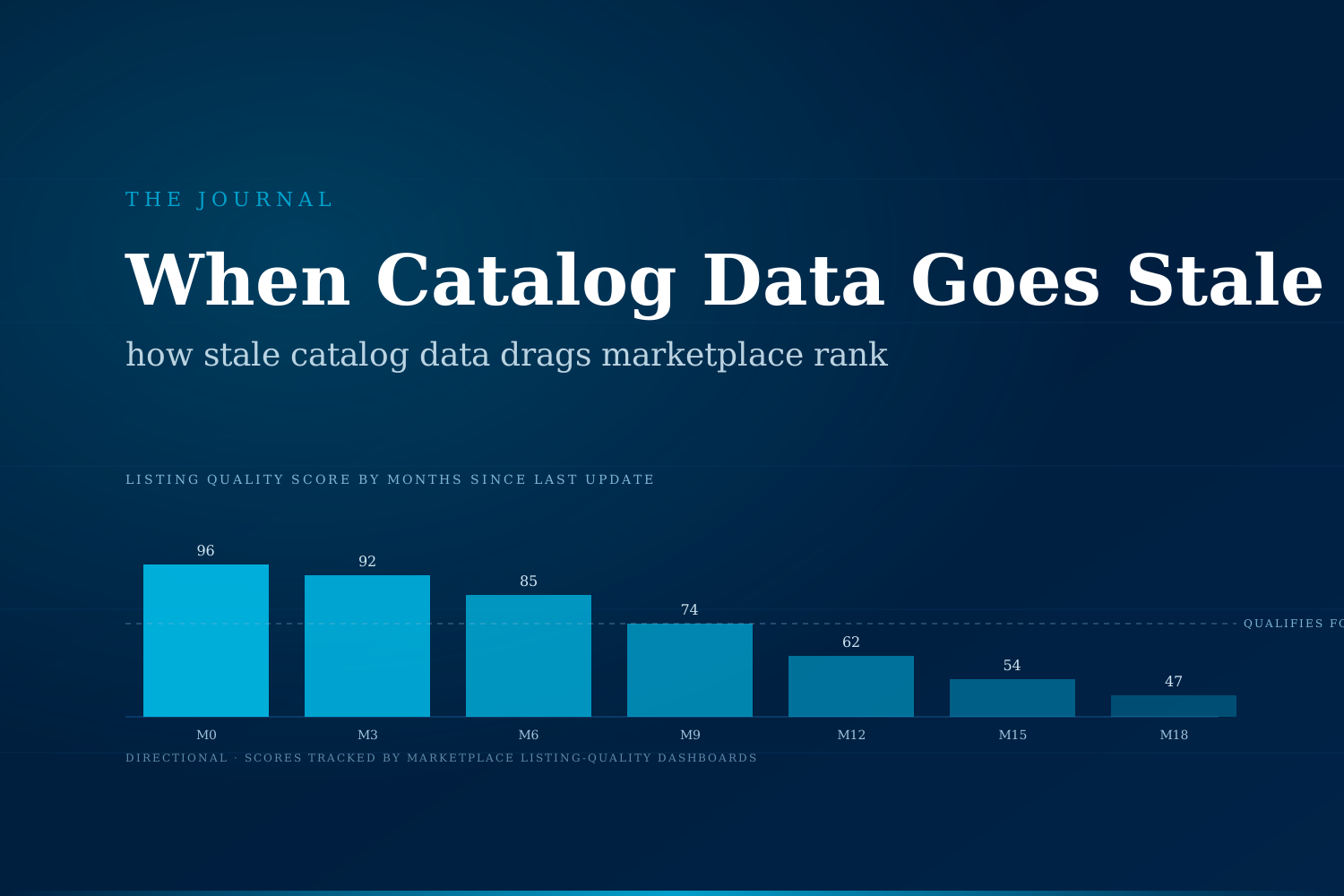
Product data drift is the slow, mostly invisible way DTC brands lose ground on marketplaces. A title that was optimized in 2024 still ships in 2026. Attributes go missing as marketplace schemas evolve. Imagery falls a generation behind. The catalog still sells. It just sells worse, and the ranking decline is rarely traced back to the cause.
For DTC brands running 500 to 50,000 SKUs across Amazon, Walmart Marketplace, Target Plus, and TikTok Shop, the question is not whether the data has drifted. It almost certainly has. The question is how much organic ranking and conversion that drift is costing per quarter, and whether the catalog team is built to keep up.
What is product data drift on a marketplace?
Every marketplace listing is more than a title and a price. It is a structured record made up of brand, GTIN, attribute fields (size, color, material, fit, capacity, voltage, and dozens of category-specific others), bullets, A+ or enhanced content, imagery sets, video, variants, parent-child relationships, and category placement. Some of those fields are visible on the product page. Most are invisible to the shopper but visible to the marketplace's search engine, where they drive how the listing is indexed and shown.
Drift is what happens when the version of that record sitting on Amazon, Walmart, or Target stops matching what the brand actually sells, what the marketplace currently expects, or what the brand has already updated everywhere else. A new bullet copy ships to the website but never makes it to Amazon. A new attribute Amazon added six months ago sits empty because nobody on the team noticed. A discontinued color variant still appears in the parent-child structure. The product hero image was reshot for the website, but the marketplace still uses the original from launch.
Each individual gap is small. The cumulative effect across hundreds of SKUs is a catalog that, viewed through the marketplace's index, looks consistently less complete and less current than the competitors gaining ground on the same search terms.
Why does stale product data drag a DTC catalog down on marketplaces?
The marketplaces are getting better at scoring listings, not worse. Amazon's search system (informally known as A9 and its successors) has steadily increased the weight of listing completeness, attribute richness, and content freshness in ranking decisions, per analyses from Marketplace Pulse, Pattern, and Helium 10 over the past several years. Walmart has been more direct about the same direction in its Walmart Connect documentation, which now grades listings on a Listing Quality Score that includes attribute completion and imagery thresholds.
What that means in practice:
- A listing missing 4 of 12 category-required attributes will lose to a competitor's listing that has all 12, even when the brand's product is objectively better.
- A listing whose Listing Quality Score drops below a marketplace threshold can be excluded from "shop by" filter pages and category browse pages entirely.
- A listing that has not been touched in 12 to 18 months is treated as a lower-priority candidate for promotional placements, even when the brand is paying for the placement.
The brand does not get a notification when any of this happens. The conversion rate and impressions just slowly slip, attributed to "the algorithm" or "the season" rather than to the catalog record itself.
There is also a quieter category of loss. Many catalog teams default to updating only the listings that get complaints, returns, or chargebacks. The middle of the catalog, the long-tail SKUs that earn 20 to 40 percent of marketplace revenue in aggregate, never gets touched between launch and discontinuation. That is exactly the segment where small ranking shifts compound the most.
What changes when marketplaces update their schemas underneath you?
Marketplace schemas are not static. Amazon adds and deprecates attributes by category several times a year. Walmart Marketplace migrated to a newer content-spec API model in 2024 that changed how variations and category attributes are submitted. TikTok Shop, still maturing, revises required fields more aggressively than the older marketplaces because it is still defining what a quality listing looks like.
When the schema changes and the brand's data pipeline does not, the brand's listings start failing the marketplace's own completeness checks without any visible error on the seller dashboard. The records technically remain published. They just stop competing on the dimensions the marketplace started weighting more heavily.
A DTC brand running catalog updates by spreadsheet and manual upload will typically detect a schema change weeks or months after it lands, usually after a quarterly performance review surfaces a category-wide impression decline. A brand with an automated catalog operation that watches schema notifications and field-completion rates closes the loop in days, not quarters.
Manual catalog ops vs AI-assisted catalog ops, side by side
| Step | Manual catalog operation | AI-assisted catalog operation |
|---|---|---|
| Schema change detection | Spotted reactively after a performance dip or via marketplace newsletter | Monitored against published schemas, flagged the day fields change |
| Attribute completeness | Audited quarterly by sampling, gaps fixed in batches | Audited daily across the full catalog, gaps prioritized by SKU revenue |
| Title and bullet refreshes | Updated when marketing reships creative, often skipping marketplaces | Reviewed against search-term performance, refreshed where ranking has slipped |
| Imagery sync | Hero swapped manually when the brand redesigns; older variants linger | New imagery propagated across marketplaces from a single source of truth |
| Variant and parent-child hygiene | Cleaned up reactively when a customer complaint surfaces a broken variant | Reconciled continuously against the PIM master record |
| Content freshness signal | The marketplace sees a listing untouched for 12 to 18 months | The marketplace sees regular structured updates aligned with category trends |
| Outcome | Long tail decays out of sight, hero SKUs hold rank but lose share | Long tail holds rank, hero SKUs defend share, expansion to new marketplaces becomes feasible |
The work that disappears is the rote work. The catalog manager stops chasing spreadsheets and starts making editorial calls. Which long-tail SKUs deserve a content investment this quarter? Which categories are worth expanding into now that the data foundation is reliable? Those are the questions the role was meant to focus on in the first place.
What we will not give away in this article is the field-mapping schema, the marketplace-API specifics, or any of the prompt and model choices that make AI-assisted catalog operations work in production. Those are the parts that need real engineering judgement on a per-brand basis, and pretending they fit in a blog post is how brands end up with a half-finished feed and worse rankings than they started with. The point here is operational: what changes when catalog data stops being a quarterly clean-up project.
When does stale catalog data become a margin problem?
The inflection point we see most often sits between $5M and $30M in marketplace revenue. Below $5M, the catalog is small enough that a single dedicated person can keep it current with manual tools. Above $30M, the brand has usually built a small catalog team and bought enterprise software. In between, the catalog has outgrown spreadsheets but the brand has not yet justified a four-person ops team to manage it.
A few directional signals from brands we have worked with:
- Impression volume on hero SKUs is flat or declining across two or more quarters, even with steady ad spend.
- The marketplace's own listing-quality dashboard shows scores trending down across more than a quarter of the catalog.
- New product launches are missing attribute coverage by 20 percent or more in the first 30 days because the team is still cleaning up the launch sheet.
- Long-tail SKUs (the bottom 70 percent of the catalog by revenue) have not been edited in the last 12 months.
- Customer service is fielding more "is this the current version" questions because the marketplace listing still shows last season's product.
Any one of those is fixable inside a quarter. Two or three, persistent, usually points at a structural ceiling that hiring a junior catalog coordinator will not break through.
Three signals your DTC marketplace catalog is slipping
- Your marketplace impressions are dropping faster than your ad-spend reductions explain. Organic ranking decline is the most reliable early indicator that catalog data quality is starting to drag.
- Your team finds out about marketplace schema changes from a newsletter, not from a system. If the visibility loop is monthly, the catalog is already weeks behind on whatever the marketplace started weighting.
- Your catalog updates cluster around launches and customer complaints, with nothing in between. Healthy marketplace catalogs see continuous, prioritized maintenance, not waves of triage.
Want to find out where your catalog is losing ground?
We run a completely free automation audit for DTC brands that want a second opinion on where marketplace listings are leaking impressions and conversion before committing to anything. No slide deck, no procurement gauntlet. We look at your current catalog operation, sample listing-quality scores across your top categories, and walk you through what changes when catalog maintenance stops being a quarterly project.
Sami Raza
Software Developer & Technical Author
Sami Raza builds AI automation for logistics, DTC, and construction operations teams at ApexifyLabs, and writes about the operational failures that automation is actually worth pointing at.