Spot Load Carrier Sourcing: Before and After Agentic AI
Manual spot load carrier sourcing eats 30 to 90 minutes per load in calls, load-board pings, and compliance checks. Here is what changes with agentic AI in the loop.
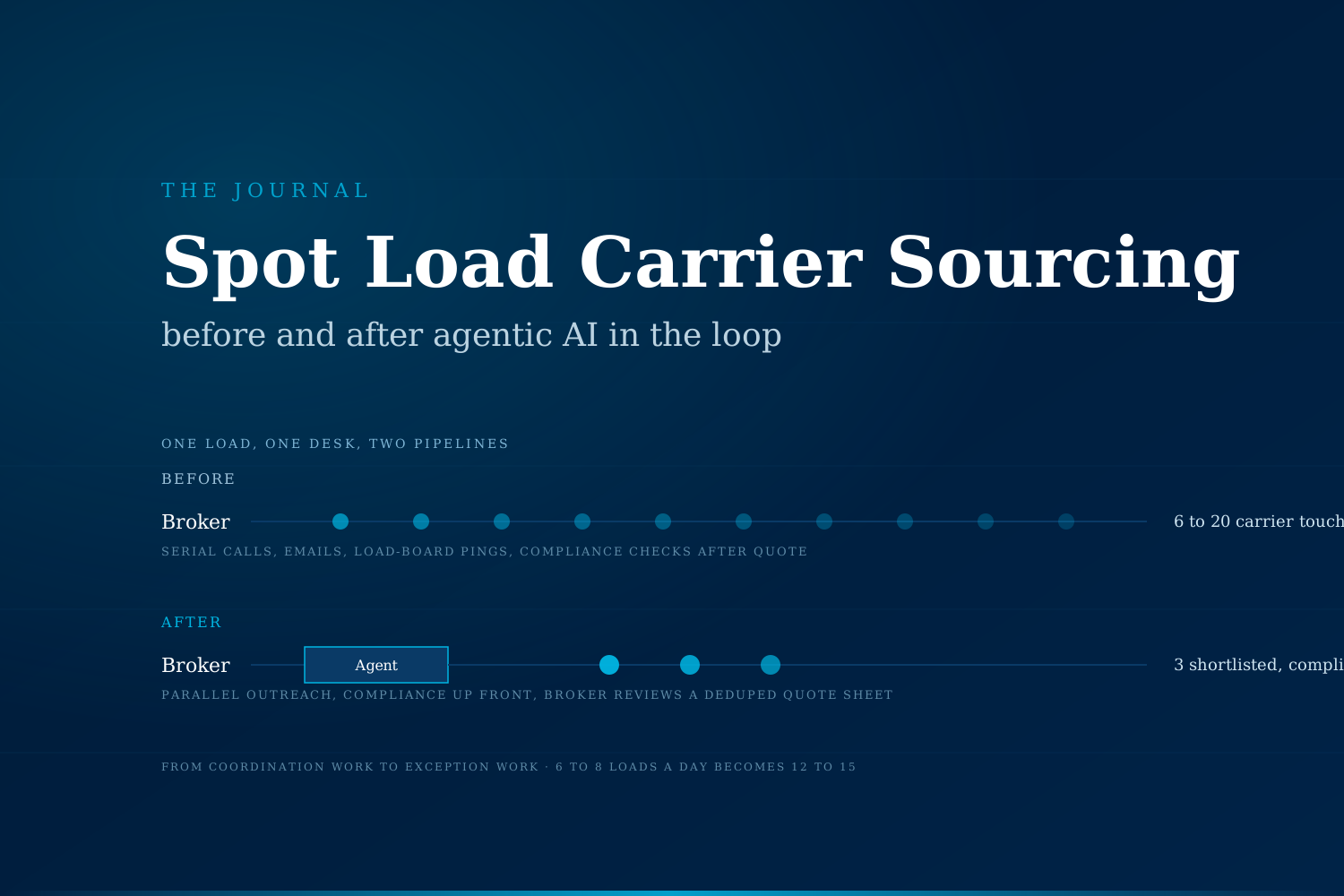
Spot load carrier sourcing is the work of finding, qualifying, and confirming a truck for a single load on the open market. Done manually, it is a 30 to 90 minute round of load-board postings, phone calls, and email pings per load. With agentic AI in the loop, most of that round runs in the background and the broker only handles exceptions.
For mid-size FTL brokerages running on tight spot-market margins, the difference between those two workflows is no longer a small productivity gain. It is the difference between a desk that books 6 loads per rep per day and one that books 12 to 15, with the same headcount and a smaller error rate.
What is spot load carrier sourcing?
Every spot load follows the same shape. A shipper tenders a load to a broker. The broker posts it (or already had capacity in mind), works the phones and the load board, gathers two or three viable carrier quotes, runs compliance checks, and confirms one. The clock between "load tendered" and "carrier confirmed" is the sourcing window.
For contract freight that window is hours. For spot freight, it is often minutes. The brokerage that confirms a carrier first at the right rate is the one that wins the load. Everyone else gets the leftovers, or worse, gets the load back at a worse rate after the original carrier falls through.
Why is manual spot sourcing so expensive?
The work itself is not complicated. The cost comes from how much of it is repetitive coordination, and how it scales with desk volume.
A typical mid-size broker covering FTL spot loads will:
- Touch 6 to 20 carriers per load (depending on lane density), per the Transportation Intermediaries Association's broker operations surveys.
- Spend 3 to 8 minutes on each carrier touch, between dial time, qualification, and the back-and-forth on rate and equipment.
- Re-run the same FMCSA, insurance, and safety-rating checks for repeat carriers that should already be on file.
- Re-enter the same lane, equipment, and rate context into the TMS, the email thread, and the load-board posting.
DAT Trendlines and Truckstop's market reports have tracked a steady compression in average broker net margin on spot, from the mid-teens during 2022 toward the low double digits across 2024 and 2025. With margins thinner, the cost of every extra minute spent on coordination shows up directly in book-per-rep.
There is also a quieter cost. Many desks default to the same handful of carriers because cold-calling new ones takes longer than calling the rolodex. Capacity gets concentrated, rate leverage shrinks, and lane coverage on unfamiliar geographies suffers. The desk runs, but it runs narrower than it could.
What does an agentic carrier-sourcing workflow change?
Agentic AI does not replace the broker. It replaces the round trip.
When a load is tendered, an agent already has the lane, equipment, weight, pickup window, and shipper preferences in context. It surfaces a ranked shortlist of carriers from the brokerage's own historical data plus public load-board signals, weighted by recent on-time performance, lane familiarity, and last-quoted rate. It pings the top candidates through the channels each carrier actually responds on (some answer SMS in 30 seconds, others only respond to email, the agent already knows which). It runs the compliance checks before the broker sees the candidate, not after.
By the time the broker is at the desk, the work has moved one layer up. They are not chasing six carriers for quotes. They are reviewing three shortlisted carriers with verified compliance, a suggested rate band, and a recommendation. They confirm, negotiate, or override.
What we will not give away in this article is the carrier-scoring schema, the agent's tool stack, or the integration recipe with any specific TMS or load board. Those are the parts that take real engineering judgement on a per-brokerage basis, and pretending they fit in a blog post is how brokerages end up with a half-finished script and a worse desk than they started with. The point here is operational: what changes when the round trip is no longer your bottleneck.
Manual vs agentic-AI sourcing, side by side
| Step | Manual workflow | Agentic-AI workflow |
|---|---|---|
| Load arrives | Broker reads the tender, opens the TMS, mentally indexes lane and equipment | Agent ingests the tender, indexes lane, equipment, shipper history, target margin |
| Carrier shortlist | Broker scrolls the rolodex and posts to load boards, builds a shortlist by memory | Agent ranks carriers from historical performance, current capacity signals, and lane fit |
| Outreach | Broker phones, emails, and texts 6 to 20 carriers serially | Agent contacts the top candidates in parallel on each carrier's preferred channel |
| Compliance | Broker re-checks FMCSA, insurance, and safety after a carrier expresses interest | Agent runs compliance up front and drops non-compliant candidates before the broker sees them |
| Negotiation | Broker juggles rate offers across multiple inboxes and a notepad | Broker sees a deduplicated quote sheet with suggested rate bands and counter recommendations |
| Coverage | Time pressure pushes the desk toward familiar carriers | Time recovered lets the desk place loads with new and underused carriers |
| Outcome | 6 to 8 loads per rep per day, narrow carrier pool, repeat-carrier dependency | 12 to 15 loads per rep per day, broader pool, exception handling instead of coordination |
The work that remains is the work brokers should be doing in the first place. Building shipper relationships, negotiating edge cases, handling fall-throughs, and protecting margin on lanes the agent has flagged as non-standard.
When does agentic carrier sourcing pay back for a freight brokerage?
The math is mostly straightforward, and it does not require a 20-rep operation. The inflection point we see most often is somewhere between 4 and 25 brokers on the desk, where the volume of repetitive coordination has grown beyond what the back office can absorb but the brokerage has not yet reached the scale where a dedicated capacity-procurement team is justified.
A few directional signals from operators we have spoken with:
- Average loads-per-rep-per-day has plateaued for two or more quarters despite headcount adds.
- Compliance checks are happening at the wrong end of the workflow, after rate has already been negotiated.
- The same 30 to 50 carriers cover the majority of loads, even though the carrier database has thousands.
- Friday and end-of-month spikes still rely on a few senior brokers personally working the phones.
- New hires take longer than six months to reach the desk's average book per day.
Any one of those, on its own, is fixable with discipline. Two or three, persistent over quarters, usually points at a structural ceiling that headcount alone will not break through.
An agent that works a sourcing loop end to end is custom AI software, not a configuration of something you already licence: the limits on what it may do alone have to be written into the system itself. This desk's other pressure points are load board tab churn, carrier no-show re-coverage, and AI pricing engines on the quote desk.
Three signals you have outgrown manual sourcing
- A live load with eight viable carriers takes longer to confirm than the load itself takes to fall off the board. If a hot lane is moving faster than your sourcing process, the desk is leaving margin on the floor.
- Carrier turnover from your active pool is replacing itself, not expanding it. Brokerages that grow lane coverage need to be onboarding new carriers continuously. If new-carrier onboarding has flatlined, sourcing is the bottleneck.
- Your best brokers spend more time coordinating than negotiating. The expensive humans on a brokerage desk are paid to win rate conversations and protect margin. When most of their day is dial-and-update, the desk is paying premium wages for clerical work.
Curious what your sourcing desk is actually losing?
We run a completely free automation audit for freight brokerages and 3PLs that want a second opinion on where spot sourcing is leaking margin before committing to anything. No slide deck, no procurement gauntlet. We map your current carrier-sourcing flow, look at where the round trip is eating book-per-rep, and walk you through how the desk runs with an agentic layer underneath it.
Sami Raza
Software Developer & Technical Author
Sami Raza builds AI automation for logistics, DTC, and construction operations teams at ApexifyLabs, and writes about the operational failures that automation is actually worth pointing at.