Why Slow Broker Payment Terms Cost Spot Fill Rates
Freight brokerages paying carriers on 30 to 45-day terms lose first-call access to capacity. Fill rate slips, spot premiums rise, and margin compresses.
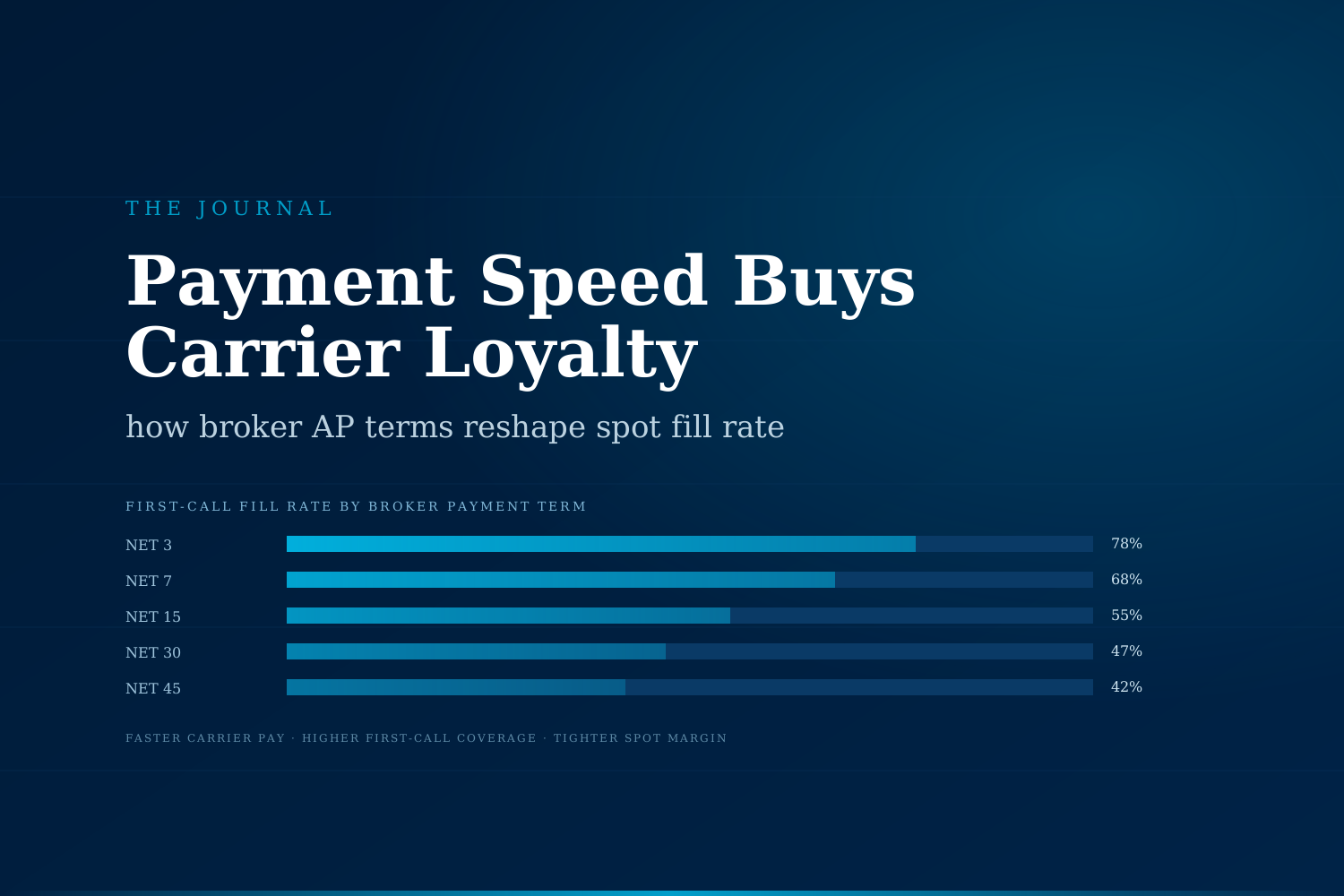
Fast carrier payment terms give freight brokerages first-look access to spot capacity, especially in tight markets. When brokers pay carriers within seven to fifteen days instead of thirty to forty-five, dispatchers push their loads to the top of the call queue, coverage costs drop, and fill rates rise. The economics are simple: cash speed buys carrier loyalty.
What Do Broker Payment Terms Mean for Carrier Fill Rates?
Payment terms are the number of days between a carrier delivering a load and receiving payment. Standard broker terms run thirty to forty-five days. Quick-pay programs settle in one to seven days, usually with a small fee that the carrier accepts in exchange for cash speed.
Fill rate is the share of booked loads that get covered by a carrier at target margin without escalation. When your dispatcher list ranks you low on their call sheet, the fill rate silently drops. You still cover the load, but you pay more for it or take longer to find a truck.
Fast-pay brokers land higher on that ranking. Carriers under $500K in trailing revenue, which describes most owner-operators and small fleets, treat cash cycle as a survival metric. Industry surveys of small-fleet carriers, published by trade associations and factoring providers, consistently show payment speed near the top of the factors that determine whether a broker gets a callback first.
Why Do Quick-Pay Brokers Win Spot Capacity First?
Small carriers run tight cash cycles. Fuel, insurance, and truck payments are weekly obligations. A carrier waiting forty-five days for one broker's payment while another broker pays in five will preference the second broker's freight, especially on repeat lanes.
This preference compounds. A dispatcher who books three fast-pay loads in a quarter builds a habit of calling that broker first when a truck is empty. In tight capacity weeks, when spot rates spike and the phone rings twenty times, the fast-pay broker gets the first ring back. The slow-pay broker gets the twentieth.
Factoring firms and quick-pay providers, who serve the same small-carrier segment, report that predictable cash cycle ranks above rate and load consistency as the reason carriers stay loyal to a specific broker. TIA-affiliated carrier surveys tell the same story from a different angle: net-45 relationships are the first to get dropped when a carrier's book fills up.
The effect is strongest on spot loads booked outside routing guides. Contract freight has volume commitments that pull dispatchers back regardless of pay speed. Spot has no such anchor. It runs on relationships, and relationships in trucking run on cash speed.
Where Does the Fill-Rate Cost Show Up on the P&L?
The cost is rarely obvious on a single load. It shows up as a series of small margin leaks across the quarter. The table below shows a pattern seen on brokerages that shifted from standard terms to quick-pay defaults on their carrier network.
| Metric | Standard Terms (Net 30–45) | Quick-Pay Defaults (Net 3–7) |
|---|---|---|
| First-call fill rate | 42%–55% | 68%–80% |
| Time to cover on tight days | 3.5–5.0 hours | 1.5–2.5 hours |
| Spot buy-rate premium vs target | 4%–7% | 1%–3% |
| Carrier repeat-lane rate | 22%–31% | 41%–58% |
| Broker net margin on spot | 8%–11% | 12%–16% |
Ranges aggregated from published carrier-experience benchmarks and freight marketplace reporting. Actual numbers vary with lane mix, seasonality, and market tightness.
The pattern is consistent. Fill rate is not just a service metric. It is a margin lever, and payment speed is one of the biggest inputs to it that a brokerage controls directly.
What Holds Broker AP Back From Moving Faster?
The slowdown is rarely a policy choice. Most brokerages want to pay carriers quickly. The blockers are operational.
- Manual POD collection. Payment cannot start until proof of delivery lands. When PODs sit in email inboxes, driver text threads, or scanned uploads that no one processes until Friday, the clock keeps running.
- Invoice reconciliation queues. Rate confirmations, invoices, and PODs need to match before AP releases funds. Manual line-by-line matching adds three to seven days on the average brokerage.
- Accessorial review. Detention, layover, and lumper reimbursement need approval. When the ops manager takes two days to sign off, that is two days of carrier waiting.
- Fraud checks on new carriers. A legitimate concern, but often layered on top of existing bottlenecks rather than run in parallel with them.
Each step is small on its own. Stacked, they turn a five-day cash cycle into a thirty-day one.
What Changes When Carrier Invoice Reconciliation Runs on AI-Augmented Flows?
Payment speed depends on how fast a broker moves from POD received to invoice approved to funds released. AI-augmented workflows collapse each of those steps by handling the repetitive matching, extraction, and validation work automatically. The dispatcher, ops manager, and AP clerk stay in the loop only on the exceptions.
The immediate effects, seen on brokerages that have made this shift:
- POD arrival is auto-detected across email, EDI 214 streams, and driver messaging apps. Nothing sits in an inbox waiting to be routed.
- Invoice line items are extracted and cross-checked against the rate confirmation. Matches auto-approve. Mismatches surface with the exact variance highlighted, so the human review is minutes, not hours.
- Accessorial claims like detention or layover pull the underlying tracking data automatically, so ops approves or declines with the evidence already attached.
- Carrier onboarding checks run in parallel with the first load, not sequentially before it, without loosening the compliance standard.
The compounding effect on the broker's spot desk is measurable. Fill rate on tight days climbs. Repeat-carrier percentage on target lanes rises. The spot buy-rate premium that used to feel like a fixed cost of covering hard freight starts shrinking.
None of this requires the broker to become a technology company. It requires the AP and ops workflow to stop treating fast payment as a special favor and start treating it as the default.
When Should a Brokerage Move to Quick-Pay as the Default?
Not every brokerage needs to shift. The move makes the most financial sense when the following are true:
- Spot freight is more than 25% of the load mix.
- Fill rate on the top ten lanes has drifted below 65% over the last two quarters.
- Carrier turnover on target lanes runs above 40% annually.
- AP has more than four full-time roles processing carrier invoices.
- Weekly buy-rate premiums over target exceed 4% on spot coverage.
If three or more of those describe the desk today, the payback horizon on tightening the payment cycle is usually inside two quarters. If none apply, the standard-terms model can hold, at least for now.
Is This the Right Time to Rethink the Carrier Payment Cycle?
If fill rate has been slipping, or dispatchers have been going quieter on spot inquiries, the pay cycle is worth a hard look. It is often the input change with the shortest path to a visible margin lift.
We run a completely free automation audit for freight brokerages that want a second opinion on where AI could compress the AP-to-carrier cycle without adding headcount. No commitment, no slide deck, no pressure. → Book the audit
Sami Raza
Software Developer & Technical Author
Sami Raza builds AI automation for logistics, DTC, and construction operations teams at ApexifyLabs, and writes about the operational failures that automation is actually worth pointing at.