Retainage Aging: The Slow-Cash Cycle on Mid-Size GCs
Retainage aging can tie up millions on a mid-size GC's balance sheet. Here's what it costs and what changes when tracking moves off a monthly spreadsheet.
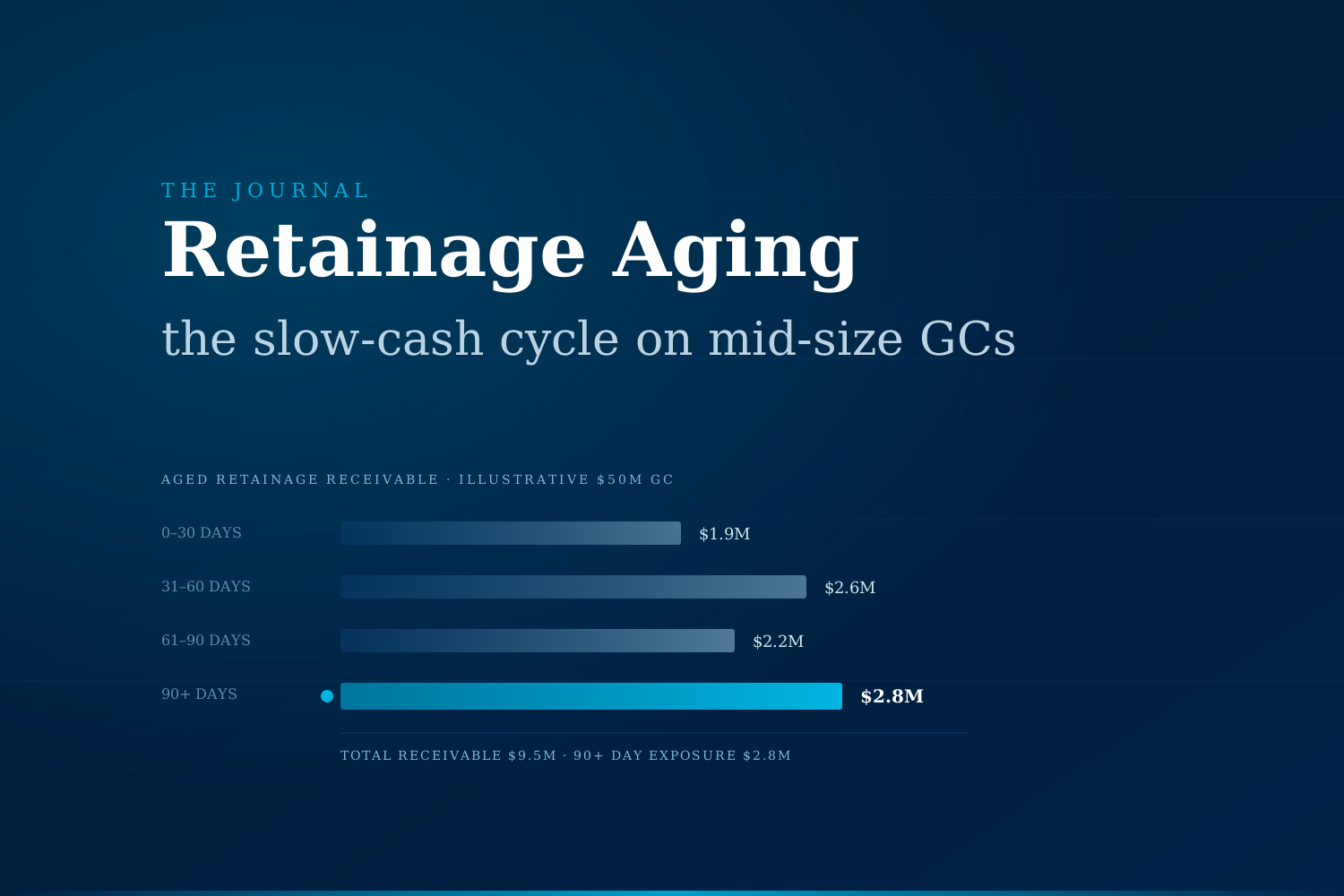
On a mid-size general contractor, retainage rarely gets the same attention as accounts receivable, but it is one of the slowest cash lines on the books. Between five and ten percent of contract value sits with the owner until closeout is complete, and industry surveys place the average collection cycle at sixty to ninety days after substantial completion.
What is retainage aging on a GC's books?
Retainage is the portion of each progress payment an owner holds back as security for final completion. Standard AIA contracts use five percent. State public works commonly use ten percent. That withheld amount stays on the general contractor's balance sheet as a retainage receivable, accumulating across every open job while those jobs move through their final phases.
Retainage aging measures how many days pass between the point where the owner is contractually free to release the balance and the point where the money actually clears into the GC's operating account. On a well-run project, the answer is around thirty days after substantial completion. According to Construction Financial Management Association benchmarking, the industry average sits closer to sixty to ninety. On projects with complex closeout requirements or slow public owners, one hundred twenty days is not unusual.
The number itself does not appear on most weekly operating reports. That is part of the problem. It sits between operations and accounting, and neither side owns it end-to-end.
Why does retainage move slower than regular receivables?
Regular progress billings run through a defined pay-application cycle, usually thirty days. Retainage does not. It sits behind a long list of closeout deliverables that must all clear before the owner is willing to cut the final check. A typical trigger list includes:
- Final punch list signed off by the owner and architect
- As-built drawings delivered and approved
- Operations and maintenance manuals compiled and delivered
- Warranty letters filed for each installed system
- Certificate of Occupancy issued by the local authority
- Final lien waivers collected from every subcontractor and material supplier
- Consent of surety received
- Final change orders processed, executed, and reconciled
Every item on that list depends on a different party. The architect signs punch. The municipality issues the CO. Subs return lien waivers. The surety writes consent. The owner approves as-builts. Any single item can stall the whole release. A recent Levelset construction payments report found that closeout-related payment delays are the top contributor to construction cash flow strain, ahead of change-order disputes and progress-billing rejections.
Most of the aging on a mid-size GC's retainage report is not owner resistance. It is a handful of small hand-off delays compounding across the closeout phase.
What does the current process look like on a typical GC's desk?
At most mid-size GCs, retainage tracking lives in the project accounting system, which shows the outstanding balance but says nothing about what is holding it up. The project manager knows the job is closing out. The controller knows retainage is due. The gap between those two views is where cash quietly ages.
The manual workflow tends to run on a monthly rhythm. Someone in accounting pulls an aged retainage report, walks it over to operations, and asks project managers for status on each stuck project. Project managers reply when they can. Some items get chased down. Others get forgotten. Next month's report looks a lot like last month's.
The report is accurate. That is not the issue. The issue is that reading it does not tell anyone what to do next.
Manual retainage follow-up vs AI-augmented tracking
| Dimension | Manual monthly review | AI-augmented tracking |
|---|---|---|
| Update cadence | Monthly aged report, ad-hoc chases in between | Daily status view, blocking-item pane per project |
| Blocking items | Buried in email threads and PM memory | Surfaced automatically as each trigger opens or clears |
| Owner communication | Reactive, request-driven, chased manually | Prompted the day the last trigger clears |
| Sub lien-waiver chase | Manual list per project, called one at a time | Auto-tracked against every signed subcontract |
| Aged retainage report | Same layout every month | Movement view: what shifted this week, what stalled |
| Cash flow forecasting | Estimated by the CFO from history | Modeled off live document and status data |
The comparison is not tool versus tool. It is a different operating posture. In the manual world, retainage is a static balance the accounting team watches age. In the AI-augmented world, retainage is an active pipeline with a next action attached to every dollar.
Where does this show up on a CFO's numbers?
On a mid-size general contractor running forty to eighty million in annual revenue, retainage receivable often sits between three and seven million at any given moment. Aged retainage past ninety days commonly falls in the one to three million range. That is money the CFO cannot lever, cannot bond against efficiently, and cannot deploy into working capital for the next project.
CFMA's Financial Benchmarker consistently shows that GCs which push their average days-to-collect-retainage below sixty carry stronger current ratios and lean less on their line of credit at comparable revenue levels. Days-to-collect-retainage is quiet enough to slip past a normal financial review. It is also one of the highest-leverage numbers on a construction balance sheet, because the collection cycle multiplies against every open project at once.
Put simply, cutting fifteen days off the average retainage cycle at a fifty-million-a-year GC frees up meaningful working capital without adding a single new project.
Three signs the retainage cycle needs a fresh look
- Aged retainage over ninety days is climbing quarter over quarter, even as revenue holds flat. Growth in aged balance without revenue growth is a process signal, not a business signal.
- The accounting team can produce an aged report, but nobody in operations can explain why any specific balance is still open. That gap between "we know what is outstanding" and "we know why" is where cash gets stuck.
- The company is drawing on its line of credit to fund payroll during the last week of a project's closeout month. If closeout cash was moving, it would land before the draw was needed.
None of these signals is unusual on its own. All three showing up together is the shape of a follow-up loop that has become expensive without anyone flagging it.
When is it worth solving?
Retainage aging is worth a serious look when two thresholds cross at once. The first is dollar magnitude, typically north of two million sitting in aged receivable. The second is diagnostic gap, meaning nobody on the team can walk a CFO through the specific reason each stalled balance is still open. When both are true, the problem is not accounting hygiene. It is an operational visibility problem that happens to land on the balance sheet.
The closeout process generates enough structured signal to make this tractable. Punch walks produce documents. Lien waivers produce documents. CO issuance, warranty letters, as-builts, consent of surety, and final change orders all produce documents. When those signals feed the same view that shows retainage balances, most of the aging collapses on its own, because the follow-up loop becomes obvious. What used to be a monthly conversation about aged balances becomes a daily view of what needs to move today.
None of this requires ripping out the accounting system. Most of the useful data already exists. It just is not being read alongside the balance it explains.
Curious what your own retainage aging looks like?
We run a completely free automation audit for GCs that want a clearer picture of where closeout cash is actually stuck, and what an AI-augmented follow-up loop would look like against their real project mix. No slide deck, no pitch. → Book the audit
Sami Raza
Software Developer & Technical Author
Sami Raza builds AI automation for logistics, DTC, and construction operations teams at ApexifyLabs, and writes about the operational failures that automation is actually worth pointing at.