Recovering Billable Hours from T&M Ticket Backlogs at GCs
Mid-size general contractors leave real revenue inside unreconciled time and materials tickets. The work happens, the paperwork slips, the margin disappears at month-end.
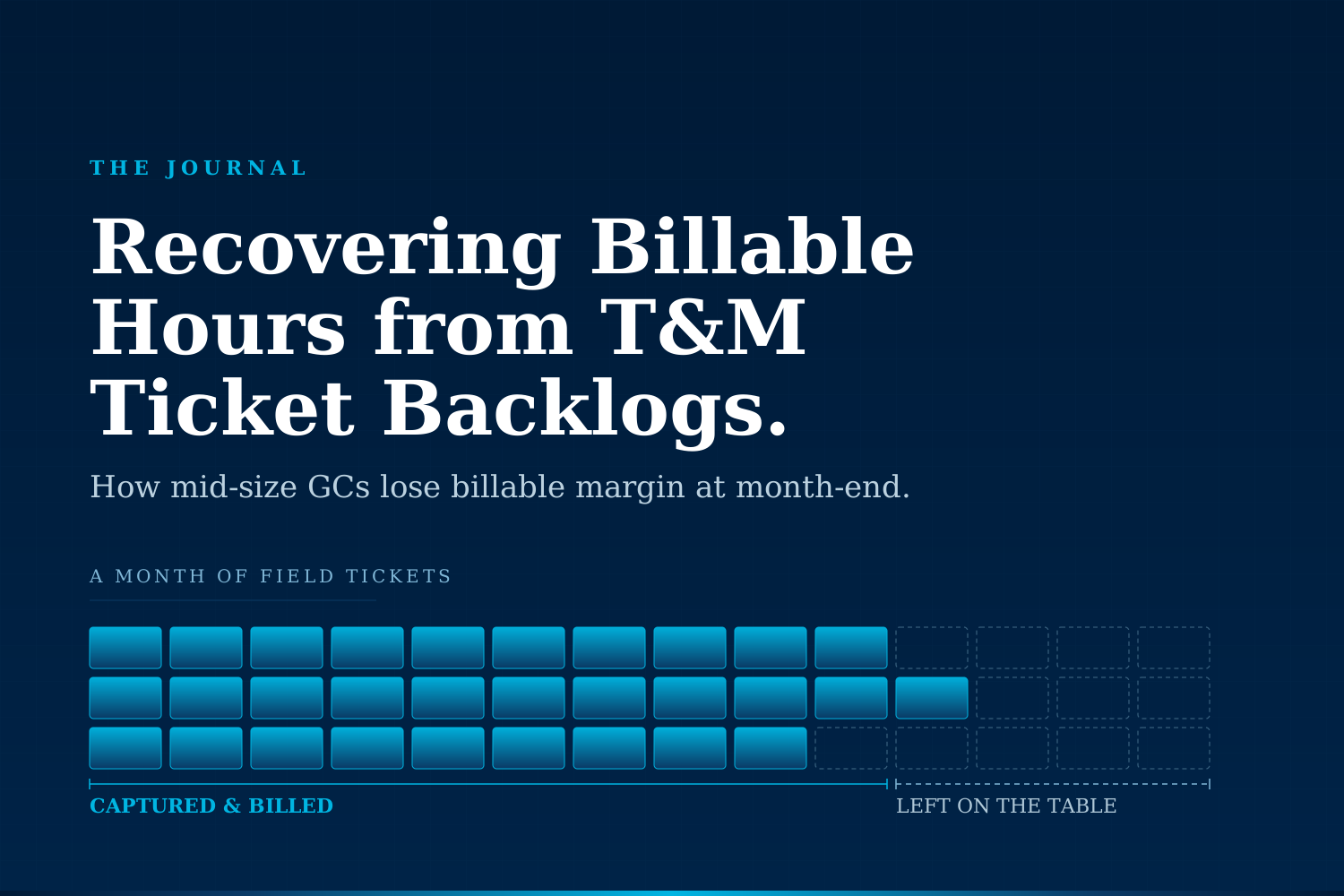
Time and materials tickets are how general contractors bill owners for work outside the base contract scope. On mid-size projects, a meaningful percentage of those tickets never get recovered, not because the work was not done, but because the paperwork around them slipped. The cost lands directly on the GC's margin.
What is a T&M ticket and why does it create a backlog?
A time and materials ticket is the field-level record of work performed outside the base contract, usually under a change directive, allowance, or owner-directed extra. A typical ticket lists labor hours by trade, equipment used by the hour, materials installed, and a foreman's signature. The owner's representative is supposed to sign that ticket the day the work happens.
That is the design. The reality on most mid-size jobs is messier. Field tickets get written on carbon-paper pads, photographed and texted in, or scribbled in a foreman's notebook and typed up later. The owner's rep is in the trailer at the moment of the work and signs it next Tuesday, or not at all. Three weeks later, the project engineer is trying to reconcile a stack of half-signed tickets against the foreman's daily reports, the equipment logs, and the subcontractor invoices that just landed.
That gap between when the work happens and when it becomes a defensible billable line is the backlog. It is small on day one and large by month six.
Why do mid-size GCs lose money on T&M work?
A handful of failure modes recur on almost every project:
- Tickets written but never signed. The foreman did the work, the labor cost is real, but no owner signature means no billable backup. The GC eats it.
- Tickets signed but lost. Paper tickets in a field office migrate to a glove box, then a job-trailer drawer, then a banker's box. By billing time, the ticket cannot be found.
- Tickets submitted past the cutoff. Many owner contracts have a 7 or 14-day notice clause. Miss it and the right to bill is technically waived. Some owners enforce strictly.
- Tickets unsupported by daily logs. Owners increasingly ask for daily report excerpts, photos, and timesheets to validate ticket lines. If the daily report does not reference the extra work, the ticket gets contested.
- Tickets folded into a re-priced change order. A pile of T&M tickets sometimes gets converted to a lump-sum change order downstream. In the negotiation, the GC concedes the unrecovered fringe to close the order.
None of these are exotic. They are routine, low-grade leakage. They show up at month-end as a billable number lower than the project engineer's pipeline projection.
How much revenue typically gets stranded in unreconciled tickets?
Hard to source precisely, because few GCs publish ticket-level recovery rates. The directional numbers from industry research are consistent, though.
The Construction Financial Management Association (CFMA) Annual Financial Survey has tracked unbilled costs and dispute-driven write-offs at general contractors for years. Their reporting shows that net pretax margins for general contractors typically sit in the low single digits, often between 2% and 4%. Any leakage on a billable revenue stream lands directly on that thin margin.
Industry coverage of change order disputes, including data summarized in Dodge Construction Network research and Engineering News-Record reporting, has consistently identified disputed or lost change-order recovery as one of the larger margin compressors on mid-size projects. T&M tickets sit upstream of that fight, because a missing or unsigned ticket means there is nothing to dispute in the first place. The cost is silent.
A working estimate that tracks with field interviews from project accountants: on a 12-month, 20 million dollar GC project, an unrecovered ticket leakage of 1% to 2% of T&M revenue is not unusual. On a portfolio of jobs, the number compounds. For a 200 million dollar annual revenue GC running a 6% to 8% T&M mix, that is six-figure territory, every year, hiding in plain sight.
What does a closed-loop T&M cycle look like?
Compare the typical current state on a busy mid-size project with what the same workflow looks like when it is actively tracked and closed weekly.
| Step | Current state on most mid-size projects | What a closed-loop cycle looks like |
|---|---|---|
| Ticket creation | Handwritten in the field, often illegible | Digital capture at the source, photo plus structured fields |
| Owner sign-off | Chased manually, sometimes verbal | Sent same day, with a 48-hour acknowledgement window |
| Backup attachment | Pulled together at month-end | Auto-linked to the same day's daily report and crew timesheet |
| Notice-clause compliance | Tracked by memory | Tracked against contract terms, flagged before the cutoff |
| Reconciliation | A project engineer reads paper for two days | A short exception list, reviewed in an hour |
| Billing readiness | A 30 to 45 day lag is common | Same billing cycle as the work |
The point of the comparison is not the digitization. Plenty of GCs already have a ticket app of some kind. The point is closing the loop: every ticket has an owner action attached, every ticket has its backup attached, and the project engineer is reviewing exceptions instead of doing data entry.
Where does AI shift the burden on a busy project?
AI does not replace the foreman, the project engineer, or the owner's rep. It removes the work that sits between them, which is mostly chasing, matching, and assembling. Three specific places where the lift shows up:
- Source capture and validation. A foreman dictates the day's extra work, the system structures it into a ticket draft, flags missing crew names or equipment IDs, and routes it for signature before the foreman has driven off the site.
- Cross-document matching. The same system pulls the corresponding daily report excerpt, the timesheet entries for the listed crew, and the equipment usage log, and assembles them as a single billable package the owner can accept without follow-up.
- Cutoff and exception monitoring. Notice clauses, by contract, get tracked. The project engineer gets a short list each Monday: tickets pending owner signature past the cutoff, tickets missing backup, tickets where the foreman's hours do not match the timesheet. Everything else is already clean.
The shift is from a project engineer who spends two days a month reconciling paper to one who spends an hour a week reviewing exceptions and nudging the few owners who are slow to sign. The recovered hours go back into the actual job.
Three signs the T&M cycle is leaking
If the project team cannot answer yes to all of these, the ticket cycle is probably losing money.
- Can you say, today, how many T&M tickets are sitting unsigned across active projects, and how old each one is?
- For tickets billed last month, did each one ship with a matched daily report excerpt and timesheet backup?
- Was every ticket submitted inside the contractual notice window, by clause?
A clean answer to all three is rare on mid-size GCs without a deliberate system. That is normal. It is also the cleanest place to recover margin the team already earned.
A short word on what we will not give away here
We do not publish the specific stack, model, or workflow that takes a project from the current state to the closed-loop one. Every project's contract terms, owner rep relationship, and existing software footprint shape the build. A generic recipe ships generic results, and we have seen enough generic systems fail to know the difference matters.
What we will tell a project team in a free audit is exactly which step in their current cycle is leaking the most, what the recovery would be worth on their portfolio, and whether the problem is worth solving with automation at all. Some projects do not need it. Some need it badly.
If T&M reconciliation feels like an end-of-month archaeological dig on your projects, we run a completely free automation audit for mid-size GCs. No slide deck, no commitment. We will read the cycle, point at the leaks, and tell you what a fix would be worth. → Book the audit
Sami Raza
Software Developer & Technical Author
Sami Raza builds AI automation for logistics, DTC, and construction operations teams at ApexifyLabs, and writes about the operational failures that automation is actually worth pointing at.