How Promo Code Stacking Drains DTC Campaign Margin
Welcome, loyalty, and affiliate codes often layer onto the same DTC order. Where the missing margin actually goes after the cart accepts them all.
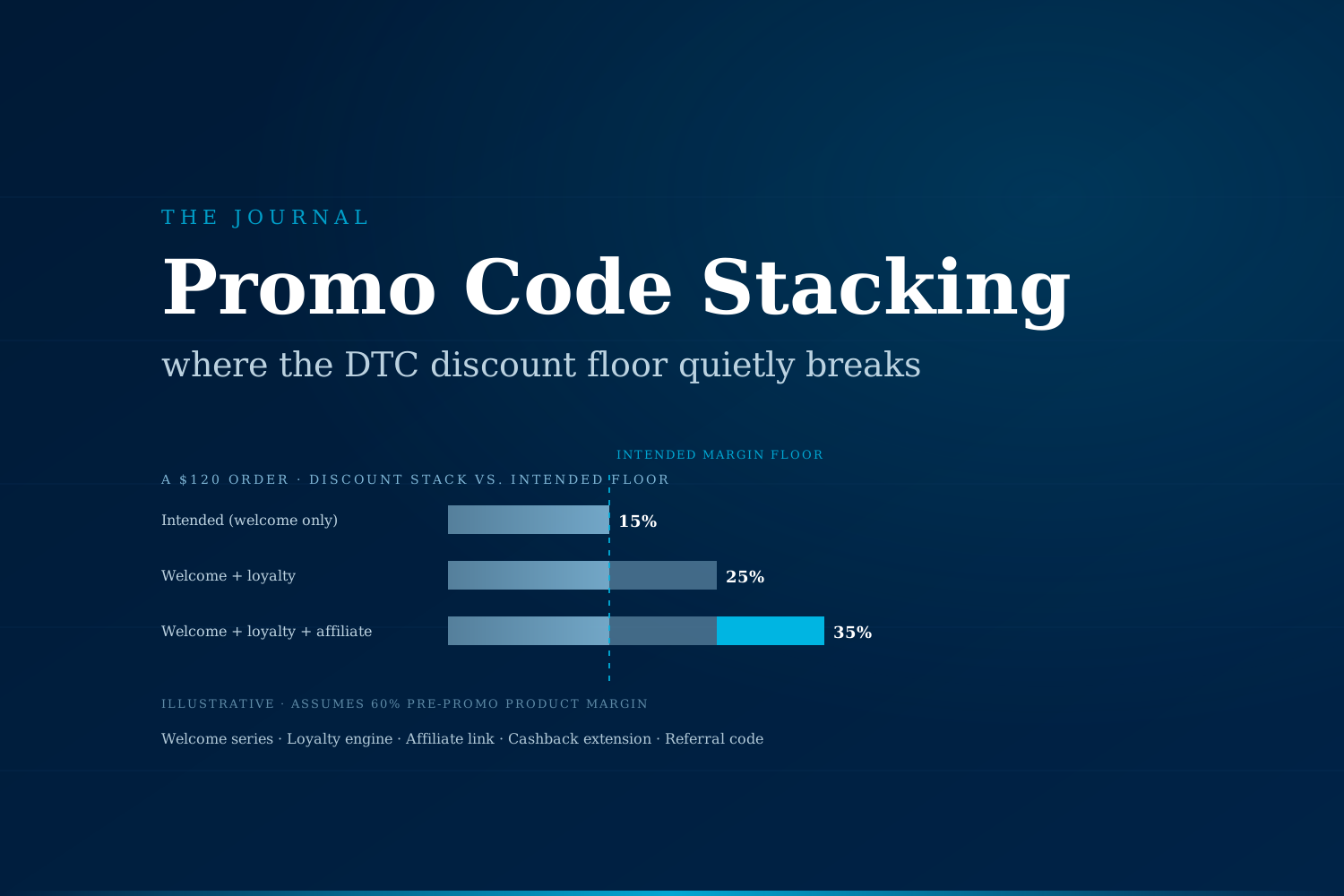
Promo code stacking, where a single DTC checkout applies a welcome code, a loyalty discount, and an affiliate link all to the same order, is one of the quieter sources of margin leak in e-commerce ops. The cart often allows it by default, finance rarely audits it line by line, and the actual cost shows up months later in the campaign profitability review.
This article looks at how stacking happens in a typical DTC checkout, why the cart accepts it, where the missing margin actually lands across discount lines and commission lines, and what changes when an AI-managed layer enforces the stacking rules in real time.
What does promo code stacking actually look like on a DTC order?
A standard DTC checkout receives a code from at least three places.
- The brand's welcome email series ships a first-purchase code, usually 10 to 15 percent.
- The loyalty or referral program assigns a returning-customer code, often a tiered percentage or a flat dollar amount.
- An affiliate, creator, or cashback partner shares a tracked link, which silently injects a third code at checkout. Some of those codes arrive through browser extensions the shopper installed months ago and forgot about.
A cart that does not enforce a strict one-code-per-order rule will accept all three. The shopper sees the stacked total, the brand fulfills the order, and the marketing dashboard sees three different attribution sources each claiming credit for the same sale.
The order itself looks normal in the order-management system. The leak shows up later, in the gap between the campaign's intended discount floor and the actual realised margin once commissions, free shipping, and stacked discount lines are netted out.
Why does the cart accept stacked codes in the first place?
Most DTC stacks land in one of three configurations, and each one leaves a different door open.
| Cart configuration | What it allows | Where the leak shows up |
|---|---|---|
| Single code field, no rule engine | One code typed in, link-based code applied silently underneath | Discount line doubles, finance sees the stack only at month-end |
| Multi-code field, soft rules | Any combination of welcome, loyalty, and affiliate codes | Margin floor breached on the heaviest discount day of the campaign |
| Single code field, strict rules but with link overrides | Link-injected affiliate codes bypass the rule because they are applied as automatic discounts | Affiliate commission paid on a sale the welcome code already discounted |
The third configuration is the one most operators miss, because the cart UI shows a single code in the field while a second discount is being applied underneath through a link-based automatic discount object. The order looks clean. The discount math does not.
Industry surveys on DTC checkout configurations consistently report that the share of brands with a strict, audited single-code rule sits well below half, while the share running multiple discount engines (loyalty, referral, affiliate) in parallel keeps climbing as those channels mature.
Where does the missing margin actually go?
Take a single $120 order with a 60 percent product margin before promotion. The intended campaign discount is 15 percent. Here is how the same order can look after a quiet stack.
| Line | Intended order | Stacked order |
|---|---|---|
| Order subtotal | $120.00 | $120.00 |
| Welcome code (15%) | $18.00 off | $18.00 off |
| Loyalty code (10%) | not applied | $10.20 off |
| Affiliate code (10%) | not applied | $9.18 off |
| Net revenue | $102.00 | $82.62 |
| Affiliate commission (15% of net) | $0 | $12.39 |
| Free-shipping cost | included | $7.50 |
| Realised gross margin | $42.00 | $11.13 |
The intended margin held at roughly 35 percent of net. The stacked margin landed near 13 percent. The order shipped, the customer was happy, and the campaign report still showed a "15 percent code" promotion.
This is not a hypothetical from a tutorial. It is the math that surfaces in DTC finance reviews when a single quarter of campaign orders gets pulled and reconciled against intended discount rates. Industry benchmark reports on DTC promotional spend have flagged double-digit growth in promotion expense as a share of net revenue for several years running, and code stacking is one of the lines inside that growth.
Why does this leak survive the dashboards?
Three structural reasons keep stacking off most ops radars longer than it should be.
- The order-management system records each line correctly but does not flag the combination as a policy violation. There is no exception queue for a stacked order, because nothing technically went wrong.
- The marketing dashboard groups discount by code, not by order. A single order with three codes shows up in three different code-level reports, with each report looking healthy on its own.
- Affiliate platforms attribute on last click by default. A welcome-coded order with a cashback extension applied at the last second routes the commission to the extension, even when the brand never intended that path.
The leak is real, the data is in the warehouse, and no single team owns the cross-line view. Finance sees discount expense. Marketing sees campaign performance. Affiliate sees commission payouts. The order ops team sees fulfilment. The discount floor breach lives between them.
What signals usually mean a DTC brand is bleeding margin to stacked codes?
Three operational signals tend to mean the math has already shifted in favor of a closer look.
- A growing share of orders where the realised gross margin sits more than 5 percentage points below the campaign's intended floor.
- A widening gap between the campaign's named discount rate (for example, 15 percent off welcome) and the average realised discount per order in that campaign.
- A persistent share of affiliate-attributed orders where a brand-issued code was also redeemed on the same order.
The tighter those signals get, the more likely the brand is paying through three discount engines on the same shopper without the policy intent ever sanctioning it.
Sourced benchmark studies on affiliate-extension behavior, including coverage of cashback and coupon browser extensions, have shown that a meaningful share of affiliate-attributed orders is intercepted at the last click by an extension installed for a different purpose. The exact share varies by category, but the pattern is consistent enough that most DTC affiliate program audits find some level of last-click hijack worth quantifying.
What changes when an AI-managed layer holds the stacking rules?
The interesting outcome is not a brand that bans every code combination. It is a brand that decides, on purpose, which combinations are sanctioned and which are not, and then has a layer that enforces that decision at checkout, at attribution, and at commission payout.
That layer does three things that no single team currently owns end to end.
- At checkout, it reads every code, every link-injected discount, and every active loyalty rule on the shopper's account, then applies the policy the marketing team actually wrote.
- At attribution, it routes credit to the partner the brand actually wants to compensate, instead of defaulting to last click or first click without policy oversight.
- At reconciliation, it flags any order where the realised discount, commission, and shipping total exceeded the campaign's intended floor, and groups those flags by code combination so the policy can be tightened on the next campaign.
That is the change. Not a brand running fewer promotions. A brand that knows, for every order, what discount engines were active, which combinations were sanctioned, and what the campaign was meant to cost in the first place.
A note on what AI does not solve here
It does not pick the brand's promotional calendar, set the welcome-code rate, or negotiate the affiliate commission percentage. Those are still leadership and marketing decisions. What it does is take the policy the team has already written and enforce it consistently at every cart, in every channel, on every order, so the campaign that ran at the intended floor is the campaign that gets reported at month end.
Where this lands for a DTC brand thinking it through
Promo code stacking is one of those lines that looks invisible at any single order and material across a quarter of orders. The brands that get hurt are rarely the ones with no promotion strategy. They are the ones that grew their welcome, loyalty, and affiliate programs in parallel, then never closed the loop on the rules between them as each program scaled.
We run a completely free automation audit for DTC ops teams that want a clear read on how often their carts are stacking past the intended discount floor, and how much realised margin is sitting under that gap. No commitment, no slide deck, no upsell. → Book the audit
Sami Raza
Software Developer & Technical Author
Sami Raza builds AI automation for logistics, DTC, and construction operations teams at ApexifyLabs, and writes about the operational failures that automation is actually worth pointing at.