Parcel Surcharge Refunds DTC Brands Never Claim
Most mid-size DTC brands pay UPS and FedEx invoices in full and never file a refund. The recoverable money is real, time-bound, and routinely left behind.
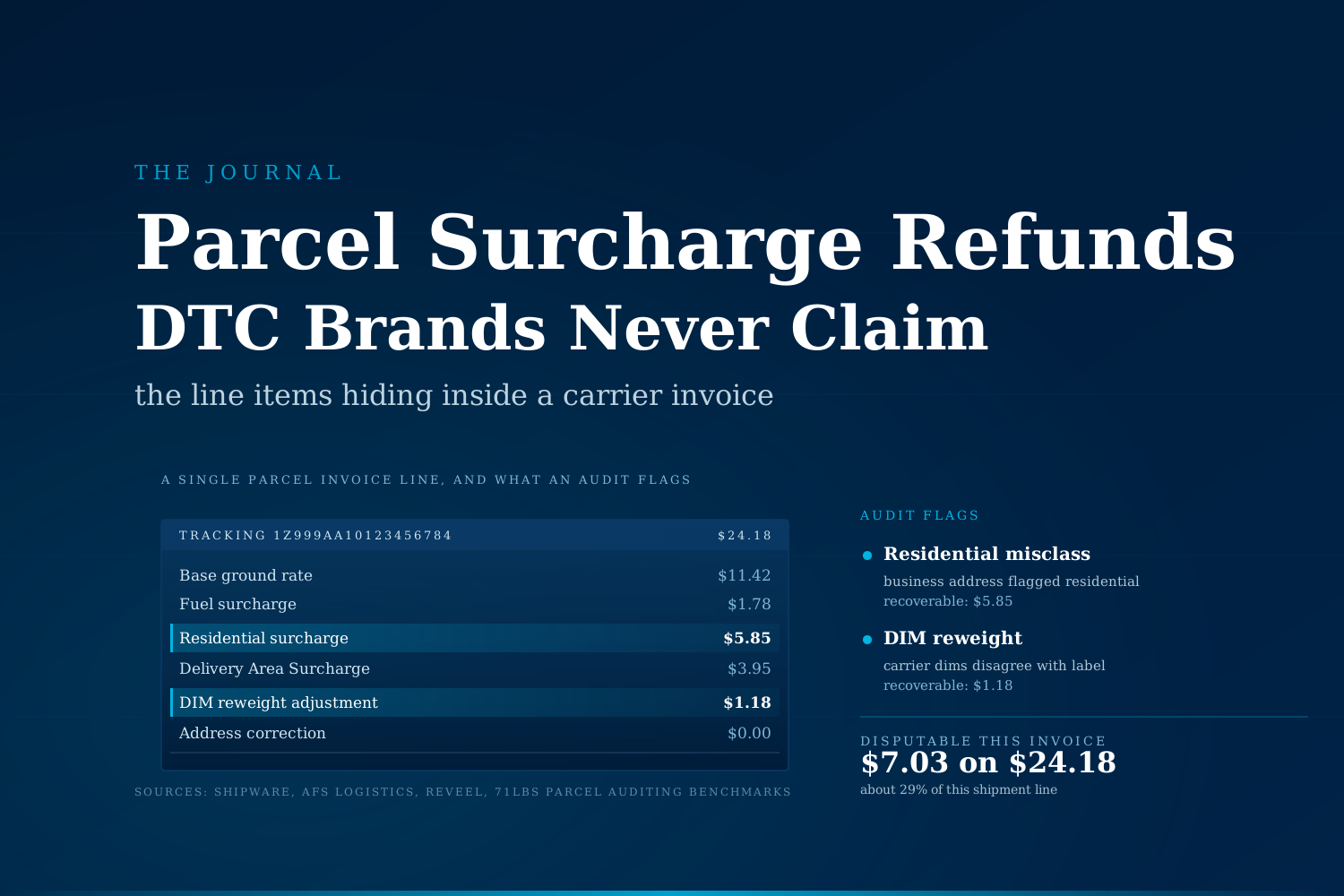
Mid-size DTC brands typically lose 2 to 5 percent of their annual parcel spend to surcharge errors that never get disputed. The invoices look normal, finance approves them, the audit window closes. AI-augmented parcel auditing flags the recoverable line items inside that window, without adding headcount to a finance team that already has none.
What's actually inside a parcel carrier invoice?
A UPS or FedEx invoice for a $15M DTC brand carries thousands of shipment records per cycle. Each shipment lists a base rate and a stack of optional charges that depend on the destination, package profile, and service level. Most finance teams see the totals at the top, sign off, and move on. The recoverable money lives several layers deeper, in the line items.
A typical parcel shipment can attract any of the following charges:
| Charge category | Why it shows up | Common error mode |
|---|---|---|
| Fuel surcharge | Indexed weekly to diesel | Applied at the wrong tier or twice |
| Residential surcharge | Address flagged as home | Misclassified business shipment |
| Delivery Area Surcharge (DAS) | ZIP outside metro tier | DAS-extended applied when only DAS applies |
| Large package surcharge | Exceeds size threshold | Misapplied to standard parcels |
| Dimensional weight (DIM) | Volume-based billing | Reclassified higher than actual dims |
| Address correction | Carrier reformats address | Charged when address was already valid |
| Signature required | Service add-on | Charged when not requested |
| Saturday delivery | Premium service | Charged when delivered Friday |
Industry consultants who specialize in parcel auditing (Shipware, AFS Logistics, Reveel, 71lbs) consistently report that the average mid-market shipper recovers between 2 and 5 percent of total parcel spend when invoices are systematically audited. For a brand spending $1.8M a year on UPS and FedEx, that is $36K to $90K in recoverable refunds that simply do not get claimed.
Why DTC brands rarely audit their parcel invoices
The economics of internal auditing fail at this revenue band. A finance lead at a $15M brand is already closing month-end, managing AP across multiple 3PLs, and supporting the founder on cash flow forecasting. Manual parcel auditing requires reading every shipment's metadata, cross-checking against the carrier's published tariff, identifying misclassifications, and filing each dispute through the carrier's portal. The work is high-volume and low-signal.
Three structural reasons the audit gets skipped:
- Invoice cadence. UPS and FedEx bill weekly. A brand with 1,200 shipments a week generates roughly 60,000 shipment records a year, each with five to twelve line items. Nobody on the finance team has time to read that.
- Dispute windows. Carrier dispute terms typically allow 15 to 30 days from invoice date. Once that window closes, the refund is permanently lost, regardless of how clear the underlying error is.
- 3PL pass-through opacity. Brands using a 3PL or fulfillment partner often see consolidated invoices that bundle the carrier's underlying line items into summary categories. The detail is there if you request it, but few finance teams know what to ask for, and fewer get a clean export from their 3PL.
The result is predictable. The refunds exist, the audit window passes, the money stays with the carrier.
What's actually recoverable, and what isn't
Not every line item on a parcel invoice is in play. The recoverable categories are well-defined and worth knowing before any audit work begins.
Recoverable in most cases:
- Residential vs. commercial misclassification, verified against USPS or third-party address data
- Dimensional weight reclassifications where the carrier's measurement disagrees with the shipper's
- Late delivery refunds, on lanes and services where the carrier's money-back guarantee still applies
- Duplicate billing on the same tracking number
- Address correction charges where the original label matched the carrier's own validated address
- Saturday or signature surcharges billed when the service was not requested
- DAS-extended applied to a ZIP that the carrier's own published tariff lists as standard DAS
Generally not recoverable:
- Fuel surcharges applied at the rate published for the week of shipment
- Accessorials the shipper genuinely incurred and acknowledged
- Negotiated rate exclusions that were always part of the contract
- Hazmat fees on legitimately classified shipments
The point of an audit is not to dispute every charge. It is to find the misapplied ones inside the carrier's own published rules and file them before the window closes.
What changes when AI handles the line-by-line scan
The shift is not about what gets audited. It is about whether the audit happens at all. For most $5M to $30M DTC brands, the choice today is binary. Either pay a third-party auditor (typically 30 to 50 percent of recovered refunds as a contingency fee) or absorb the loss internally. An AI-augmented workflow inside the brand's own stack changes that math.
Before:
- The carrier invoice arrives. Finance approves it for payment in full.
- Disputes filed: zero, or close to it.
- Refunds recovered on residential misclass, DIM reclass, late delivery, address correction: roughly zero.
- The annual recoverable spend, by the consultant benchmarks above, sits on the table.
After:
- The invoice arrives. An AI workflow ingests the shipment-level detail from the carrier's data feed, joins it against the brand's own shipping system (the addresses, dim weights, and service levels actually requested), and surfaces line items that do not match.
- Each flagged item is grouped by dispute category, packaged with the supporting evidence, and either auto-filed through the carrier's dispute API or dropped into a queue for finance to approve in one click.
- Recovery shows up on the carrier credit memo two to six weeks later.
- The finance team spent under an hour reviewing exceptions, not days reading invoices.
The change is not theoretical. The same logic that powers carrier-level auditing inside large 3PLs (Stord, ShipBob, Flexport's parcel arm) is now reproducible inside a brand's own ops stack. What used to be a service tier becomes a workflow.
What an ops team notices in month one
When an AI-augmented audit runs against a backlog of invoices still inside the dispute window, three patterns show up consistently:
- The recoverable percentage is higher than the brand expected. A 4 percent recovery rate on $1.5M of annual parcel spend is $60K. For most brands at this revenue band, that is a real number on the P&L, not a rounding error.
- Residential misclassification is usually the largest single category. Address databases shift. Business addresses get reflagged residential after a tenant change. The carrier defaults to charging the higher rate, and the dispute is mechanical once detected.
- Late delivery refunds are smaller in 2026 than they were pre-2020, but not zero. UPS and FedEx have narrowed their service guarantees significantly since the pandemic, and SMB-rate lanes carry fewer guarantees than they used to. Specific tiers (certain ground commercial under three days, certain express services) still carry refund eligibility. Brands that gave up on late delivery refunds in 2021 are leaving partial money on the floor.
The downstream effect is quieter than the headline number. Finance gets back the bandwidth that would have gone into manual reconciliation. Operations gets a clean data feed showing which lanes and which 3PL nodes are generating the most disputes, which is useful information well beyond the refunds themselves.
When this becomes worth doing
Two practical thresholds. If a brand is below about $750K in annual parcel spend, the recoverable dollar amount may not justify the effort, even automated. Above $1M in parcel spend the math starts to work cleanly. Above $3M, the audit pays for itself in the first quarter and then keeps paying.
The other gating factor is data access. The brand needs shipment-level invoice detail from the carrier, or from a 3PL willing to forward it. UPS and FedEx both provide this on request for direct shippers. For 3PL-fulfilled brands, the conversation with the 3PL is usually the first blocker. Worth having before the audit work begins.
What we are not covering here
This piece is not a build guide. We are not publishing the carrier API integration, the address-validation logic, the DIM reconciliation rules, the dispute templates, or the categorization model that makes a closed-loop audit actually work. Those are the engineering, and they are meaningfully different for every brand's carrier mix and 3PL setup. What this article is for: clarifying what the operational shift looks like, what the recoverable dollars typically are, and whether the underlying problem is worth solving on your desk.
If your DTC brand ships more than $1M a year through parcel carriers and has not run an invoice audit in the last 12 months, the recoverable refunds are probably sitting inside the dispute window right now. We run a completely free automation audit for ops-heavy DTC brands that want a second opinion before committing to anything. No commitment, no slide deck, just a look at where the leaks are and what is worth automating first. → Book the audit
Sami Raza
Software Developer & Technical Author
Sami Raza builds AI automation for logistics, DTC, and construction operations teams at ApexifyLabs, and writes about the operational failures that automation is actually worth pointing at.