When Marketplace Suppressions Halt DTC Sales for Hours
Marketplaces suppress DTC listings in minutes. Most brands notice hours later, through a sales dip. Where the observability gap lives and what it costs.
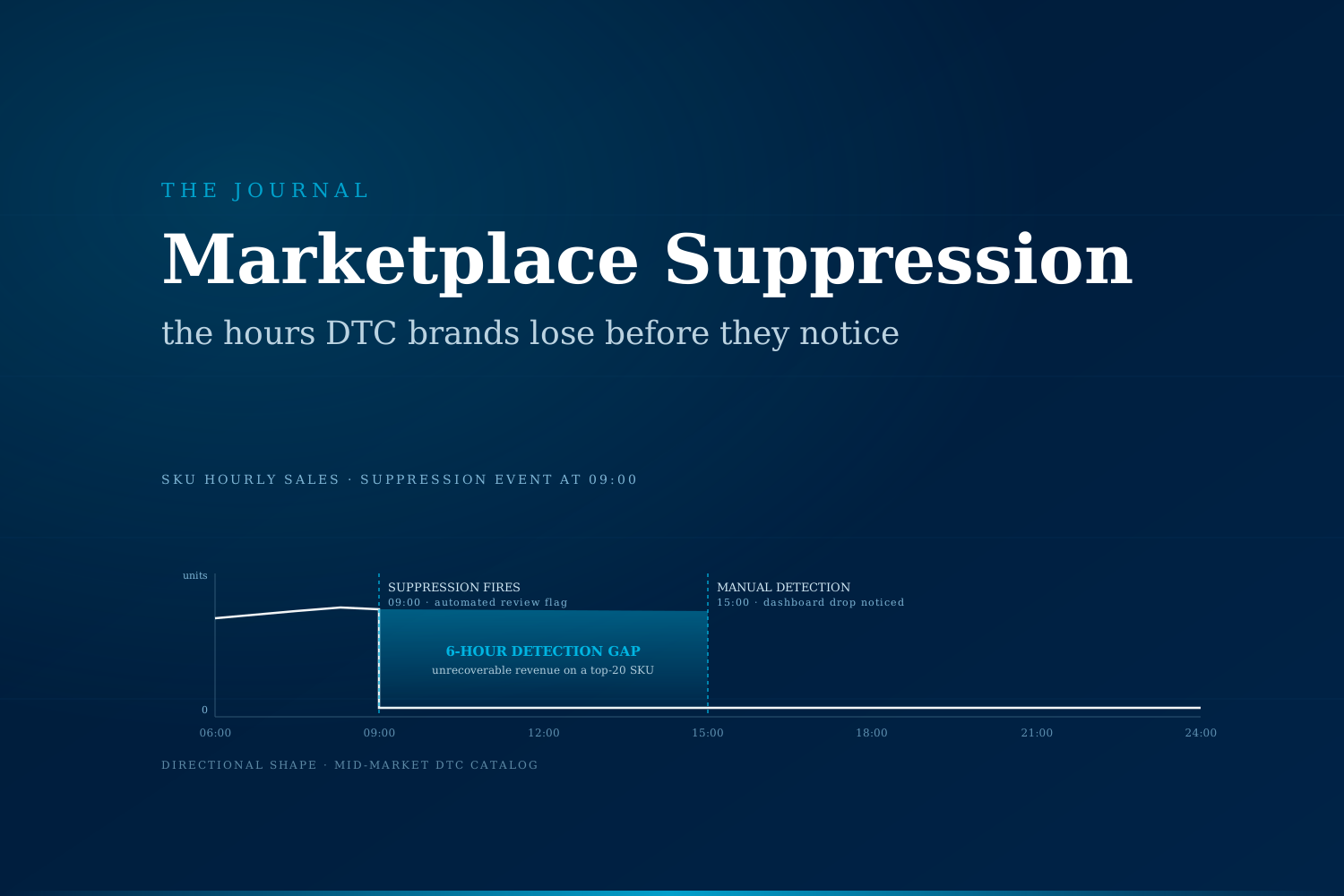
Marketplace suppression is when a platform such as Amazon, Walmart, or Target Plus removes or demotes a DTC brand's product from search results and buy-box eligibility, usually for a content, compliance, or attribute reason. Sales on that SKU drop within minutes. Most brands notice hours later, through a dashboard drop rather than an alert. That observability gap is where the revenue leak lives.
What is marketplace listing suppression?
Suppression is any platform action that makes a live listing effectively invisible to shoppers without permanently taking it down. The product still exists in the catalog, still has an ASIN or item ID, and still shows in the seller dashboard as active. It just no longer surfaces in organic search, no longer wins the buy box, or no longer appears in category browse.
The most common forms across the major marketplaces:
- Search suppression when the product falls below a required attribute completeness threshold.
- Buy-box loss when a compliance flag posts to the listing (recall, safety, regulated category).
- Image or A+ content pull when the platform's automated content compliance scanner rejects an updated asset.
- Category re-classification when the marketplace decides a product needs hazmat, adult, or restricted flags.
- Listing detail-page removal when a policy violation is filed by another seller or by the platform.
The common thread across all five is that they are effectively silent. The seller portal does not push a real-time alert. In some cases the notification lands in a message centre inbox that the ops team does not check daily. In others there is no notification at all until the seller opens the reports view.
Why does a suppression event happen without warning?
Marketplace enforcement is built for platform scale, not for individual seller responsiveness. Amazon's automated review process, Walmart's item setup validation, and Target Plus' partner catalog review each run continuous checks against millions of listings. When a rule trips, the action is applied immediately and the notification is queued in whatever async system the platform uses for seller communication.
Public seller documentation from Amazon and Walmart both describe suppression as an operational tool the platform can apply without notice for a range of catalog conditions. Third-party analyses from Marketplace Pulse and Feedvisor have observed that mid-market sellers routinely experience unannounced buy-box or search-visibility events, with typical detection lag of many hours when monitoring is manual.
For a DTC brand that treats a marketplace as one channel among many, the seller dashboard is not the first surface someone looks at every morning. It gets checked when Shopify orders slow, not before.
How long does it take a typical DTC brand to notice?
The detection lag depends on how the brand instruments its own dashboards. In practice:
| Monitoring posture | Typical detection lag | What triggers the check |
|---|---|---|
| No proactive monitoring | 24 to 72 hours | Weekly sales review, marketplace revenue drop noticed after the fact |
| Daily dashboard review | 6 to 18 hours | Ops opens the seller portal at start of shift, spots a suppressed SKU |
| Threshold alert on hourly revenue | 2 to 6 hours | Alert fires when a SKU's rolling hourly units drop past a threshold |
| Catalog-health polling with alerts | 5 to 30 minutes | Automated poll notices attribute, buy-box, or search-visibility change |
The bottom row is the target state. Most mid-size DTC brands operate somewhere between the first two rows.
The revenue difference between the top and the bottom row is not proportional to the delay. It is worse than that, because sales a suppressed SKU loses in the first four hours are not recovered later. A shopper who searched for the product, did not see it, and bought a competitor's version does not come back to re-buy from the DTC brand when the listing re-surfaces.
What does the sales gap actually cost?
Directional math on a DTC brand doing $6M annual gross merchandise value across marketplaces, concentrated on Amazon and Walmart:
| Metric | Assumption |
|---|---|
| Annual marketplace GMV | $6.0M |
| Effective daily marketplace GMV | ~$16,400 |
| Share of GMV in top 20 SKUs | 60% |
| Daily GMV concentrated in top 20 SKUs | ~$9,900 |
| Suppression events per top-20 SKU per year | 2 to 4 (industry observation) |
| Average detection lag on manual monitoring | 12 hours |
| Effective GMV lost per suppression event | ~$250 to $500 |
| Estimated annual GMV lost to detection lag | $10K to $40K on the SKU concentration alone |
Add the tail. A suppression on a mid-catalog SKU rarely gets noticed at all until the weekly review, and the review defaults to blaming seasonality or ad performance rather than a platform enforcement event. Marketplace Pulse has published seller-side commentary consistently observing that a meaningful share of a mid-market seller's SKUs sit in some suppressed state at any given moment, and most sellers underestimate the count.
At the $6M scale, the leak looks like a mid-four-figure to low-five-figure line. At $30M with a wider active SKU base, it climbs into six figures without any single event being large enough to draw attention.
What triggers a suppression on the major platforms?
The trigger list is long and platform-specific, but a small number of causes account for most events. On the three platforms most mid-market DTC brands sell on:
- Amazon: product safety flag from a customer complaint, restricted keyword in a title update, expired brand registry documentation, image dimension or background rule violation, mismatch between title and category attribute, or a competitor-filed policy report.
- Walmart Marketplace: attribute completeness score falling below the required threshold after a feed refresh, GTIN mismatch with the GS1 registry, content quality score decay, or a seller-performance metric slipping under the tier requirement.
- Target Plus: compliance documentation expiring, catalog data validation failure, or a merchandising review outcome that repositions the SKU out of the category browse.
None of these are exotic. All of them can happen mid-week without any change on the seller's side, purely because the platform ran its automated review or a customer filed a report.
What does proactive suppression monitoring look like?
The mechanical difference between a manual review posture and a proactive one:
| Step | Manual monitoring | AI-assisted monitoring |
|---|---|---|
| Catalog health check | Weekly, human eyeballing the seller portal | Continuous, structured monitoring across each marketplace |
| Suppression detection | Noticed after a sales drop | Signal changes on buy-box, search visibility, or attribute completeness are surfaced within the shift |
| Root cause identification | Ops staff searches the message centre | Alert includes the specific rule that likely tripped, cross-referenced against recent catalog changes |
| Recovery routing | Ticket filed with the platform, waits in a queue | Recovery playbook pre-mapped to the trigger, staff acts within the same shift |
| Reporting | Monthly suppression count in the channel review | Rolling suppression log with revenue impact estimated per event |
The shift is not from human to machine. It is from noticing after the fact to noticing while the event is still recoverable. Once the ops team knows within thirty minutes, the platform ticket, the attribute fix, or the compliance response can land in the same day rather than the same week.
What most operators miss when pricing this
Three costs tend to land in the wrong place on the P&L when suppression monitoring is manual:
- Ad spend on suppressed listings. Sponsored placements often continue to run against a suppressed SKU until the ad system catches up, so the brand pays for impressions on a listing that cannot convert. Ad reports usually credit the loss to a low conversion rate rather than to the underlying suppression.
- Ranking decay. Marketplaces reward consistent sales velocity in organic ranking. A SKU that goes dark for two days loses velocity and often does not recover its previous position for weeks after the listing is restored.
- Reviews and Q&A stall. A suppressed listing collects no reviews. On a launch SKU, a two-day gap during the early review-collection window compounds because there is no way to make up the momentum later.
None of these show up as a line item labeled suppression. They show up as softer ad ROAS, weaker organic rank on the SKU, and a review count that trails competitors by a small margin the brand never quite explains.
What changes when suppression becomes a measured event?
Two shifts follow when a brand starts logging every suppression event by SKU, marketplace, trigger, and detection lag.
The first is faster recovery. When the trigger is captured in structured form, the recovery playbook stops being invented from scratch each time. A GTIN mismatch fix is different from a policy-report response, and having the trigger already classified cuts the time to first action.
The second is upstream prevention. A rolling suppression log tends to reveal patterns the ad team never sees. A run of image compliance suppressions across a category usually points at a template asset that just went out of spec, not at random enforcement. A cluster of attribute completeness suppressions after a feed refresh points at a catalog validation gap on the way out.
We describe the outcome shape here, not the workflow. The behind-the-scenes stack (catalog polling, trigger classification, recovery routing, and the merchandising loop that catches the pattern before the next feed refresh) is where the operator-level automation earns its budget.
Three signals worth checking on your own catalog
If you sell $2M to $30M across Amazon, Walmart, or Target Plus and are not sure whether your team is catching suppression events in time:
- Time-to-detect on your last known event. Ask the ops team when the most recent suppression happened and how many hours passed between the event and the ticket being filed. If the answer is more than four hours, the loop is running on defaults.
- Attribute completeness distribution. Pull the attribute completeness score for the top 20 SKUs on each marketplace. Any SKU below the platform threshold is one automated review away from suppression.
- Ad-spend on zero-conversion SKUs. Look at the last 30 days of sponsored spend. Any SKU with meaningful spend and zero units sold is a suppression suspect the ad platform never flagged.
None of these require new tooling to check. They require one afternoon with the seller portal, the attribute report, and the ad platform.
Closing
Marketplace suppression is the kind of event that does not surface in a monthly channel review because the platform does not report it as a distinct incident. The revenue it removes is real, the detection lag is fixable, and the recovered rank compounds over a quarter rather than a single day.
If your team has not tracked suppression events by SKU this quarter, an hour with the seller portals will tell you where the loop is running blind.
Curious what this would look like on your catalog? We run a completely free automation audit for DTC operators that want a second read on where marketplace enforcement is cutting into revenue before anyone notices. No slide deck, no pitch, just the numbers on your own seller reports. → Book the audit
Sami Raza
Software Developer & Technical Author
Sami Raza builds AI automation for logistics, DTC, and construction operations teams at ApexifyLabs, and writes about the operational failures that automation is actually worth pointing at.