The Margin Cost of MAP Violations Across DTC Catalogs
When resellers drift below MAP, the damage rarely shows up on a P&L line item. Here is where the margin actually goes, and what disciplined monitoring protects.
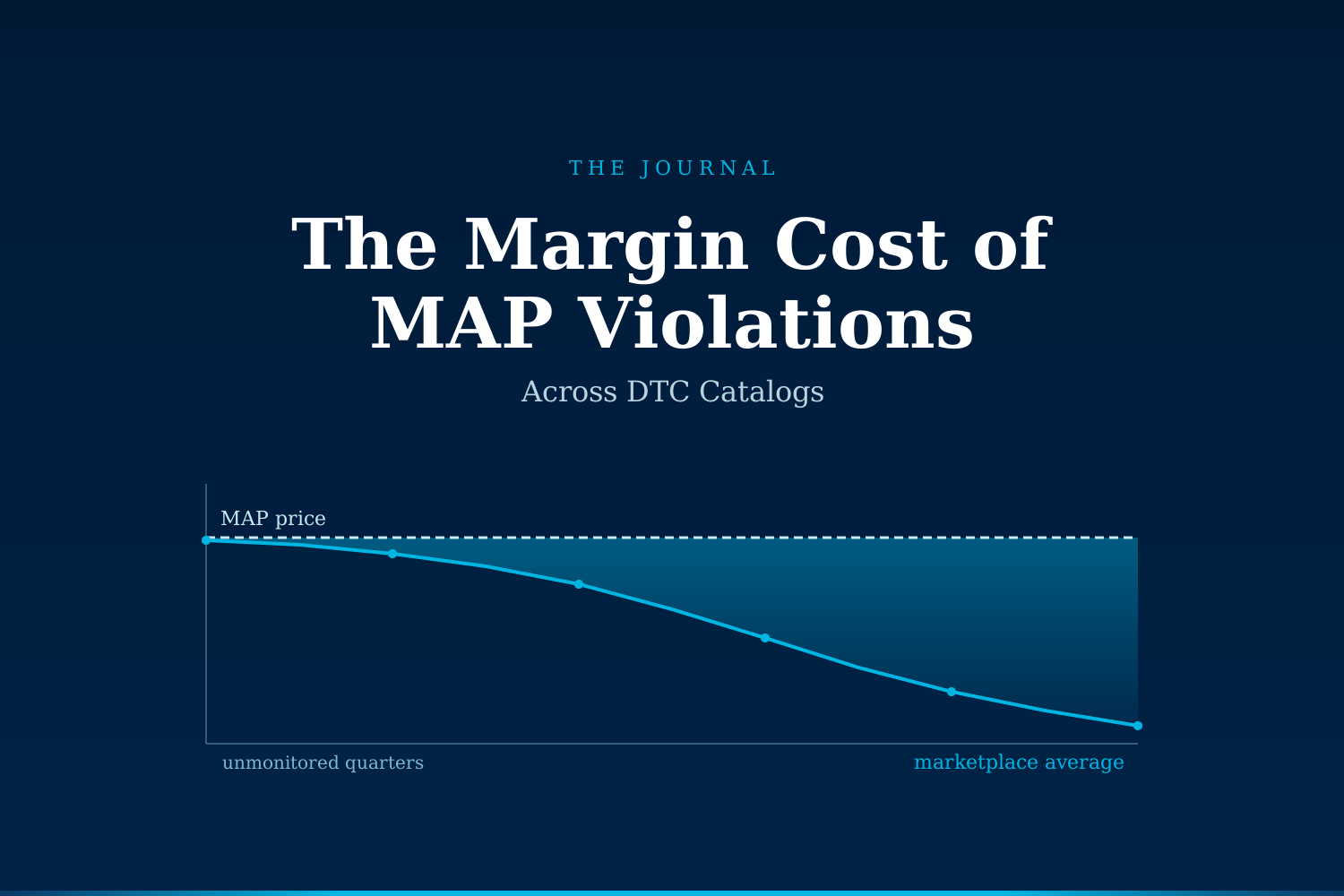
When a third-party reseller drops your product below MAP, the cost rarely lands on a "MAP violation" line in your P&L. It lands as authorized resellers walking, as reactive discounting on your own DTC site to stay competitive, and as a slow drift in average selling price you only notice a quarter later.
What is a MAP violation, in plain operator terms?
MAP, Minimum Advertised Price, is the public price floor a brand sets for how low any reseller can advertise a product. It is not a fixed retail price. Resellers can discount at checkout. The number in the search result, the marketplace tile, the affiliate ad: those are what MAP governs.
A violation happens any time an advertised listing breaches that floor. The most common venues: Amazon 3P sellers, Walmart Marketplace, eBay, Google Shopping ads from unauthorized affiliates, and the long tail of niche marketplaces a brand never explicitly authorized.
Why does a $5M to $25M DTC brand feel MAP violations more than an enterprise?
Two structural reasons. First, leverage. A large brand has the legal budget and channel weight to keep violations rare. A mid-size brand sends polite emails. Second, visibility. Enterprise brands run continuous price monitoring across thousands of SKUs. A mid-size DTC team usually has one or two people spot-checking Amazon a few times a week. The violations they do not see still move the market.
The result is that the same percentage of catalog drift hits a mid-size brand's margin harder, faster, and with less institutional pushback than it would at an enterprise.
Where does the margin actually go when MAP slips?
Four places. None of them sit cleanly on a single line item.
- Authorized reseller attrition. Your strongest wholesale partners, the ones who carry the premium SKUs and merchandise them well, are the first to call. They competed under the assumption MAP held. When it does not, they walk, or they shift shelf space to a competitor brand whose floor still holds.
- DTC site discounting to compete. When a marketplace listing sits 12% below your own product page, paid traffic conversion craters. The marketing team is the first to feel it. They run a coupon. The recurring coupon becomes a recurring promo. The recurring promo becomes your new effective MAP.
- Premium SKU mix shift. Resellers who still hold MAP only carry your protected SKUs. As MAP erodes, they carry fewer SKUs, the mix tilts toward lower-margin items, and the brand's blended margin contracts even if unit volume is flat.
- Subscription LTV pressure. For subscription DTC brands, public price drops train acquisition channels that the product "is on sale." Cancel-and-resubscribe loops shorten. The team rationalizes the LTV drop as a churn problem. It is often a price-anchor problem.
Industry analyses from pricing-intelligence vendors (Wiser, Skai, and similar pricing-monitoring providers publish recurring benchmarks on this) consistently place MAP non-compliance for brands with active policies in the 30 to 40% range across monitored listings at any given moment. The compounding effect on margin is what most ops dashboards never surface.
How fast does the damage compound?
Faster than the monitoring cycle. The typical mid-size DTC team checks priority SKUs once or twice a week. A single below-MAP listing on a high-traffic marketplace can move the buy-box price within 24 to 48 hours, because automated repricers run by other 3P sellers respond to the lowest listing in minutes. By the time a human operator sees the violation, the entire marketplace shelf has often already matched it.
The window from first violation to category-wide price drift is measured in days. The window from human-scheduled monitoring to action is usually a week. That mismatch is where the margin leaks.
Why is MAP enforcement framed as legal work when it is mostly operations?
The framing inside many DTC brands is that MAP is "what the lawyer handles." That framing is half true. The policy itself, the reseller agreement language, and the cease-and-desist escalation path do live with counsel. The detection, prioritization, evidence collection, and routine outreach are operations work.
When the entire program sits with legal alone, three things happen. First, response volume is throttled to whatever a lawyer can review, which is a fraction of weekly violations. Second, the brand only addresses high-stakes cases, leaving everyday drift unchecked. Third, the data legal needs to act, screenshots, listing histories, repeat-offender records, arrives messy because no one is tasked with capturing it cleanly.
A reframe that tends to work: MAP detection and routine enforcement is ops; MAP escalation and structural agreement changes are legal. The handoff between the two is what makes the program effective or theatrical.
Manual MAP monitoring vs AI-assisted monitoring: what is different?
| Dimension | Manual desk | AI-assisted desk |
|---|---|---|
| Catalog coverage | Top 30 to 50 SKUs spot-checked | Full catalog, continuously |
| Channels watched | Amazon, occasionally Walmart | Every marketplace, Google Shopping, affiliate ads |
| Cycle time | 2 to 4 days per review round | Continuous, alert within minutes |
| Action latency | Human writes outreach, days to send | Outreach drafted instantly, queued for human approval |
| Repeat-offender tracking | Spreadsheet, drifts over time | Persistent reseller history with escalation paths |
| Evidence capture | Manual screenshots, often missing | Listing snapshots stored automatically with timestamps |
| Reseller relationship signal | Reactive after damage | Proactive before mix shifts |
The shift is not "automation replaces the policy team." The shift is that the policy team operates on current data instead of week-old data, and on the full catalog instead of the top 50.
What changes when MAP monitoring runs continuously?
Three operational outcomes worth naming, none of which require the brand to staff a dedicated pricing team.
First, premium reseller retention stops being a quarterly fire drill. When violations get flagged and addressed within hours, authorized resellers see the brand actively defending their margin. Renewal conversations change tone.
Second, DTC promo cadence rationalizes. The marketing team stops reactively running coupons to match marketplace drift, because the drift gets corrected at the source. Promotional calendars get planned around real demand, not defensive response.
Third, the catalog's premium SKU strategy holds. Resellers continue carrying the higher-AOV items because the brand has demonstrated it will enforce. The mix stays where the brand wanted it.
What we will not detail in this article
We are not going to walk through the rule logic for repricer detection, the specific cease-and-desist language we draft on a brand's behalf, or the comparison-shopping data pipelines we wire into a brand's monitoring stack. Those choices depend on the brand's channel mix, reseller agreements, and legal posture, and they are precisely what an audit is for.
What is worth saying publicly: every mid-size DTC brand we have looked at had at least one structural blind spot in their MAP monitoring that compounded into measurable margin loss within two quarters. None of them had noticed it on a single line item.
A starting diagnostic any operator can run this quarter
Without buying any tools: pull a list of every SKU sold through authorized resellers in the last six months. Pick the top ten by revenue. Manually check the public listing price on Amazon, Walmart, and Google Shopping for each, once per day, for two weeks. Log the variance against your MAP.
If more than two of those ten drift below MAP in the two-week window, the brand has a MAP monitoring problem that is already costing margin. The conversation then becomes not whether to address it, but how much catalog coverage and how short an action latency the brand actually needs.
If this sounds like your catalog, we run a completely free automation audit for mid-size DTC ops teams that want a second opinion on where pricing discipline is leaking. No commitment, no slide deck, no pitch.
Sami Raza
Software Developer & Technical Author
Sami Raza builds AI automation for logistics, DTC, and construction operations teams at ApexifyLabs, and writes about the operational failures that automation is actually worth pointing at.