How Slow Shipper Pay Ages a Freight Broker's Books
Freight brokers pay carriers on 7-day terms and wait 45 to 60 days for shipper pay. Once invoices age past 60 days, the working-capital cost starts to compound.
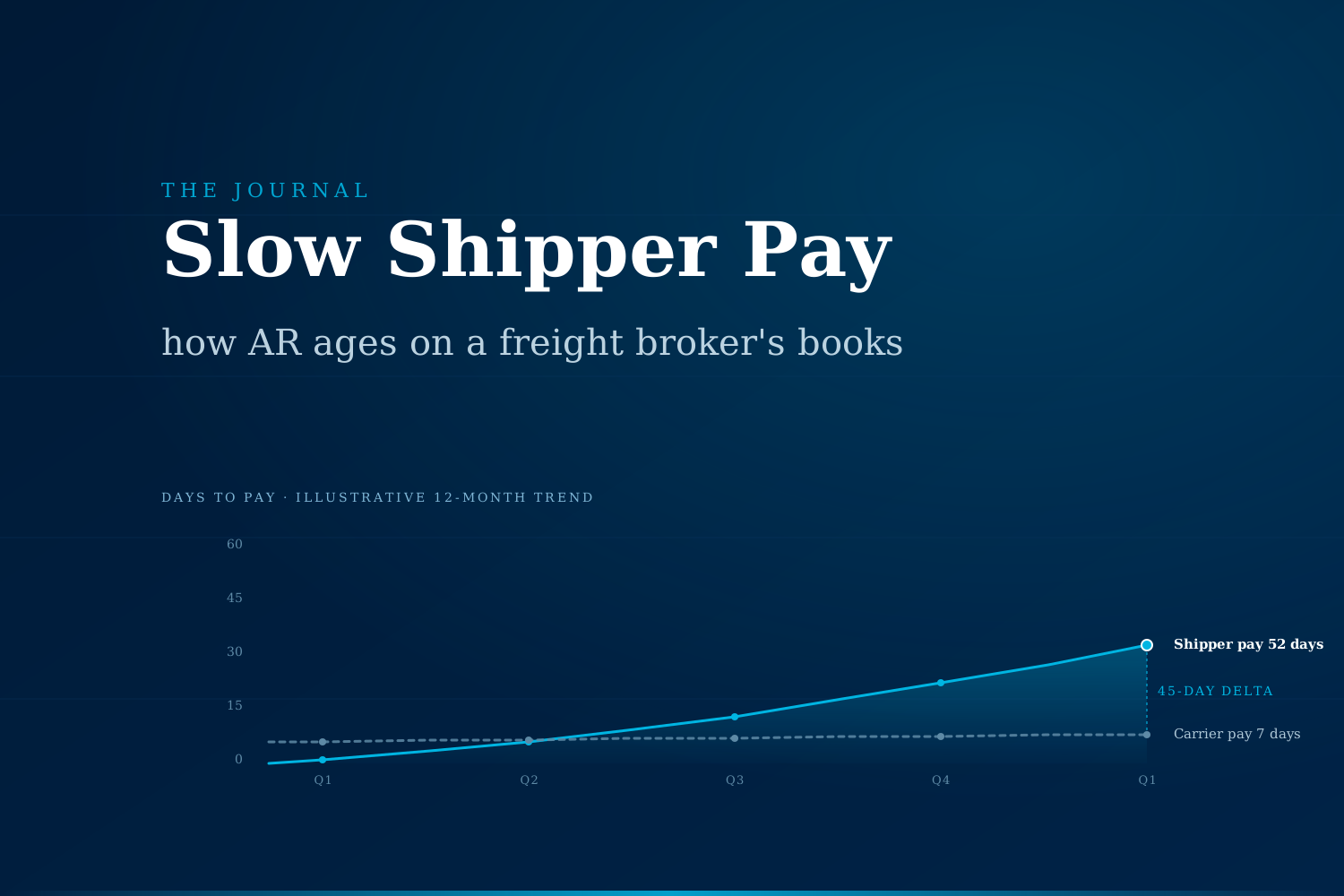
Freight brokerages sit inside a difficult cash cycle. Carriers expect payment inside seven days, often through quick-pay or a factoring assignment. Shippers pay on thirty, forty-five, or sixty-day terms, and many slip past that. As shipper invoices age, the brokerage's line of credit does the work of financing the gap, and gross margin absorbs the interest.
Why does shipper AR age faster on freight brokerages than on other B2B categories?
Freight is one of the few B2B categories where the buyer routinely receives the service before an invoice can even be issued. A load moves, delivers, and only then does the paperwork chain start: POD upload, accessorial reconciliation, rate confirmation matching, invoice generation, and finally submission to the shipper's accounts payable inbox. Every step is a possible pause.
Compare that to a SaaS renewal, where the invoice fires the moment the term rolls over, or a manufacturing PO, where the invoice attaches to a specific line item on a specific date. Freight bills carry more exception fields and more discretionary approvals. Industry benchmarking published by TIA and BlueGrace consistently places average brokerage DSO in the forty to fifty-day range, well above the thirty-day standard invoice term most shippers sign into master service agreements.
The interesting question is not why the average is high. It is why the tail is so long. A brokerage running a forty-five day DSO on paper often has a distribution where fifteen to twenty-two percent of open invoices are still sitting past day sixty. That tail is where the working-capital problem actually lives.
What happens when broker AR crosses the sixty-day line?
Every dollar of AR past sixty days is a dollar the brokerage is financing on someone else's behalf. Some brokerages finance internally, on cash reserves. Most rely on one of three external mechanisms:
- A traditional bank line of credit, priced at prime plus one to three percent.
- A factoring arrangement, priced at one to three percent per invoice.
- Delayed pay to carriers, which is not a financing tool so much as the fallback when the first two are tapped.
The financing cost is not the only cost. When aged AR builds on a material share of the book, four secondary effects tend to show up quickly.
- The credit line's advance rate on eligible receivables usually drops for anything past sixty days, so working-capital availability shrinks even when top-line revenue grows.
- Factoring partners start pricing invoices individually, and the higher-risk shippers get flagged or excluded from the facility.
- Sales stops signing new shippers with attractive lanes because credit underwriting has no room left.
- Carrier relationships fray. The quick-pay carriers do not care why the brokerage is slow. They simply move to the next brokerage that is not.
How does AR aging scale across brokerage sizes?
The pattern scales with book size, and often the biggest brokerages carry the most aged AR by percentage. Bigger books mean more shippers, more diverse terms, and more inherited legacy contracts with generous payment schedules.
| Broker gross revenue | Typical DSO | Share of AR aged 60+ days | Financing-cost drag on gross margin |
|---|---|---|---|
| $10M | 35 to 45 days | 8 to 14% | 1.5 to 2.5% |
| $50M | 40 to 50 days | 12 to 18% | 2.5 to 3.5% |
| $100M+ | 45 to 60 days | 15 to 22% | 3.0 to 4.5% |
Ranges reflect year-over-year variance and were derived from public 10-K disclosures of RXO, Landstar, and Hub Group cross-referenced with SMB brokerage surveys published by TIA and BlueGrace.
Two things stand out. First, the financing-cost drag alone can absorb an entire percentage point of net margin in a category where three to five percent net is a good year. Second, the biggest brokerages benefit from scale everywhere except AR, where the size of the shipper base tends to work against them.
Why do collection calls stall on freight AR?
The collections seat at a mid-size brokerage is usually the least-staffed function in the building. One or two people are expected to touch every open invoice past day forty-five and get it paid. In practice, the calls stall for reasons that have very little to do with the money itself.
- POD attachment questions. The shipper's AP team cannot find the delivery receipt or wants a signed copy rather than the electronic version.
- Missing accessorial backup. A detention or lumper charge went out without the underlying documentation, so it gets held for review.
- Rate confirmation and invoice mismatch. A late-stage rate change was verbally agreed but never updated on the RC, and the invoice reflects the newer figure.
- Approver rotation on the shipper side. The AP contact changed roles, and the invoice sits in a queue no one owns.
- Invoice not received. The most common answer, and often true. Emails route to spam, portals reject uploads, and paper still exists.
Each of these is a five-minute problem in isolation. But five minutes times a book of three thousand open invoices per month is a full-time person, and most brokerages do not have that person. So the calls happen, the notes get logged, and the invoice moves from day sixty-one to day seventy-five to day ninety.
What signals suggest AR aging is worse than the standard report shows?
The standard AR aging report understates the working-capital drag on a brokerage. Watch for these five signals to gauge whether the desk is losing more ground than the aging bucket alone suggests.
- DSO is stable, but the AR balance is climbing. Growth is masking a slowdown per invoice. If AR grows faster than gross revenue, days-per-dollar are getting worse.
- Factor advance rates trend down. The lender is pricing risk into the book, whether or not the collection team has noticed.
- Carrier quick-pay adoption is climbing. Carriers are voting on the brokerage's cash reliability, and they are asking for immediate pay.
- AR concentration in a few large shippers. A single delayed shipper can move DSO by four to six days on a $50M book. Concentration multiplies the risk.
- Sales quotes decline on marginal-credit shippers. Credit review is cutting quotes without anyone flagging it internally, so revenue that used to move now never gets priced.
None of these signals show up on a standard weekly report. They emerge from cross-referencing collection logs, factoring statements, and sales pipeline. Very few brokerages run that cross-reference.
What changes when follow-up runs on a rhythm?
Consider what a brokerage's AR looks like when the collection function stops depending on human capacity to work every invoice by hand. Every unpaid invoice past day twenty gets an appropriate touch, tuned to the shipper's known payment behavior. Every response, whether from an AP inbox, a portal update, or a portal rejection, gets triaged and routed to the right internal owner in seconds. Every disputed invoice gets an audit trail attached automatically: POD, RC, accessorial backup, communication history. Every uncollected balance past day sixty gets a full workup for the collections team, not a name and a number.
The team does not disappear. The team stops chasing paperwork and starts negotiating. The two or three people who used to touch every invoice by hand become the ones who resolve the ten percent that actually need judgment. Case data published by transportation-focused finance platforms like Denim and OTR Solutions places typical DSO improvement at six to twelve days on a well-tuned book. On a $50M book, six days of DSO is roughly eight hundred thousand dollars of released working capital.
Those numbers are not the point. The point is that most brokerages do not have to raise their line of credit, do not have to expand factoring, and do not have to slow carrier pay, once the follow-up cadence runs on rhythm rather than on manual capacity.
What does this look like from a CFO's chair?
For a brokerage CFO, the interesting shift is not the DSO number. It is the predictability of the cash forecast. When aged AR follow-up runs on a rhythm, the CFO can model expected cash for the next four weeks with materially higher confidence, because the exceptions surface as they happen rather than at end-of-month reconciliation. Credit committees move faster. Growth capital gets deployed sooner. The finance function stops being the constraint on how quickly the sales team can sign new shippers with attractive terms.
None of this shows up as a line item on the P&L. It shows up as fewer late-week draws on the line of credit and calmer conversations with the factoring partner. Those are cheaper than the alternative, but they are also easier to underestimate.
Curious what your own AR aging pattern is actually costing?
We run a completely free automation audit for freight brokerages that want a clear read on where their AR aging pattern is holding cash hostage, and what an AI-augmented follow-up loop would unlock on their real shipper mix. No slide deck, no pitch. Just a working diagnosis. → Book yours
Sami Raza
Software Developer & Technical Author
Sami Raza builds AI automation for logistics, DTC, and construction operations teams at ApexifyLabs, and writes about the operational failures that automation is actually worth pointing at.