How Pre-Order Backlogs Eat DTC Launch Margin
Pre-order launches at DTC brands rarely fall short on supply. They fall short on the backlog between checkout and ship: card reauths, stale addresses, allocation, fraud queues.
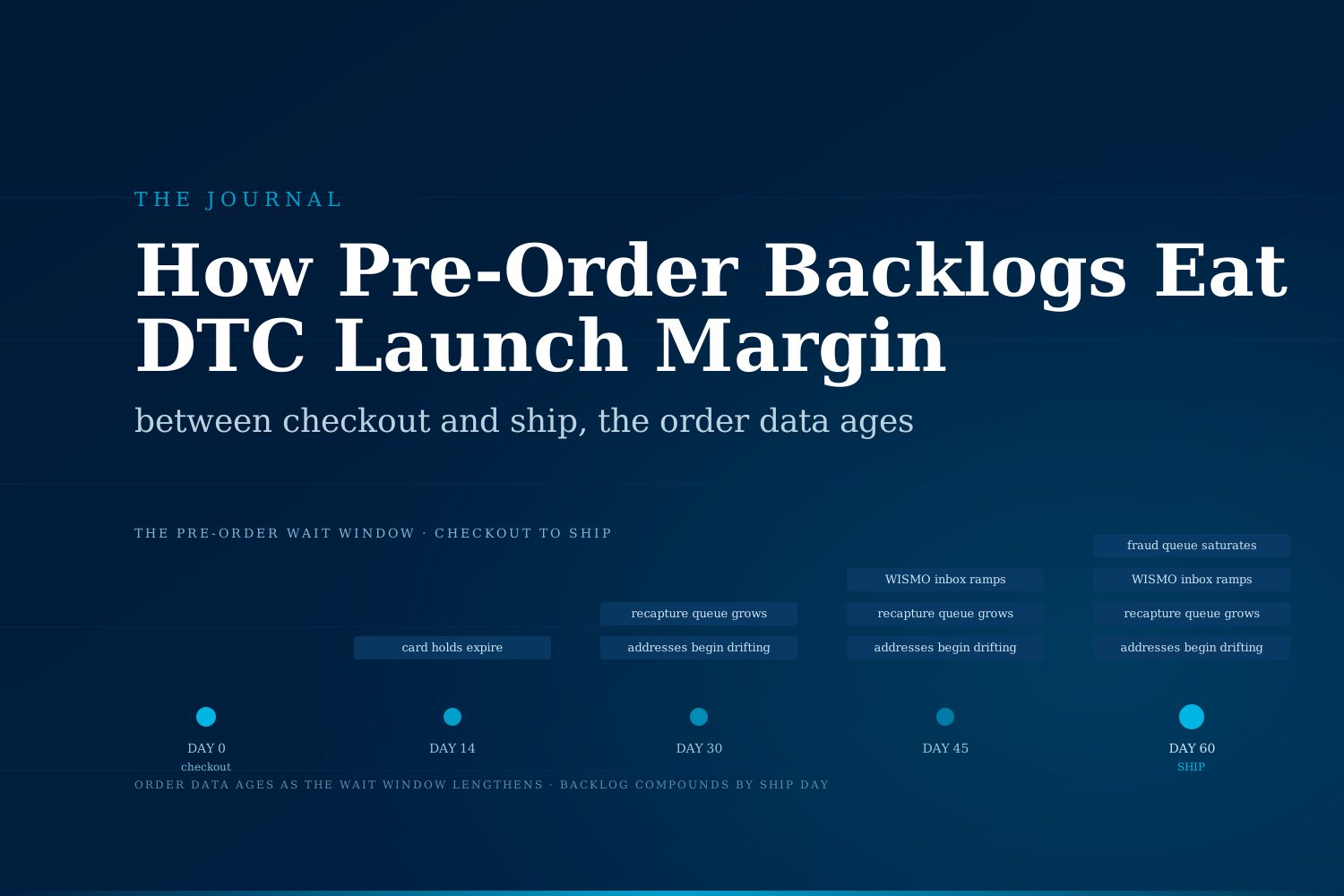
Pre-order launches at DTC brands rarely fall short because the product undersells. They fall short because the backlog between checkout and ship grows faster than the team can clear it. Card reauths, stale addresses, allocation calls, fraud queues, status emails. Each looks small alone. Stacked across a launch window, they compound into the margin loss most operators only see in hindsight.
What is a pre-order backlog, exactly?
A pre-order backlog is the open-but-unshipped order queue that forms whenever a DTC brand sells inventory it does not yet hold. The queue grows during product launches, restocks of out-of-stock SKUs, presale drops, founder-club exclusives, and any window where checkout opens before the warehouse can ship.
Most operators treat it as a fulfillment problem. It is closer to a payments, comms, allocation, and fraud problem with a fulfillment deadline attached. By the time the SKU is finally in hand, the order data on every line has aged. Card authorizations have expired. Customers have moved. Addresses no longer route. Fraud flags have shifted. The customer service inbox has filled with where-is-my-order questions the team cannot answer truthfully.
Industry research, including Salesforce's State of Commerce report series, has flagged order-data staleness (rather than pure stockout) as a leading reason pre-order conversion underperforms forecast at growing DTC brands. Shopify's commerce trends reporting has repeatedly noted that brands running frequent pre-order or presale windows see backlog handling costs that compound across each launch.
Where does the margin actually leak?
Five operational lines, each of which a manual ops team has to touch by hand during a typical launch:
- Card authorization aging. Stripe, Adyen, and Braintree all hold an initial authorization for a fixed window, commonly around seven days. After that, the brand must reauthorize before capture. Across a 30 to 90 day pre-order, every order needs a second auth attempt. Public guidance from major payment processors indicates that recapture failure rates climb meaningfully on cards older than 12 months, which is the norm across longer pre-order windows.
- Address staleness. The US Census American Community Survey reports US household mobility at roughly 8 to 9 percent per year. Across a 60 day pre-order window, the chance any given shipping address has gone stale sits at about 1.4 percent. At 5,000 orders per launch, that is close to 70 reships before the box even leaves the warehouse.
- Allocation when inventory lands short. When the PO arrives several percent under, a manual team picks who gets fulfilled first by spreadsheet, by order date, by support escalation pressure, by whoever pushed loudest in the support inbox. Without an articulated allocation policy, the brand often absorbs the cost of canceling its most valuable customers and shipping to its least.
- Customer comms. When ship dates slip, the support inbox fills with where-is-my-order tickets. Benchmarks from helpdesk vendors like Gorgias and Re:amaze suggest pre-order WISMO can run 2 to 3x the volume of standard order WISMO. Tickets average over five minutes of agent handling each.
- Fraud queue swell. New email addresses, prepaid cards, and gift-purchase patterns all spike during launches. Manual review queues climb in parallel. A team that screens 80 transactions a day at normal volume can see 200 to 300 during a launch week. Reviewers tire, false positives climb, and loyal customers get canceled.
Each line on its own is a known problem. The compounding is what catches most teams off guard.
What does manual vs AI-augmented pre-order ops look like?
| Workflow line | Manual pre-order ops | AI-augmented pre-order ops |
|---|---|---|
| Card auth refresh | Done by hand, day of ship | Continuous reauth monitor with per-card retry logic |
| Address verification | Sent only after ship triggers fail | Daily flag for stale, invalid, or relocation-risk addresses |
| Allocation when short | Spreadsheet, ad hoc rules | Policy-aware allocation across tiers, LTV, comms history |
| Customer status | Bulk email blasts, generic copy | Per-order status, escalation-aware, multi-channel |
| Fraud screening | Linear reviewer queue | Risk-tiered queue with auto-clear on low risk |
| Channel reconciliation | Shopify, Amazon, Klaviyo checked manually | Reconciled state across channels, no drift |
The point of the comparison is not the tool stack. It is the human ops cost of each line, summed across thousands of orders, compared against the same line summed at near-zero marginal cost. The difference is where launch margin gets recovered.
What does this cost a brand at $10M ARR?
Operator interviews in DTC trade publications like Modern Retail and Retail Dive, combined with public ops benchmarking work, suggest a typical mid-size DTC brand running quarterly drops carries hidden launch costs in roughly these ranges:
- 4 to 7 percent of pre-order revenue lost to canceled-card non-recovery.
- 1.5 to 3 percent of orders reshipped because of address drift during the wait.
- 8 to 12 percent of launch-week support hours absorbed by avoidable WISMO.
- 0.5 to 1 percent of orders falsely canceled by fraud queue overload.
- 12 to 18 percent of ops team launch-week hours spent reconciling Shopify, Klaviyo, and the 3PL.
Applied to a $10M ARR brand with two launches per year, the cumulative number lands somewhere between $80K and $250K of margin pressure most operators never see itemized. It does not show up cleanly on the P&L. It shows up in a tired ops team, a chargeback rate that creeps, and a slightly lower repurchase rate the quarter after launch.
What changes when the backlog stops compounding?
A few things become possible that are not currently on the table for a manual team.
The brand can run more launches without scaling the ops team linearly. A team of four can support six launches a year instead of two without losing weekends to recapture work.
The cancellation rate decouples from launch volume. Today, canceled-card and stale-address rates rise with the size of the queue. With continuous reconciliation, that curve flattens.
Customer status becomes truthful at scale. Pre-order buyers can be told where their order is, what the next event is, and what to expect, without an agent typing the answer manually.
Allocation becomes a policy choice rather than a fight. When the PO lands short, the brand decides in advance who waits and who ships first based on lifetime value, region, channel, or any rule the team can articulate, without negotiating it order by order.
Fraud screening stops being launch-dependent. The reviewer's day looks the same on launch week as it does on a normal Tuesday.
None of this is theoretical. Several growing DTC brands have already restructured their pre-order ops along these lines. The work to get there is not glamorous, but it is contained, and the payback shows up in the first launch after.
Three signs a brand is paying the pre-order backlog tax
You do not need a formal audit to spot the pattern. Three observations usually do it.
- The launch-week support backlog took more than five business days to clear after the last drop landed.
- Card decline at recapture rose more than a percentage point above the brand's standard order baseline.
- Ops leadership cannot answer, within five minutes, what the brand's pre-order cancellation rate was on the last launch.
If any of those three are familiar, the backlog is already costing more than the team can see from the P&L.
What this article will not detail
We are not going to walk through the field-level reconciliation between Shopify, Klaviyo, the payment processor, and the 3PL inventory snapshot, the specific thresholds for flagging address risk against a 60 day wait, the allocation policy that survives a real launch, or the recapture cadence that actually works against issuer-side decline patterns. Those choices depend on the brand's stack, its launch cadence, and its risk tolerance, and they are precisely what an audit is for.
What is worth saying publicly: every growing DTC brand we have looked at had a meaningful pre-order backlog cost line that was not labeled as such on the launch debrief. None of them had a real-time view of which orders were still healthy and which were aging out.
What an AI-augmented pre-order ops program looks like at a glance
The goal is not to replace the ops team. They already know how a launch runs. The goal is to give them a single, current picture of which orders are still healthy and which are not, so reauth, address verification, allocation, and comms happen on the day they should rather than the day the launch ships. The integration typically takes three to six weeks of work, lives in the background once it is wired in, and shows up to the team as a flatter, more boring launch week.
If your last launch felt like the support inbox owned the team for a fortnight, the first move is usually to look at the order data, not the marketing plan. We run a completely free automation audit for DTC ops teams that want a second opinion on what their pre-order backlog is actually costing them. No commitment, no slide deck.
Sami Raza
Software Developer & Technical Author
Sami Raza builds AI automation for logistics, DTC, and construction operations teams at ApexifyLabs, and writes about the operational failures that automation is actually worth pointing at.