The Hidden Cost of Manual Submittal Tracking on a GC's Desk
Where general contractors quietly lose schedule weeks and margin on submittal logs, and what the same desk looks like once AI handles the repetitive 80%.
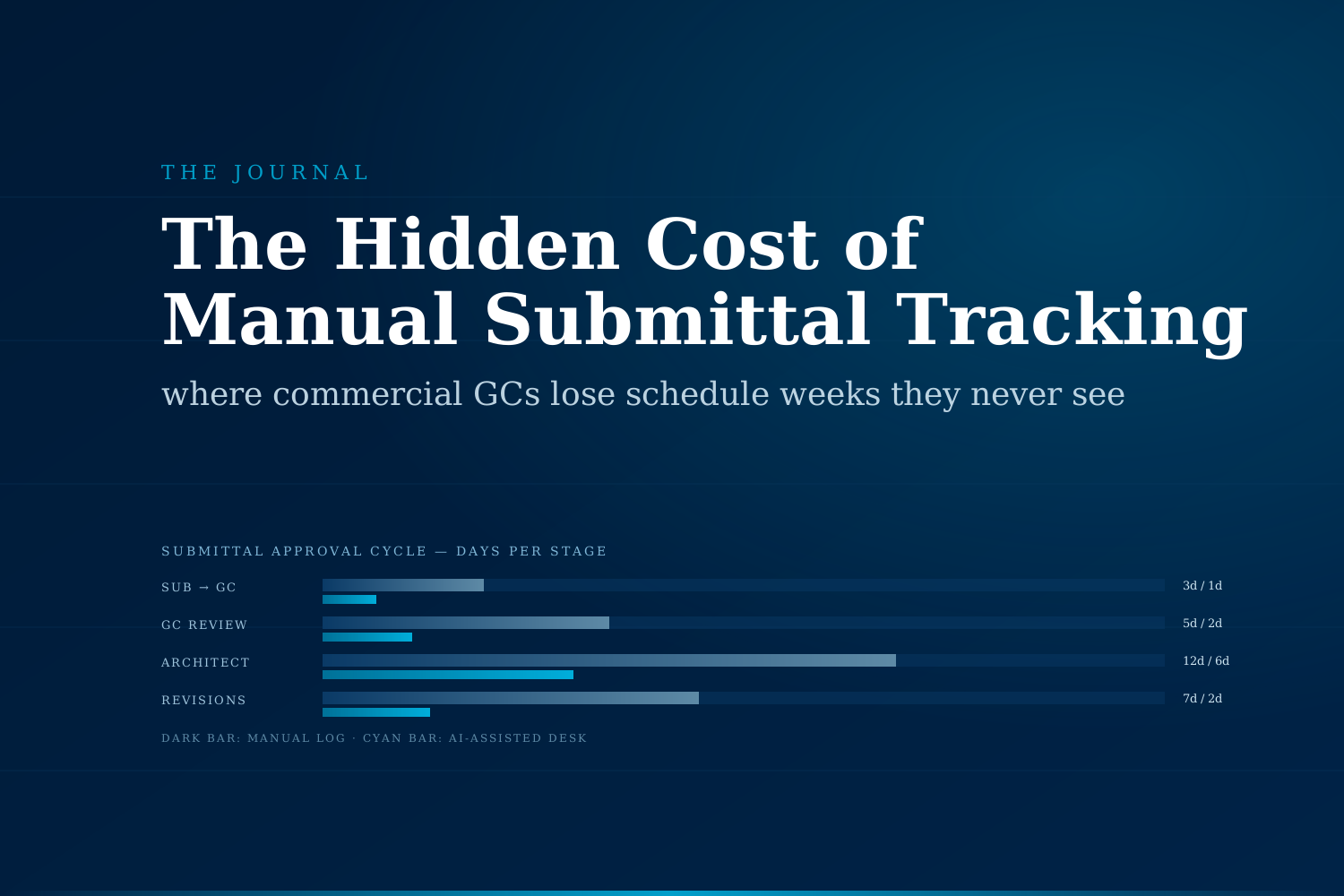
On a $20M commercial project, a general contractor's submittal log tracks hundreds of items (shop drawings, product data, samples, mockups), and a single late approval can stall a multi-week sequence. Manual tracking quietly costs GCs schedule slippage, rework, and project managers working as document-traffic-cops instead of running the job.
What does "manual submittal tracking" actually look like on a GC's desk?
Walk into the project trailer of a typical mid-market GC and the submittal log is one of three things: a shared Excel sheet, a PDF checklist updated weekly, or a folder structure inside a project platform that nobody is sure is current. The PM "owns" the log, but ownership in practice means re-keying status fields, chasing the architect for a stamp that has been sitting for nine days, and forwarding revised shop drawings to the right sub before the embedded plate gets framed over.
A single submittal moves through five or six hands before it is closed: sub submits to GC, GC reviews, architect reviews, engineer of record reviews, revisions return, re-review, approved, distributed. On a project with 400 submittals, that is more than 2,400 hand-offs, each with a clock running.
When the log is manual, none of that clock is visible until something is already late.
Why does the gap exist on every job?
It is not poor management. It is structural, and it shows up in three reinforcing patterns.
Information lives in inboxes. The architect's response sits in someone's email until the PM remembers to reconcile the log. By the time it propagates to the field, the sequence has already shifted.
Status is reactive, not proactive. PMs find out a submittal is late when a sub calls asking where their approval is. The system that should warn them (the log) is the same system they only update when they have a free Friday.
Rework on site is invisible until it is expensive. A wrong revision, an unflagged design change, a sub building from an outdated spec. The cost lands in the field, not in the office.
McKinsey's Reinventing Construction report puts construction productivity growth at roughly 1% per year over the past two decades, compared to ~2.8% for the overall economy. Industry research consistently identifies document and approval flow (submittals, RFIs, change orders) among the primary contributors to that productivity gap.
Where does the money quietly disappear?
Five places. None of them show up cleanly on the P&L, which is part of the problem.
1. Schedule slippage from late approvals. A long-lead item (structural steel, switchgear, custom glazing) that gets approved two weeks late does not just push that item; it cascades through every sequence that depends on it. Industry studies on construction delay routinely find that schedule overruns affect the majority of large projects, with submittal and approval delays repeatedly cited among the top contributing factors.
2. PM bandwidth burned on document choreography. Surveys of construction project managers consistently report that 30–40% of their week is spent on non-productive administrative work: chasing emails, reconciling logs, building reports for owners. A senior PM costing $130k–$180k loaded is, on those days, doing $25-an-hour traffic-cop work.
3. Rework on site. The Construction Industry Institute and others have estimated rework at roughly 5% of total project cost on commercial work, with document and communication breakdowns among the leading drivers. A wrong-version submittal that makes it to the field is one of the more expensive kinds of rework, because it is caught after install, not before.
4. Owner and architect relationship erosion. Owners notice when submittal status is fuzzy. Architects notice when GCs forward stale information. The relational cost of looking disorganized does not show up on the current job. It shows up in the next bid you do not get invited to.
5. Closeout chaos. Every submittal eventually has to land in the project closeout binder: approved versions, samples, warranties, O&M data. A log that has been "good enough" all year becomes a six-week archaeology project at substantial completion. PMs and admins burn weekends reconciling what should have already been clean.
Add those up across a portfolio of three to five active projects and the cost is not theoretical. It is a real, recurring drag on the operation.
Manual log vs. AI-assisted submittal desk: what actually changes?
| Workflow step | Manual submittal log | AI-assisted submittal desk |
|---|---|---|
| Log creation from spec | PM or coordinator builds line-by-line from spec sections | Submittal register drafted from the spec automatically; PM reviews and approves |
| Status updates | Hand-keyed after the fact, often days late | Updated continuously from email and platform activity |
| Late-approval alerts | Discovered when a sub calls or a sequence slips | Surfaced before the due date, with the responsible party flagged |
| Cross-reference to schedule | Done manually, if at all | Linked to long-lead items and float; downstream impact visible |
| Revision tracking | "Latest" depends on who you ask | One source of truth, with full version history |
| Owner / architect reporting | Weekly PDF, often outdated by Tuesday | Live dashboard, no PM time required to produce |
| Closeout | Six weeks of reconciliation | Closeout package essentially compiles itself |
The work does not disappear. Judgment calls still belong to the PM and the architect. What disappears is the choreography.
What changes for the project manager?
A PM running an AI-assisted submittal desk does not get a fancier log. They get their week back.
- Mornings start with exceptions surfaced (the three submittals at risk this week), not an inbox archaeology session.
- Field calls about "did this get approved?" are answered in five seconds, not five hours.
- Owner meetings open with a current-state dashboard already on the screen, not a status spreadsheet that someone stayed late to update.
- Closeout begins on day one of construction, not at substantial completion.
The PM gets back to running the job: managing trades, walking the site, solving the problems that actually need a human. That is the work the company is paying senior PM salaries for.
How big is the prize on a typical commercial project?
It depends on project size, but the operating math is consistent. On a $15M–$30M commercial build:
- A senior PM reclaiming 6–10 hours a week of administrative work over an 18-month project is 400–700 hours back per project.
- Avoiding even one cascade-causing late approval on a long-lead item typically saves multiple weeks of schedule and the associated general conditions burn.
- Cutting documented rework by even 1% of project value on a $20M project is $200,000 straight to the bottom line.
None of this requires the PM to become a software person. It requires the back office to stop running on inboxes.
A submittal log is a small internal application pretending to be a spreadsheet, which makes it the textbook case for a custom internal system: the workflow is specific to your job, and the workaround has already become load-bearing. The same document chain shows up in what slow RFIs really cost, long-lead procurement slippage, and punch-list closeout drag.
Three signs your submittal log is costing you more than you think
- Your PMs find out a submittal is late from a sub, not from the log. The log is supposed to be early-warning. If it is a historical record, the warning has already failed.
- Closeout takes more than two weeks of dedicated time per project. Closeout effort is a lagging indicator of how clean the log was during construction.
- Owner and architect status reports are produced by hand on Friday afternoons. That is a paid PM doing a job a system should do, and the report is stale before Monday.
Most GCs we talk to see at least two of these. The cost is real, but it is the kind of cost that is easy to live with because it never lands in one obvious place.
Curious what this would look like on your operation?
We run a completely free automation audit for GCs and subs that want a second opinion on where their submittal, RFI, and change-order flow is silently costing them. No slide deck, no commitment. We map your current desk and show you what the same desk looks like once AI handles the repeatable 80%.
Sami Raza
Software Developer & Technical Author
Sami Raza builds AI automation for logistics, DTC, and construction operations teams at ApexifyLabs, and writes about the operational failures that automation is actually worth pointing at.