Fuel Surcharge Update Lag on Freight Broker Margin
When the weekly EIA diesel index moves and internal FSC tables refresh late, every load billed inside that gap drifts margin the brokerage never fully reconciles.
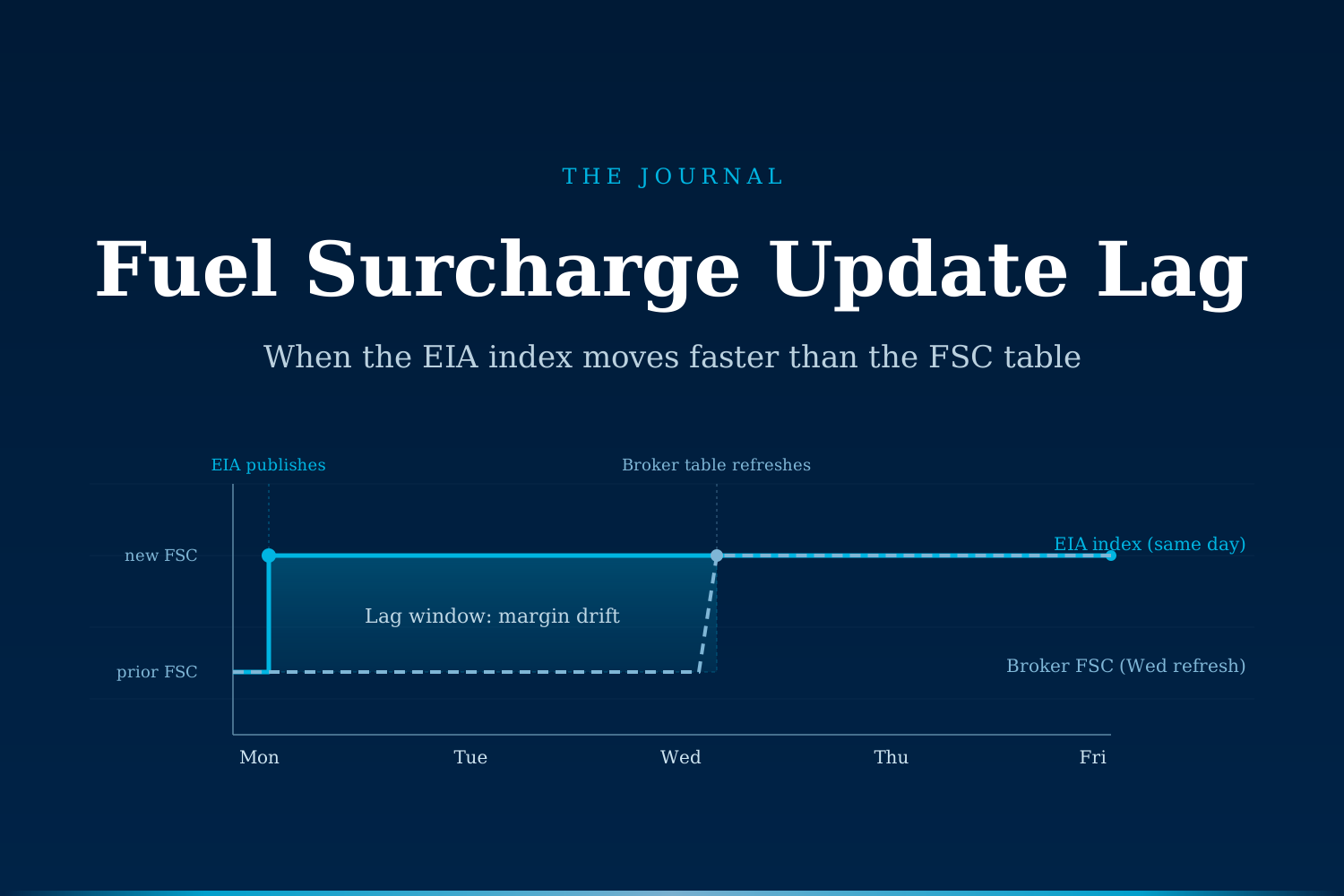
Fuel surcharge update lag is what happens when the weekly EIA diesel index moves and a broker's internal FSC table refreshes slower than that. Loads billed inside that gap use last week's number, so buy side and sell side drift apart and margin compresses on every affected invoice until the correction lands.
Most desks do not see it because the fuel surcharge line item is one of the least-audited numbers on a rate confirmation. It refreshes on a predictable calendar cadence, it is small on any one load, and it lives inside a spreadsheet or TMS lookup that a pricing analyst updates by hand. The compounding is what does the damage. This article looks at how the lag actually shows up on the P&L, why contract-heavy brokerages carry the most exposure, and what changes when the index moves in real time instead of on human time.
Why do the diesel index and broker billing rarely line up?
The U.S. Energy Information Administration publishes its Gasoline and Diesel Fuel Update every Monday afternoon. That number, the national and PADD-regional average retail diesel price, is the reference point that most fuel surcharge schedules on freight contracts and internal broker rate calculators key off. Rate confirmations, shipper contracts, spot quote engines, and reconciliation reports all point back to it.
The problem shows up because the systems on either side of a broker refresh on different clocks. Load-board pricing engines, dispatch platforms, and carrier factoring lines tend to pull the new EIA number within hours of publication. Broker internal pricing tables, especially those maintained inside a spreadsheet, TMS lookup, or rate-calculator worksheet, often update a day or two later, once a pricing analyst copies the value in and pushes it live.
Any load that gets billed inside that window uses a stale fuel surcharge. When the average moved up, the broker underbills the shipper while the carrier partner already expects the new value. When the average moved down, some brokers overbill and later credit back once shipper AP catches it. Both directions cost something. Only one direction shows up as a dispute, so the other direction stays invisible until the quarterly close.
What does the lag actually cost per load?
The EIA has published weekly diesel moves ranging from a few pennies to more than a dime in either direction across 2024 and 2025. Even a modest five-cent-per-gallon weekly shift, at a fleet-standard 6.0 MPG assumption, works out to roughly $8 to $9 in FSC value per 1,000-mile FTL load. Larger swings, which showed up multiple times during 2024, scale linearly from there.
That is the same order of magnitude as the accessorial charges most desks track carefully. Across a mid-size brokerage running 500 to 800 FTL moves a week, a persistent two-day refresh lag can drift $4,000 to $6,000 of weekly gross margin toward the buy side during rising-fuel weeks and generate a comparable pile of correction rebills during falling weeks. Compounded across a quarter, the ratio finance reports up the chain has already moved by a percentage point or two before anyone connects it to the schedule cadence.
Manual weekly refresh vs real-time indexed FSC
The table below is what actually changes when the FSC schedule refresh stops running on human time.
| Dimension | Manual weekly refresh | Real-time indexed FSC |
|---|---|---|
| Cadence | Monday index, table updated Tuesday or Wednesday | Same day EIA publishes |
| Load coverage | Loads billed inside the lag use last week's rate | Every load uses the current-week index |
| Buy vs sell alignment | Carrier feeds move first, broker feeds catch up | Both sides synced weekly |
| Reconciliation | Manual credits or rebills after AP catches it | Correct on the first invoice |
| Analyst time | 1 to 2 hours per week per pricing analyst | Effectively zero |
| Auditor trail | Screenshots and saved PDFs of the EIA page | Timestamped index snapshot per load |
| Dispute exposure | Higher on contract lanes | Minimal |
Where does the margin leak show up on the P&L?
The lag hides in three places, and each is easy to miss unless the reporting explicitly looks for it.
The first place is contract lanes where the shipper agreement ties FSC to the weekly EIA number. The broker bills last week's rate, the shipper AP team compares it to their own EIA snapshot for the pickup week, and the line item goes into dispute. FSC line-item disputes commonly sit for 15 to 45 days in shipper AP queues, based on broker collections benchmarks referenced in the Transportation Intermediaries Association's annual member surveys. While the invoice is stalled, DSO climbs and the sales team is fielding a support conversation that has nothing to do with service.
The second place is spot loads where the internal FSC calculation feeds the quote engine. A stale FSC in the pricing table means the desk quotes into a slightly lower margin than intended. On a single spot load the impact is trivial. On the share of spot volume that gets covered inside a lag window during a rising-fuel week, it adds up to a meaningful number by month-end.
The third place is reconciliation. When finance closes the quarter and compares buy-side FSC (what the brokerage paid to carriers) against sell-side FSC (what it billed to shippers), the ratio should be close to 1.0 on a healthy schedule. When the refresh lag is systemic, that ratio drifts down. On a $60M annual brokerage, one percentage point of FSC ratio drift is roughly $50,000 to $80,000, depending on FSC's share of total revenue. That is real money that never had a home in the operating budget.
Why do contract-heavy brokerages get hit hardest?
Spot volume usually carries all-in pricing, so FSC lag inside the internal margin calculation stays invisible to the shipper. Contract volume is the opposite. The contract explicitly indexes FSC to EIA and expects the value to refresh on a predictable weekly cadence. A late refresh looks like a billing error to shipper accounts payable, and shipper AP teams have gotten sharper about auditing FSC line items in the last two years, driven by shipper finance departments' own margin pressure.
The compounding is worse on contract lanes for two structural reasons. Single-shipper volume is higher, so one lag week hits hundreds of loads at once rather than a handful. And the shipper relationship is durable, so a run of disputed FSC line items shows up in the quarterly business review as a data-quality issue with the broker, not as a fuel-market event. Once that conversation lands in the QBR deck, the trust cost is out of proportion to the dollar amount.
What does the after state look like?
An FSC schedule that indexes in real time flips the whole cycle. When EIA publishes on Monday afternoon, the broker's rate calculator and TMS lookup already have the new value in place by the time the pricing desk opens Tuesday morning. Every contract invoice for a load with a pickup date inside the current week references the correct index. Every spot quote uses the current-week margin math. Shipper AP teams see FSC line items that match their own reference, and invoices move through the approval queue without triggering a hold.
The pricing analyst gets back the one to two hours a week they used to spend copying numbers, and reinvests it in lane analysis, capacity planning, or margin exception review. Finance reconciles buy-side and sell-side FSC on a rolling weekly basis rather than at quarter-end, so the ratio never drifts far enough to require an explanation up the chain. Auditors, whether internal or from a shipper, see a timestamped snapshot of the EIA value used on each load, and that single artifact resolves most FSC disputes without a phone call.
None of this is glamorous. It is not a new revenue line or a growth story. It is the kind of margin recovery that shows up as a cleaner P&L and a shorter dispute log, the sort of change a finance chief usually notices before anyone else does.
Three signs the lag is showing up on your desk
- Your FSC schedule tables live in a spreadsheet or TMS lookup that a pricing analyst updates by hand each Monday or Tuesday.
- Your shipper AP teams occasionally push back on FSC line items and your team resolves those by rebilling or crediting rather than pointing to a shared reference.
- Your finance team reconciles buy-side versus sell-side FSC quarterly, and the ratio moves by more than a fraction of a point between quarters.
If two of those three describe how the desk actually runs, the number is not zero. On a mid-size brokerage it usually lands somewhere in the low five figures per week, and it compounds while the schedule refresh keeps running on human time.
Curious where your own FSC ratio is drifting? We run a completely free automation audit for freight brokerages that want a second opinion on where margin is moving between contracts and reconciliation. No slide deck, no commitment. → Book the audit
Sami Raza
Software Developer & Technical Author
Sami Raza builds AI automation for logistics, DTC, and construction operations teams at ApexifyLabs, and writes about the operational failures that automation is actually worth pointing at.