Why Freight Damage Claims Take 90 Days to Settle
Freight damage claims at mid-size brokers commonly settle in 90 days, trapping working capital and recovery dollars. Here is where the cycle actually stalls.
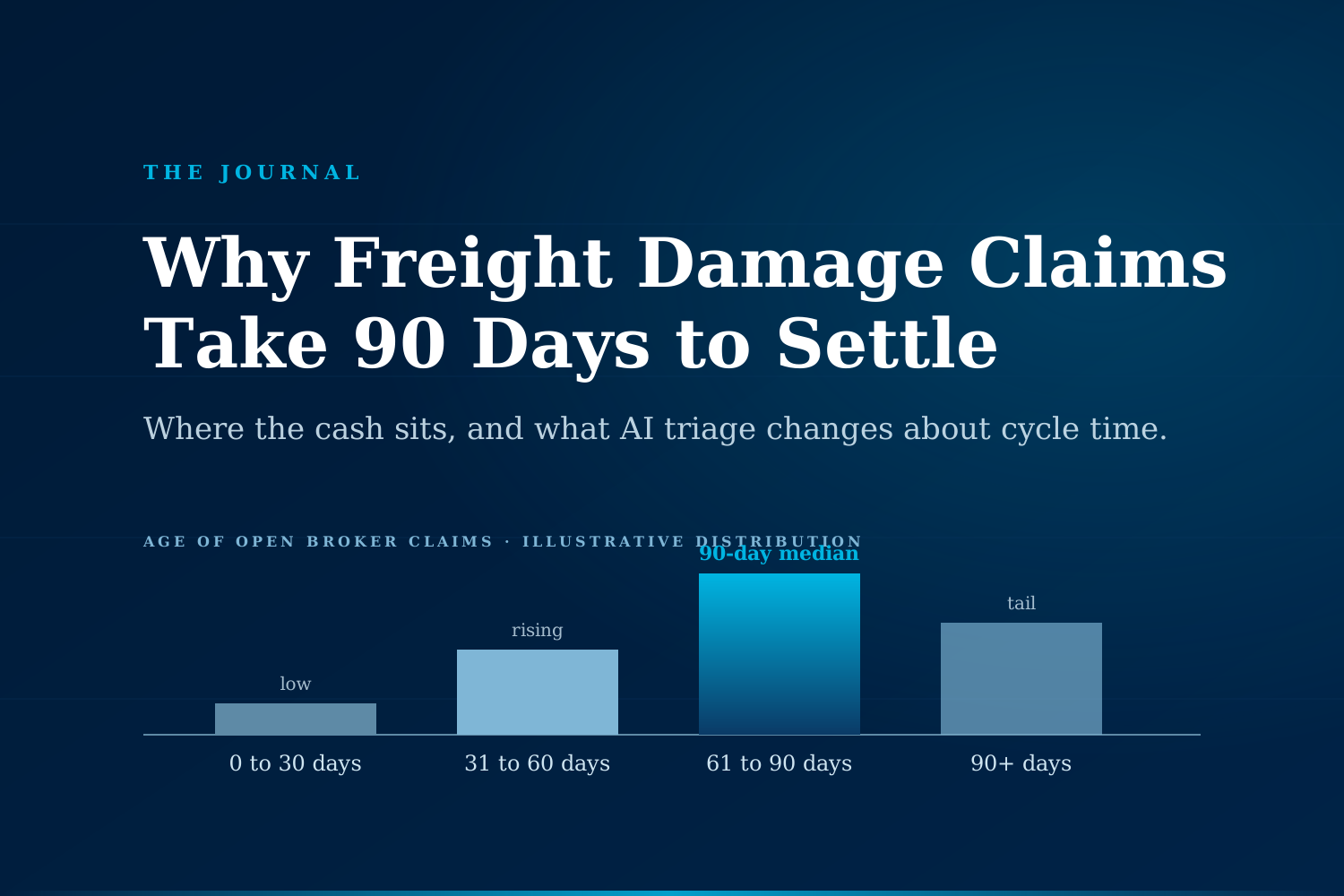
Freight damage claims at mid-size brokers commonly settle in 60 to 120 days, with a 90-day median cited across logistics surveys. The drag is not the claim itself. It is the handoffs: photo collection from receivers, BOL annotation, carrier inertia, and the slow drip of follow-up emails that never get prioritized.
This article looks at why brokerage claim cycles stretch to 90 days, where the cash actually sits while the file waits, and what changes when intake, evidence gathering, and follow-up are handled by an AI-assisted desk instead of a single overloaded clerk.
What slows freight damage claim settlement?
A claim looks simple on paper. A pallet arrives short or damaged, the receiver notes it on the bill of lading, the broker files with the carrier, the carrier pays. In practice, almost every step in that chain depends on documents that nobody collects in the same place at the same time.
Industry estimates from groups like the Transportation Intermediaries Association put the average broker claim cycle at roughly 90 days, with high-value or contested claims drifting past 180. NMFTA cargo claim guidelines, which most asset-based carriers follow, allow 30 days to acknowledge a claim and up to 120 days to resolve it, so even a clean filing can legally sit for four months before any cash moves.
The reasons claims drag tend to repeat across brokerages:
- The proof-of-damage file is incomplete the day the claim is opened.
- Carrier claims departments do not respond unless emailed weekly.
- The receiver who signed the BOL has moved on and will not return calls.
- The shipper has already invoiced the customer and stops following up.
- The broker AP team owns the claim but is measured on invoice posting, not claim recovery.
None of those are technology problems on their own. They are coordination problems. When the coordination work is split across three or four mailboxes, the file stalls.
Where does the cash actually sit during a 90-day claim?
The interesting question is not how long the claim takes. It is who is holding the money while it waits.
In most broker arrangements, the shipper is paid one of three ways: the broker absorbs the loss and recovers from the carrier later, the shipper short-pays the broker on the original invoice, or the loss is netted against future settlements. In all three cases, somebody's working capital is tied up while the claim sits open.
For a brokerage moving 2,000 loads a month with a claim rate near the industry norm, where logistics surveys typically report 0.5 to 1.5 percent of shipments generating a claim, that is roughly 10 to 30 open claims at any moment. At an average claim value of $1,500 to $4,000, that puts $15,000 to $120,000 of working capital trapped on the desk at any given time. None of it is earning margin while it waits.
For a broker on factoring, the math is sharper. Factored invoices linked to disputed PODs sometimes get pulled back, and the factor's reserve grows. The claim drag effectively borrows from tomorrow's advance rate.
Manual claims handling vs AI-assisted triage
The pattern most brokers run today still relies on a single AP or claims clerk juggling a spreadsheet, a TMS queue, and a separate folder of carrier emails. Here is what changes when intake, document gathering, and follow-up are handled by AI agents instead.
| Step | Manual claims desk | AI-assisted triage |
|---|---|---|
| Intake | Clerk opens ticket from inbound email, retypes details into TMS | Agent reads the email, opens the claim, attaches the rate confirmation and BOL automatically |
| Evidence pack | Clerk emails receiver for photos, waits 3 to 7 days for a reply | Agent requests photos at intake, follows up daily until received |
| Carrier filing | Clerk fills the carrier's web portal manually | Agent prefills portal fields from the assembled pack |
| Follow-up cadence | Weekly email, often skipped during peak | Daily structured check on every open claim |
| Status visibility | Spreadsheet updated when someone remembers | Live dashboard, age-bucketed, owner assigned |
| Median cycle | 90 days or more | 30 to 45 days typical when documents are complete on day one |
The compression does not come from the AI being smarter than the clerk. It comes from the AI never waiting until Monday to send the follow-up.
Why do carriers wait the broker out?
Asset-based carriers know that a meaningful percentage of broker claims are abandoned. Estimates from claims-recovery firms suggest 15 to 25 percent of valid broker claims are written off because the broker stopped chasing. Carriers are not adversarial about this. They are triaging their own queue, and the squeakier the wheel moves first.
When follow-up is automated and consistent, the broker's files start jumping the queue without anyone raising their voice. The carrier claims rep begins to recognize that this particular brokerage's files arrive complete and get followed up on every week, so the file moves earlier in the stack. The reputational shift compounds across hundreds of files a year.
What does an AI-augmented claims desk make possible?
The clearer benefit is not the labor savings, although a single claims clerk handling 200 open files instead of 50 is real. It is the second-order effects:
- Cash conversion. A 30 to 45 day cycle instead of 90 means roughly half to two-thirds less working capital trapped at any moment.
- Recovery rate. Claims that would have been written off because nobody chased them get settled. A 5 to 10 point lift in recovery rate is common once the desk stops dropping files.
- Shipper retention. Shippers notice when a broker pays out cleanly and quickly on a damaged pallet, and they reward it with repeat lanes.
- Carrier relationships. Paradoxically, carriers prefer brokers whose claim files arrive complete and predictable, even when the broker is firmer about follow-up.
- Sales capacity. When the AP lead is not personally chasing claims, the desk can absorb growth without adding a head.
None of this is exotic. The pieces exist in most TMS platforms already, just disconnected. What changes is who, or what, is doing the connective tissue work between intake and settlement.
Three signs your claims desk is dragging
If any of the following sound familiar, the cycle time is probably north of 90 days:
- Your AP team cannot tell you, without opening a spreadsheet, how many claims are currently open and what they total.
- Claims older than 60 days outnumber claims under 30 days on the open list.
- Your largest shippers have a separate email thread to chase you on claims you forgot about.
Brokers who have moved this work onto an AI-augmented desk tend to report the same shift in routine. The dashboard becomes the first thing the AP lead looks at each morning, not the spreadsheet they used to dread.
When is the right moment to look at this?
The honest answer is before peak. Claim volume rises in produce season, holiday DTC peak, and end-of-quarter shipper push, and a desk that is already behind in May will be visibly underwater by September. The work to stand up structured intake and follow-up is calmer to do in a quieter month.
That said, the most common signal that prompts a broker to look at claims automation is not a date. It is a single conversation with a shipper about a claim everyone forgot about, which surfaces a longer list of files that have been sitting unowned.
Curious where your own cycle is leaking time? We run a completely free automation audit for mid-size brokerages that want a second opinion on where cargo claims, follow-up, and AR are dragging. No deck, no pricing pitch, just a working diagnosis of where the cash is sitting and what could come unstuck first. → Book the audit
Sami Raza
Software Developer & Technical Author
Sami Raza builds AI automation for logistics, DTC, and construction operations teams at ApexifyLabs, and writes about the operational failures that automation is actually worth pointing at.