Freight Bill Audit: Sampled vs AI Line-Item Review
Sampled freight bill audit misses systematic small overcharges. AI line-item review reads every invoice against the contract, and the recovered margin shows up.
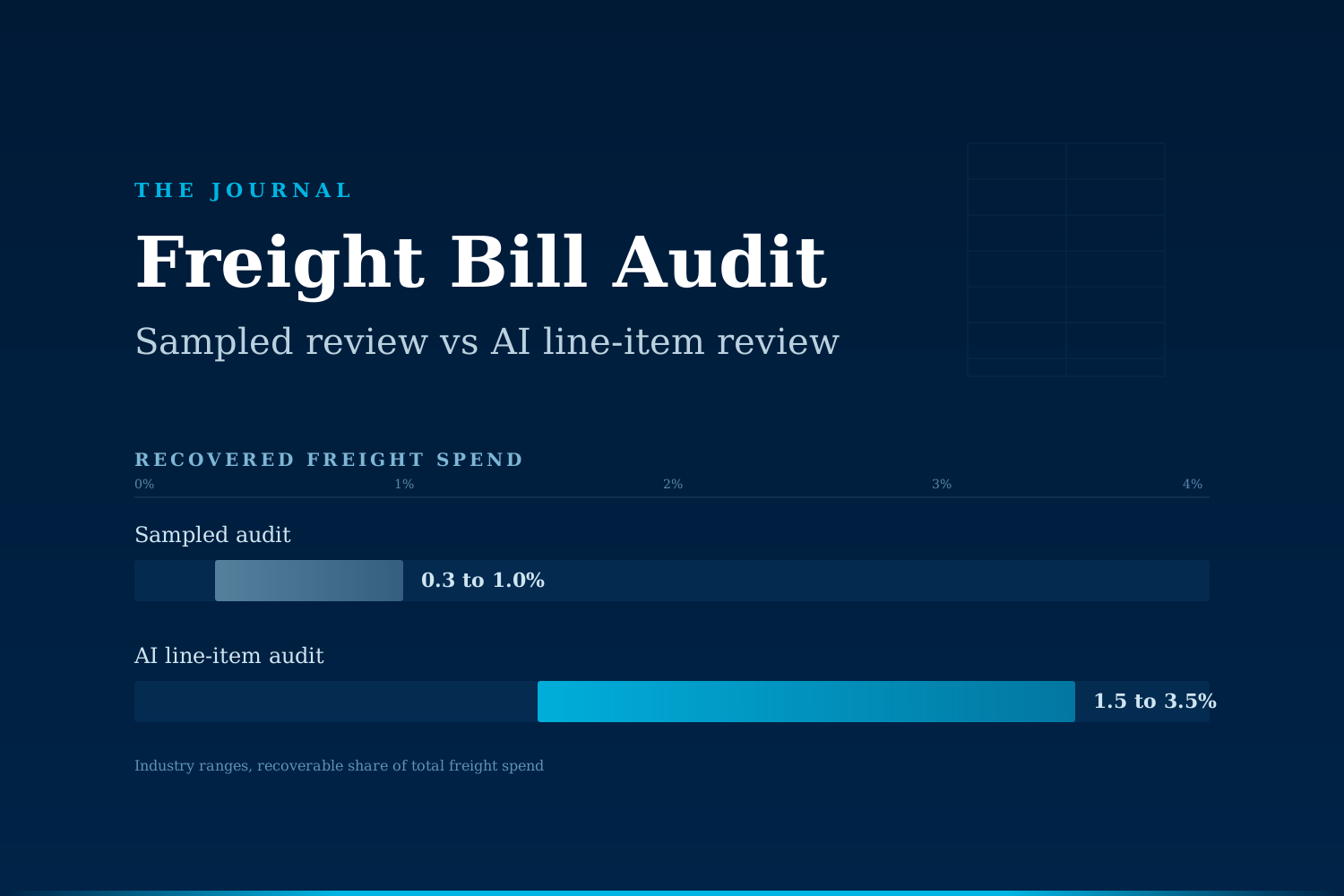
Most brokerages and mid-market shippers audit 5 to 10 percent of carrier invoices, accepting the rest as too small or too time-consuming to verify. Line-item AI review changes that math: every invoice gets read against the contract, every accessorial gets validated, and the recovery shows up where it used to disappear.
What is freight bill audit, and why has it always been a sampling job?
A freight bill audit compares each carrier invoice, the rate confirmation, and the accessorial charges against the agreed contract, and flags anything that does not reconcile. For decades, this has been a sampling job. A clerk pulls invoices over a threshold (commonly $500 or $1,000), spot-checks accessorial codes against the contract, looks for duplicate billings, and approves the rest.
The Council of Supply Chain Management Professionals has long observed that fewer than half of mid-market shippers audit more than 10 percent of inbound freight invoices, simply because the labor cost of reading every line exceeds the average recoverable amount per invoice. The math works out, at first glance. If your average overcharge is $40 and your clerk costs $35 per hour, anything that takes more than seven minutes to review is a wash. So sampling stays the default, and the long tail of small overcharges keeps funding the carrier's accessorials desk.
What gets missed when an audit only sees 5 to 10 percent of invoices?
Systematic patterns. A one-off overcharge on a $200 invoice does not look like much. But when the same carrier consistently bills a $25 lumper fee that was never in the rate confirmation, across 800 loads in a quarter, that is a $20,000 leak that no sampling protocol will catch because no single invoice trips a threshold.
Common patterns that slip past sampled audits:
- Reclassification creep on LTL. Carriers reweigh and reclass shipments at the terminal. If a 250-pound shipment gets bumped from class 70 to class 92, the rate jumps significantly. ARC Advisory Group has reported that disputed reclassifications regularly account for 1 to 3 percent of LTL invoice errors.
- Fuel surcharge index drift. The contracted fuel surcharge often references a specific DOE index, a stated week, and a stated discount. Carriers occasionally bill against a different index or a lagging week. Pennies per mile, but on a $1.2 million annual fuel-surcharge bucket, the swing matters.
- Accessorials billed twice. Detention and layover sometimes get coded under both labels for the same incident. Sampled audits catch the obvious double-billings. The non-obvious ones (different accessorial codes representing the same event) survive.
- Duplicate invoices. A re-billed claim or a corrected invoice lands in AP without the original being voided. AP pays both because the invoice numbers differ.
- Off-contract accessorials. Lumper, detention, layover, redelivery, reconsignment, inside delivery. Each carrier has a slightly different code list. If the rate confirmation did not enumerate them, the carrier's default tariff applies, which is almost always higher than what was negotiated.
None of these single events trip a sampling threshold. They show up only when you read everything.
Where does the overcharge actually come from?
Most overcharges are not fraud. They are noise: a billing clerk applying the wrong tariff, a TMS auto-populating an accessorial that was supposed to be waived, a dispatcher misreading a stop-off as a layover, a fuel index pulled on the wrong day. The carrier is not trying to overcharge. The system is just generating bills faster than humans can verify them.
Industry surveys consistently report invoice error rates in freight (combining duplicate, off-contract, mathematical, and classification errors) sitting between 4 and 8 percent of invoices on a typical book. Of those, recoverable dollars often land between 1 and 3 percent of total freight spend when audited at depth, and lower when audited only at the sampled level.
What changes when AI reviews every line item?
When the audit shifts from sampled-by-humans to every-line-by-AI, the economics flip. The marginal cost of reviewing one more invoice approaches zero. Instead of asking "is this invoice worth seven minutes of labor to verify," the question becomes "is this invoice worth one second of inference."
The output is not a stack of approvals. It is a triage queue. Invoices that match the contract pass silently. Invoices with flagged exceptions land in front of a human with the specific discrepancy already isolated and the contract clause referenced. The human reviews the exceptions, not the entire universe.
That shift produces three observable changes on the desk:
- Recovery rate climbs. Many operations see a 2 to 4x lift in recovered dollars in the first 90 days, simply because invoices that were never read are now being read.
- Audit cycle time collapses. Sampling audits often run on a monthly cadence because the queue grows faster than the clerk can process it. Per-invoice AI review runs continuously, so disputes get filed inside the carrier's typical 90-day dispute window instead of after it.
- Carrier behavior shifts. Once a carrier learns that every invoice is read, the systematic overcharges that depend on no one looking tend to decline. The recovery curve flattens after the first 6 to 12 months, which is what success looks like, not failure.
Sampled audit vs AI line-item audit
| Dimension | Sampled human audit | AI line-item audit |
|---|---|---|
| Coverage | 5 to 10% of invoices, usually over a $500 threshold | 100% of invoices, all dollar values |
| Audit cycle | Monthly batch, often 30 to 60 days behind | Continuous, within hours of invoice receipt |
| What gets caught | Large overcharges, obvious duplicates | Systematic patterns, small recurring errors, fuel index drift, reclass creep |
| Dispute window risk | Often missed (past 90 days) | Comfortable margin inside the carrier window |
| Cost basis | Linear in headcount | Fixed plus marginal compute |
| Human role | Reviewer of every invoice | Reviewer of pre-flagged exceptions |
| Typical recovery (industry range) | 0.3 to 1.0% of freight spend | 1.5 to 3.5% of freight spend |
| Behavioral effect on carriers | Limited (carriers know what is sampled) | Notable (carriers know nothing is hidden) |
What does the recovered margin look like on a typical book?
For a brokerage managing $40M in annual freight spend, the difference between sampled and line-item audit often lands between $400K and $1.2M in additional recoveries per year, plus avoided overpayments that never reach AP in the first place. For a mid-market shipper at $15M of freight spend, the range compresses to roughly $150K to $450K, still well above the cost of running the audit.
These ranges are not universal. Operations with tight carrier contracts, clean rate confirmations, and disciplined accessorial coding sit at the low end. Operations with sprawling carrier rosters, ad hoc spot rates, and informal accessorial agreements sit at the high end. The audit reveals where on that curve a book actually lives, which is often the most useful artifact of the exercise.
When does this pay back, and when does it not?
The payback case is strongest when three conditions hold:
- Freight spend is large enough that 1 to 2 percent recovery covers the cost of running the audit (a rough threshold: $5M or more in annual carrier spend).
- Contract structure is documented, even if imperfect. AI line-item review needs something to compare against.
- The operation has the appetite to actually file disputes. Recovery only exists if claims are filed inside the carrier's dispute window, with supporting documentation attached.
The case is weakest when the carrier roster is small (under 10 carriers), the spend is concentrated in a few full-truckload lanes with simple rate structures, and the existing manual audit is already catching most of the obvious errors. At that size, the recoverable gap is often too narrow to justify a parallel audit layer.
Reviewing every line instead of a sample is a data-processing problem with your own rate rules at the centre of it, which is why this tends to land as a bespoke AI system rather than an off-the-shelf audit tool. The individual charge types are broken down in LTL reweigh fees, LTL reclass charges, and the accessorial revenue most brokerages never bill.
The honest constraint: what AI line-item audit does not do
It does not renegotiate rates. It does not onboard new carriers. It does not resolve disputes that the carrier refuses to acknowledge. It does not replace a contract attorney when the underlying rate confirmation is ambiguous. It is also not the audit firm: AI handles the reading, the disputing still wants a human who knows the carrier and can pick up the phone.
What it does is read every invoice, in full, against the contract, every time, and put a human in front of only the ones that need a human. The recovery is real and the workload reduction is real, but the strategic work (carrier strategy, contract structure, lane planning) stays where it always was.
What does this look like on your desk?
The first signal is usually quiet. Total freight spend stays flat or rises gently, and no one can explain whether the rise is volume, mix, or creeping overcharges. The second signal is louder. The audit clerk is consistently 30 to 45 days behind, and the carrier dispute window has effectively become the deadline for finding overcharges, not for resolving them.
If either signal sounds familiar, we run a completely free automation audit for brokerages and mid-market shippers that want a clear-eyed view of where the recoverable margin actually lives before committing to anything. No slide deck, no commitment, just an honest read on the recovery math and the next move. → Book the audit
Sami Raza
Software Developer & Technical Author
Sami Raza builds AI automation for logistics, DTC, and construction operations teams at ApexifyLabs, and writes about the operational failures that automation is actually worth pointing at.