DTC Returns: Where the Margin Goes After the Refund
The refund is the visible cost of a DTC return. Reverse logistics, restocking, write-downs, and LTV impact compound on top. Here is where the margin actually goes.
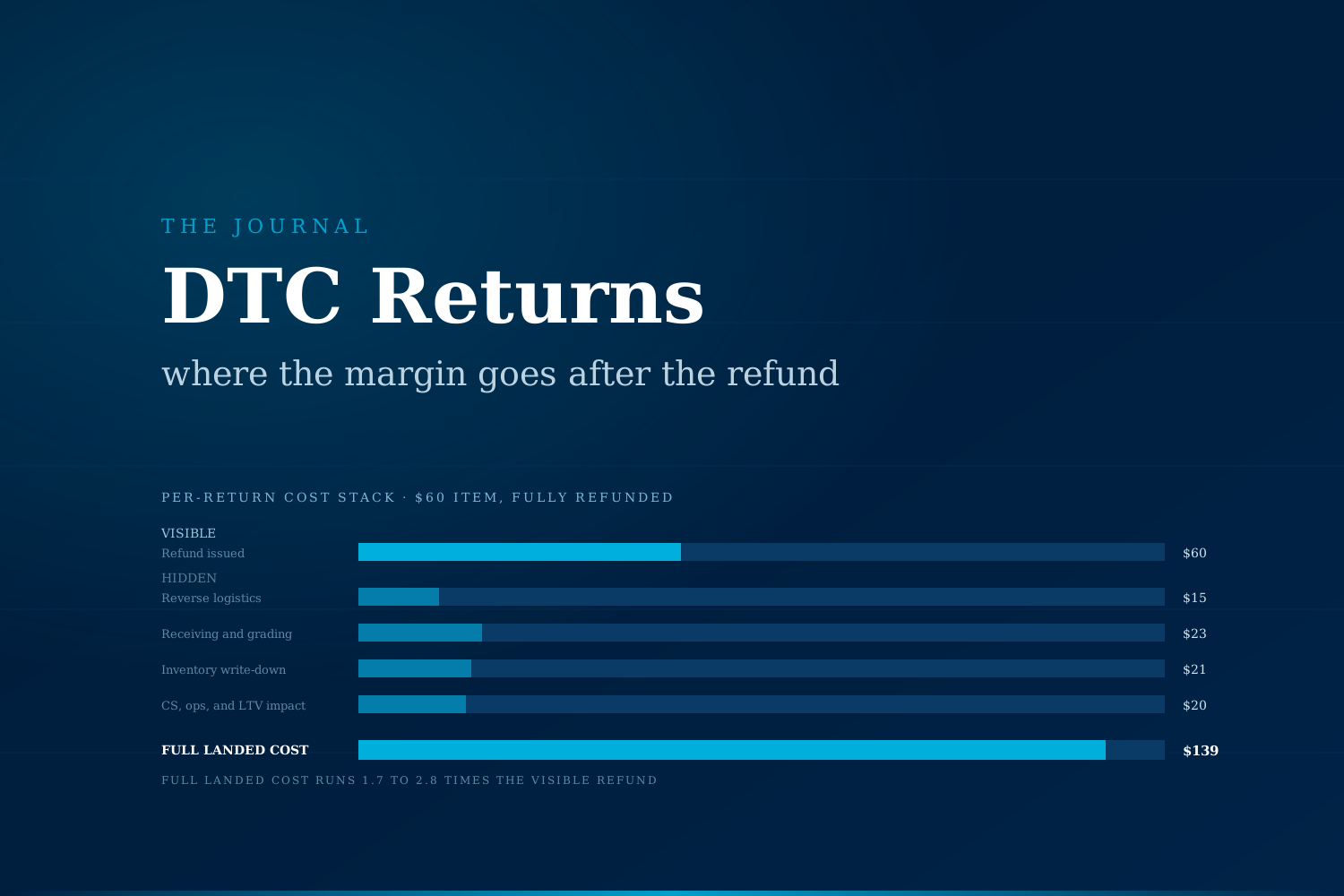
On a $10M to $30M DTC brand, the visible cost of a return is the refund. The real cost lands closer to two times that figure, distributed across reverse logistics, restocking labor, inventory write-down, and the lifetime-value impact of how the return is handled. Here is where the margin actually goes.
What does the visible cost of a DTC return actually cover?
The number a brand watches in a returns dashboard is usually one of two things: the dollar value of refunds processed, or the percentage of orders refunded. Both are useful, both are partial. Refunds are a real cost, but they sit on top of a stack of operational costs that almost never roll up into the same view.
National Retail Federation and Appriss Retail surveys put the 2023 online return rate around 17.6%, and apparel and footwear regularly exceed 25%. On a $20M DTC brand, that translates to roughly $3.5M to $5M in returned merchandise moving back through the system every year. The refund line absorbs the headline. The rest of the cost lands across logistics, fulfillment, finance, and CS lines, and is rarely added together.
Where does the rest of the cost hide?
Five places. None of them show up cleanly under "returns" in a P&L, which is the entire problem.
Reverse logistics
Every returned item needs a label, a carrier pickup or drop-off, an inbound scan, and a routing decision (back to the 3PL, back to a vendor, to a refurb facility, to liquidation). Industry returns research from Optoro and Narvar puts the average all-in reverse-logistics cost between 15% and 30% of the item's original value, with apparel sitting near the high end because of the small-parcel multi-touch shipping pattern. On a $60 item, that is $9 to $18 before anyone looks at the product itself.
Restocking and grading labor
Once the parcel lands at a 3PL or in-house warehouse, someone has to open it, inspect, photograph if disputed, grade as new or used or damaged, repackage if resellable, and re-shelve. Industry surveys consistently report processing cost between $15 and $30 per item for soft goods, more for higher-touch SKUs. That cost is invisible to most brand teams because it is buried inside the 3PL invoice as a per-touch line item.
Inventory write-down and resale loss
A meaningful share of returned product cannot be resold at full price. Apparel that went out, was tried on, and came back is rarely A-grade. Returned items are written down, moved to outlet, sold via a discount channel, or liquidated. Optoro's industry data has consistently put the resale loss between 20% and 50% of original retail depending on category. On apparel, the brand effectively lost the retail-to-cost margin twice: once on the original sale, again on the second-life sale at a discount.
Refund-fraud and serial-returner exposure
The 2023 NRF and Appriss Retail Consumer Returns report estimated return fraud at roughly 13.7% of total returns, including wardrobing, false claims of damage, and bracketing abuse. On a brand with $4M in annual returns, that is over half a million in fraud-shaped cost moving through the system. Without structured returns data, brands cannot see which customers, channels, or campaigns are correlated with elevated fraud risk.
Customer-experience and LTV impact
The return is also the second-most important customer touchpoint after delivery. A friction-free return correlates with repeat purchase. A frustrating one (slow refunds, opaque status, no proactive communication) shows up in churn cohorts months later, never traceable back to the return that caused it. Narvar's post-purchase research consistently puts repeat-purchase rates two to three times higher for customers with a positive return experience versus a negative one.
Stack these together and the math is straightforward.
What does the full landed cost of a DTC return look like?
The table below is illustrative for a $60 apparel item being returned and refunded in full. Specific numbers shift by category and 3PL contract, but the shape of the stack is consistent across most $5M to $30M DTC brands.
| Cost component | Typical range per return | Visible to most brand teams? |
|---|---|---|
| Refund issued | $60 (100% of item) | Yes (returns dashboard) |
| Reverse-logistics shipping | $9 to $18 | Sometimes (3PL invoice) |
| Receiving, grading, restocking labor | $15 to $30 | Rarely (rolled into 3PL line) |
| Inventory write-down or resale loss | $12 to $30 | Rarely (finance accrual) |
| CS and ops time on the case | $3 to $8 | No |
| LTV impact of friction (probabilistic) | $5 to $25 | No |
| Total landed cost | $104 to $171 | Almost never |
The headline refund of $60 is the floor, not the ceiling. The full landed cost is consistently 1.7 to 2.8 times the visible refund. That ratio is why returns can be one of the most expensive operational categories on a DTC brand and still appear "normal" inside the dashboard.
What does a manual returns desk actually do every day?
A typical $10M to $30M DTC brand runs returns the way it ran them at $2M, just with more people. A CS rep opens a ticket. A return reason gets selected from a dropdown that the customer half-cares about. A label gets generated. The package eventually lands at the 3PL. A warehouse associate inspects it. Status updates trickle back. The customer emails to ask where their refund is. CS replies. Finance reconciles. Someone, sometimes, looks at the return reason data quarterly.
Across that flow, almost nothing is structured. The return reason is a free-text or low-quality dropdown. The decision of refurb versus liquidate versus return-to-vendor sits in a warehouse worker's head. Fraud signals (third return this quarter from the same address, all marked "damaged") are never assembled into a flag. The brand learns about a SKU's quality issue from a quarterly review, not from the second return that should have triggered a quality-control alert.
The desk is not unprofessional. It is just running on inboxes and warehouse intuition rather than on data.
What changes once AI handles the routine returns triage?
The shift is not "fewer humans on returns." It is "humans on the cases that actually need judgment, agents on the cases that do not."
Three things change in shape.
- Return reason gets structured at the moment of submission. Free text and low-quality dropdowns get classified into a real taxonomy (size, fit, defect, damage, late, changed mind, fraud-suspect), which lets quality and merchandising teams act on it instead of skimming it.
- Routing decisions move from warehouse intuition to a rules layer. The decision of refurb, liquidate, return-to-vendor, restock as A-grade, restock as B-grade is made consistently and is auditable. Resale loss tightens because no item gets routed to liquidation when it could have gone to outlet, and vice versa.
- Fraud signals get assembled across the customer's history. Repeat returners with damage claims, addresses correlated with bracketing, post-promo refund spikes. The patterns become visible while there is still time to act on them, instead of after the quarter closes.
The CS team is left handling the genuinely ambiguous cases: the high-value customer with a complicated complaint, the wholesale partner needing a custom return authorization, the warranty claim outside policy that probably should be honored anyway. Those cases get more time and better outcomes because routine ones are off the queue.
When does returns become an ops problem rather than a CS problem?
There is a quiet inflection point on most DTC brands. While the brand is small, returns are a CS workflow because volume is low and edge cases dominate. Past a certain volume, returns become an operations and finance problem, and treating them as a CS workflow leaves money on the table.
Signals the inflection has already happened:
- Returns are running above 15% of net orders and the trend line is flat or rising.
- The brand cannot cleanly answer "what is our top return reason this quarter" from a dashboard without a CS lead spending an afternoon on it.
- Resale-loss accruals appear in finance reviews but are not tied to specific SKUs, vendors, or campaigns.
- The same customer addresses appear repeatedly in damage and "never received" claims, but no flag triggers.
Most brands we talk to see at least two of these. The cost is real. Like most operational drag at this stage, it is the kind that is easy to live with because it never lands as a single visible line item.
Three signs returns are quietly costing more than they look
- Refund-cycle time on routine cases is measured in days, not hours. When refund issuance lags the inbound scan by several days, both LTV and CS load take a hit, and the cost is doubled because the same customer emails CS to ask where their money is.
- The brand's "return rate" is a single number rather than a cohort. Brands that cannot break the rate by SKU, channel, campaign, and customer cohort are flying blind on the highest-leverage place to act.
- Quality issues on a SKU are discovered in quarterly review, not by the second return. A returns desk that does not surface the second damage claim on the same SKU within a week is leaving merchandising and QC dollars on the table every cycle.
Curious what your full landed return cost actually is?
We run a completely free automation audit for DTC ops teams that want a second opinion on where returns are leaking margin before committing to anything. No slide deck, no procurement gauntlet. We map your current returns flow, look at the points where cost compounds invisibly, and show you what the same desk looks like with structured data and an AI triage layer on top.
Sami Raza
Software Developer & Technical Author
Sami Raza builds AI automation for logistics, DTC, and construction operations teams at ApexifyLabs, and writes about the operational failures that automation is actually worth pointing at.