Why DTC False Declines Cost More Than the Fraud They Stop
Every DTC brand with a fraud screen blocks more legitimate orders than fraudulent ones. The lost-revenue gap rarely shows up on the ops dashboard, but it is consistently the larger number.
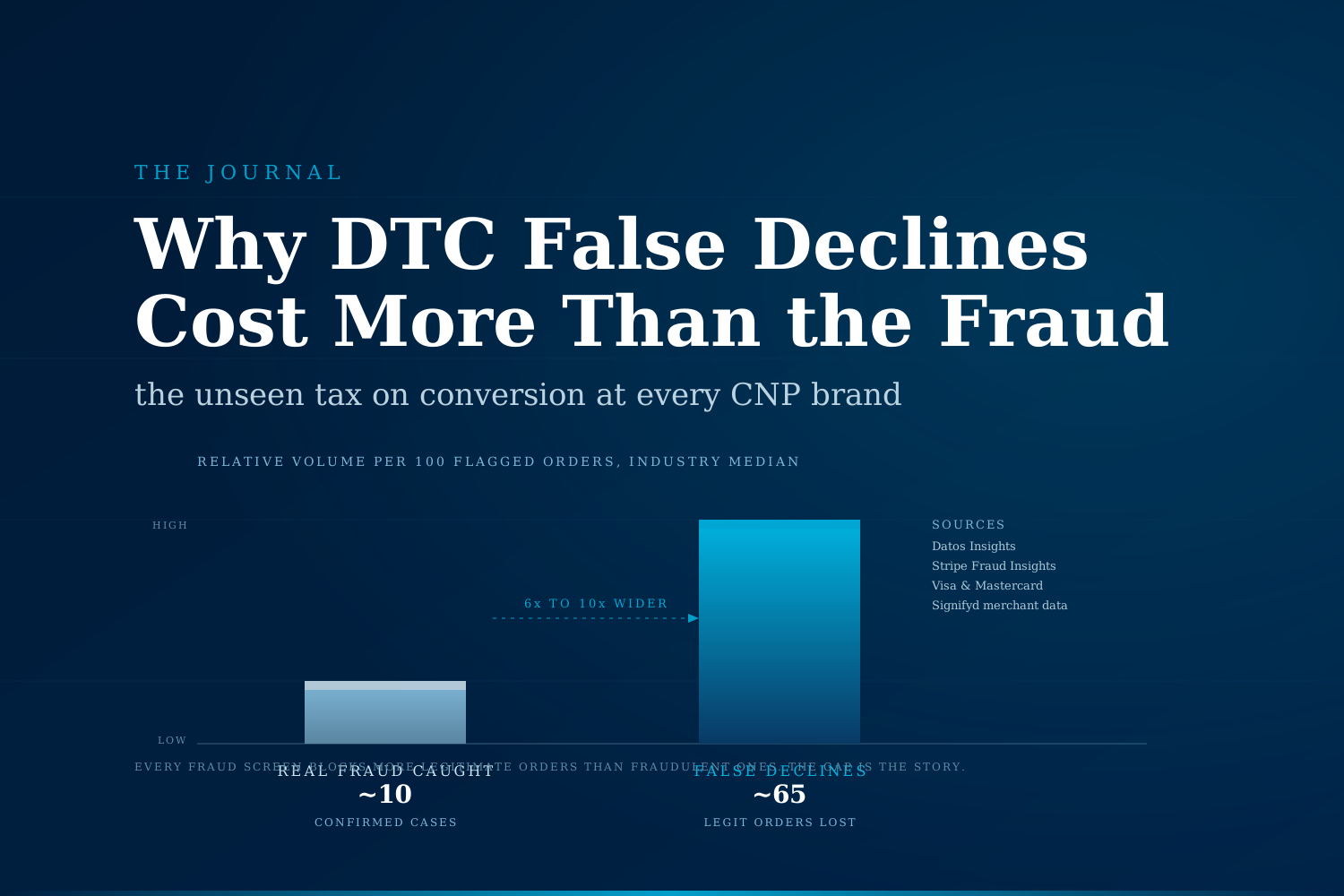
Every DTC brand running card-not-present payments lives with a fraud screen, and that screen rejects more legitimate orders than fraudulent ones. Industry research consistently shows false declines outpace confirmed fraud by 5x to 10x on typical CNP traffic. For a brand between $10M and $30M in annual revenue, the gap is not academic. It is a recurring tax on conversion that rarely shows up on the ops dashboard.
What is a false decline, and why do payment screens produce them?
A false decline (sometimes called a false positive or a "good order rejected") is a legitimate purchase blocked or held by the layered risk engines sitting in front of checkout. Most DTC brands run two or three of these stacked together: the processor's native score (Stripe Radar, Adyen Risk Hub, Braintree Advanced Fraud Tools), a third-party screen (Signifyd, Riskified, Forter, Kount, NoFraud), and an internal rules layer the ops team has accumulated over years of incidents.
Each layer is tuned to err on the side of caution. The cost of letting fraud through (chargeback, lost inventory, processor penalty, monitoring-program risk) is concrete and lands in someone's inbox. The cost of rejecting a real customer is diffuse, delayed, and shows up as a missing repeat purchase six months later. So the screens drift toward strictness, and the same signals that fraudsters trigger (travel mismatches, gift shipments to a different name, prepaid cards, first-time high-AOV orders, multiple cards on one device) catch a lot of real customers too.
How wide is the gap between real fraud and false declines?
Wider than most ops leaders expect. Stripe's published fraud reporting, research from Datos Insights (formerly Aite-Novarica), and merchant surveys from the major card networks all converge on a similar finding: false declines outnumber confirmed CNP fraud by 5x to 10x on typical merchant traffic. The exact ratio swings by category. High-AOV verticals (jewelry, electronics, supplements, premium apparel) take harder hits because the rules are tuned tighter. International orders, gift shipments, and first-purchase customers disproportionately end up in the hold queue.
The dollar direction is also consistent. Industry estimates from Visa, Mastercard, and the major fraud-screening vendors place the global cost of false declines well above the cost of actual CNP fraud. The exact totals vary by report, but the ratio holds. Brands collectively reject more revenue at the gate than they lose to fraud after the gate.
What does the math look like at a $15M DTC brand?
A concrete walk-through, using conservative inputs and standard benchmarks:
| Variable | Value |
|---|---|
| Annual revenue | $15M |
| Average order value | $120 |
| Annual orders | ~125,000 |
| Flagged-for-review rate | 4% (~5,000 orders) |
| False-positive share of flagged | 65% (~3,250 orders) |
| Abandonment during the review delay | 40% (~1,300 orders) |
| First-purchase revenue lost | ~$156,000 |
| LTV multiplier on a DTC repeat buyer | 3x to 5x |
| Total annualized LTV impact | $470K to $780K |
These are not stretch numbers. Datos Insights has reported false-positive shares above 65% on average CNP merchants. Klaviyo and Shopify benchmark reports consistently put returning-customer LTV multipliers in the 3x to 5x band for established DTC brands. The 40% abandonment figure tracks Baymard Institute checkout research on what happens when an authorization fails or a verification step is added mid-checkout.
The point is not that the model is precise. It is that the order of magnitude is half a million dollars a year on a $15M brand, and almost none of it shows up on the dashboards the ops team reviews each morning.
Why does the catch rate get prioritized over the false-decline rate?
Because catch rate is visible and false-decline rate is not. The chargeback notification arrives in the merchant's inbox with a dollar value attached. The rejected customer quietly disappears, sometimes leaving a confused support ticket, more often just going to a competitor. Measuring false declines requires customer-side data (the rejected buyer who complained, the lapsed LTV cohort, the abandoned auth that never reattempted), and almost no ops team has that data wired in.
The internal incentives are also lopsided. The fraud team is measured on the chargeback ratio. Pushing the screens tighter is the obvious lever, and it works, until the curve flips and the legitimate-order losses dwarf the fraud savings.
Manual hold review vs AI-augmented triage: what actually changes?
| Dimension | Manual hold queue | AI-augmented triage |
|---|---|---|
| Decision time | Hours to days | Seconds to minutes |
| Reviewer context | Order screen, maybe a CRM tab | Full order history, device fingerprint, behavioral signals, communication trail |
| Authorization expiry losses | Frequent, especially overnight | Rare |
| False-positive rate | High and uneven across reviewers | Vendor-reported reductions of 30% to 60% on the flagged cohort |
| Customer experience | Silent hold, sometimes a cancellation email | Real-time soft verification (3DS step-up, ID check, lightweight email confirmation) or instant approval |
| Reviewer capacity ceiling | Scales linearly with headcount | Scales with data and rules |
| Audit trail | Inconsistent across shifts and reviewers | Uniform, reviewable, learnable |
The shape of the desk changes more than the headcount. A senior fraud analyst is still in the loop, but the queue they look at is shorter, more genuinely ambiguous, and arrives with context already assembled. The bulk of the legitimate-looking orders move through automatically, before the authorization window expires and the customer gives up.
Where does AI or agentic automation actually fit here?
Underneath the existing screens, not in place of them. The fraud vendors stay. The internal rules stay. What changes is what happens to the orders the screens flag.
Three shifts tend to do the work:
- Legitimate-looking flagged orders resolve fast. Order history, device behavior, prior purchases on the same household, and verified contact data are pulled together in real time, and the order is released before the authorization window closes.
- Genuinely ambiguous orders reach the human reviewer with a complete packet. The reviewer no longer pulls together five tabs of context per case. They see the assembled risk picture and make the call.
- Customer-facing verification becomes proactive. A soft 3DS step-up, an ID check, or a clarifying email goes out within minutes rather than hours, while the customer is still on the page or near the inbox.
We are not laying out the rules engine, the scoring weights, or the verification templates here. The brands we work with do not hire us to wire up Signifyd or to retune Radar. They hire us to untangle the decision logic that already exists across three or four overlapping tools, and to agree on what an automated approval is allowed to do without a human reviewer in the loop. That conversation, not the tooling, is where the real work sits.
Three signals your hold queue is quietly costing more than it saves
Three checks any DTC operator can run in an afternoon:
- Compare the flag rate to the chargeback ratio. If the fraud screen is flagging more than 3% of orders while the chargeback ratio is comfortably inside the card network thresholds (below 0.65% on Visa, below 0.9% before monitoring kicks in), the screen is calibrated tighter than the actual risk warrants.
- Search the support inbox for "order cancelled" and "order declined" over the last 90 days. If the volume is steady and the senders look like genuine customers (familiar emails, prior order history, no obvious risk signals), each of those messages represents at least one repeat purchase that did not happen.
- Look at LTV by acquisition channel against false-decline-prone signals. International traffic, gift-purchase campaigns, and first-purchase high-AOV traffic tend to trigger the screens more often. If LTV on those segments diverges noticeably from your domestic, repeat-buyer baseline, part of that gap is sitting in the hold queue.
Any one of these is solvable on its own. The combination is what makes a brand quietly grow slower than the underlying demand suggests.
Closing
Fraud screens do a job that nobody on a DTC ops team wants to take on manually, and the right answer is rarely to turn them off or loosen them blindly. The cleaner read is to take the false-decline cost as seriously as the chargeback cost, give the hold queue real measurement, and let an AI layer handle the volume that does not need a human reviewer.
If your fraud screen is doing its job on the catch side and you are unsure what the false-decline side is costing you, we run a completely free automation audit for DTC ops teams that want a clear read on where the conversion is leaking. No slide deck, no commitment, just an honest look at the numbers. → Book the audit
Sami Raza
Software Developer & Technical Author
Sami Raza builds AI automation for logistics, DTC, and construction operations teams at ApexifyLabs, and writes about the operational failures that automation is actually worth pointing at.