Daily Reports on GC Jobs: From Forms to AI Summaries
Daily reports cost GC superintendents 30 to 60 minutes a day. AI-assisted compilation moves the mechanical work off their desk while the judgment calls stay.
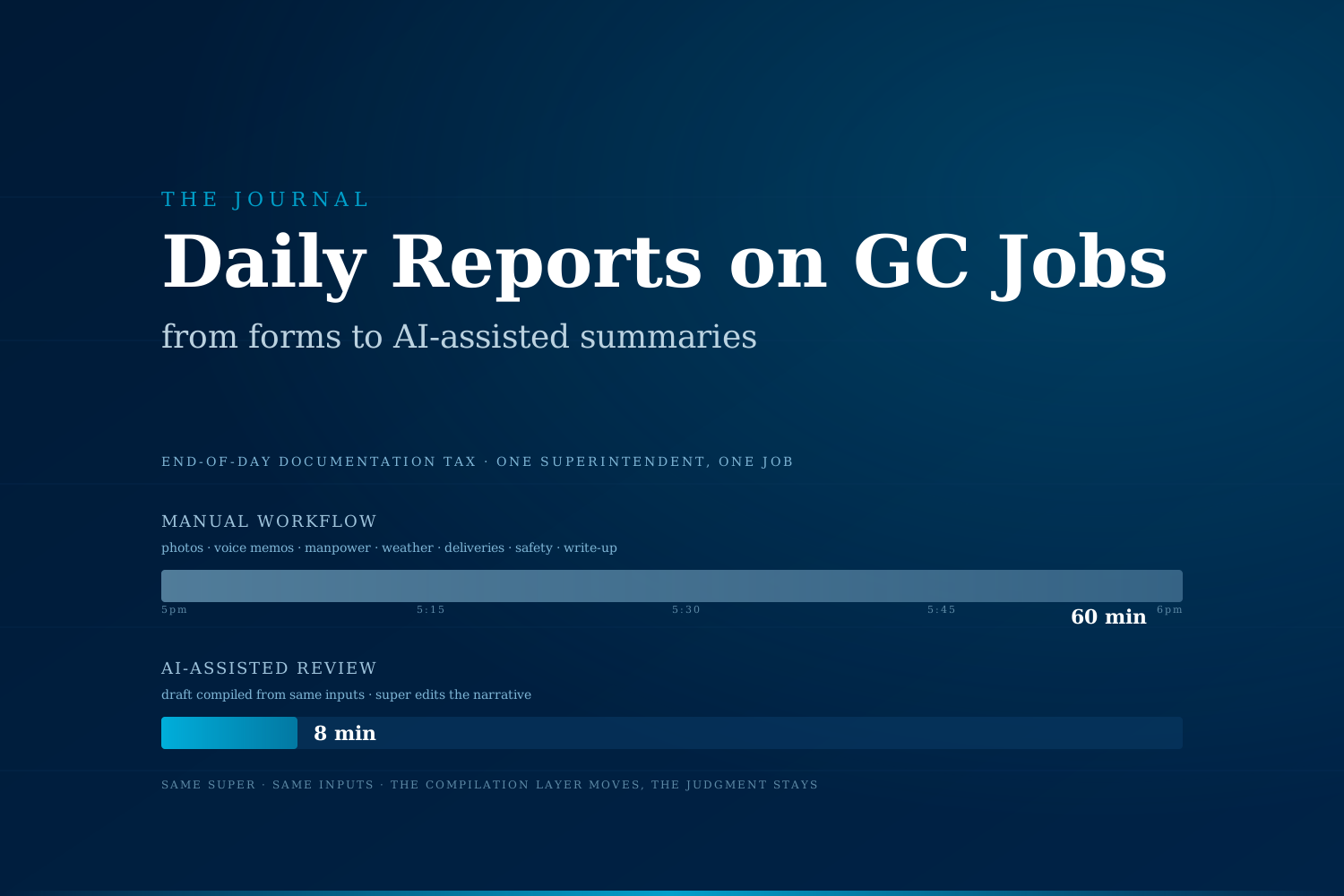
Daily reports are the heartbeat of a construction job, and they cost a superintendent 30 to 60 minutes at the end of every workday. Industry research from Autodesk and FMI consistently puts admin documentation among the largest productivity drags on a GC's field team. The work is straightforward, the volume is large, and the format is exactly what AI is good at compiling.
This article looks at what goes into a construction daily report, where the current workflow leaks the most time, what changes when AI handles the compilation step, and where the cost of staying on forms shows up on a GC's job costs.
What goes into a construction daily report, and why does it take so long?
A daily report from a working construction site is denser than most outsiders realize. A typical entry pulls together manpower (sub by sub, headcount, hours), equipment on site, weather across the day, deliveries that arrived (and the ones that did not), safety observations, work in place against the look-ahead, RFI activity, a visitor log, and a tagged photo set documenting the day's progress.
The job is mostly organization. The super already knows what happened. The work of writing the report is gathering the inputs that prove it: pulling photos off the foreman's phone, transcribing voice memos, checking the morning huddle's manpower sheet against what crews actually showed up, reconciling the delivery log against the schedule. None of it is complicated. All of it has to be done before the super can leave the trailer.
For an active job with three to six subs working at once, that is 30 to 45 minutes of stacking inputs and 10 to 20 minutes of writing. Across a portfolio of jobs and a 250-day construction year, a mid-size GC carries a meaningful documentation tax that nobody invoices directly.
Where does the daily-report workflow actually leak time?
Photo sprawl across phones and apps
A working super, two foremen, and a project engineer can generate 60 to 200 site photos a day across phones, dedicated job-walk apps, and the occasional drone pass. The report needs maybe twenty of them, captioned with location and trade. Picking and labelling that subset by hand is the largest single time-sink in the workflow.
Voice memos that have to become paragraphs
Most supers think and dictate faster than they type. A 90-second voice memo from a walk of the job becomes a paragraph someone has to write later. The translation is mechanical, but it has to happen before the report ships.
Cross-referencing the day against the plan
The report is more valuable when it ties the day's work back to the look-ahead, the schedule of values, and the open RFIs. That cross-reference takes time the super does not always have on a Friday afternoon, so the report ships without it. The downstream cost, weeks later, is that the documentation does not support the pay app, the change order, or the dispute when it shows up.
How does AI change the daily-report workflow?
AI-assisted daily reporting does not write the report from scratch. It collects the inputs the super already produces, structures them into the standard format the GC uses, and hands a draft back for a quick review. The super still owns the narrative call on what mattered today. The compilation work moves.
| Workflow step | Current state | AI-assisted daily reports |
|---|---|---|
| Pull and label site photos | Manual scroll, hand-caption per photo | Auto-grouped by trade and location, captioned from on-site context |
| Transcribe voice memos | Typed up after the walk | Transcribed and slotted into the right report section |
| Reconcile manpower vs huddle sheet | Cross-checked by hand | Compared automatically, exceptions flagged |
| Weather, deliveries, visitors | Logged in three different places | Aggregated into one daily record |
| Tie work in place to look-ahead | Skipped under deadline | Pre-linked, super confirms or edits |
| Time per report | 30 to 60 minutes | 5 to 10 minutes of review |
| Format consistency across jobs | Varies by super | Identical across the portfolio |
The change is not that the report becomes more detailed. It is that the report becomes consistent, fast enough to actually finish before the trailer locks, and useful weeks later as evidence.
What does the cost of slow daily reports look like for a GC?
Three places where the cost lands, even if no line item in the job cost report ever says "daily reports."
- Supervisor hours that never invoice. A super carrying 45 minutes a day of report compilation is carrying roughly four hours a week of work that the owner is not paying for. Across a portfolio of six active jobs and ten supers, that adds up to a measurable share of supervision capacity the firm is spending on documentation rather than on the job.
- Weak documentation when disputes surface. Change orders, T&M claims, schedule disputes, and warranty arguments all lean on the daily report. The 2018 KPMG Global Construction Survey found just 25% of construction projects came within 10% of their original deadline, which means most projects eventually have a schedule conversation. The GCs who win those conversations are the ones whose daily reports were detailed enough to be evidence.
- Project controls running on lagging data. When the daily report ships at midnight instead of 5 p.m., the PM is making Friday decisions on Thursday's data. McKinsey & Company's Reinventing Construction research has repeatedly identified slow information flow as one of the largest contributors to construction underperformance. The lag is rarely one big event. It is hundreds of small decisions made an information cycle late.
We hear the same pattern from GCs. The daily report is not a single line item anyone budgets against. It sits across supervision, project controls, and dispute exposure, so the total cost is real but invisible.
When does AI-assisted daily reporting earn its keep?
The break-even is more obvious than most GC operators expect. The firms where AI-assisted reporting pays off quickly tend to share three traits.
- Three or more active jobs running concurrently with their own super.
- A pattern of supers leaving the trailer late, or skipping the cross-reference work to make it home.
- At least one dispute or change-order conversation in the last twelve months where the daily reports were not strong enough to settle the question fast.
If any of those are true, the math usually favors moving the compilation layer onto AI. The supers stay. The forms stay. The end of their day shortens.
What stays human in an AI-augmented daily report?
This is the question superintendents ask first, and it is the right one. The judgment calls stay with them. Which safety observation belongs in the report and which is a coaching conversation. Whether a sub's manpower count is the start of a productivity problem or a one-day blip. How to characterize a near-miss for the owner without overstating it. None of that moves.
What moves is the part of the job that is mechanical: pulling photos, transcribing voice memos, reconciling the manpower sheet, formatting the document. The super becomes the editor of a draft that is already most of the way there, instead of the assembler of a document from scratch.
The job change is welcome. Less typing. More time in the field. A report that actually ships at 5 p.m.
Field adoption, not summary quality, decides whether this survives its first month, which is why the work is usually scoped as embedded technical delivery, with an engineer working directly with the field team throughout rollout. The neighbouring reporting load is covered in weekly OAC meeting prep, truck ticket capture on concrete and earthwork jobs, and what slow RFIs really cost.
Three questions for a GC weighing this
Before any tooling decision, three questions tell a GC whether daily reporting is the right place to put automation budget this quarter.
- How long does an average daily report take across our active jobs, and where are the supers when they finish it? The product of report time and active jobs is the supervision capacity the firm is currently spending on documentation.
- In the last twelve months, how many disputes or change orders did we settle slower than we should have because the daily reports were not strong enough? Even a rough number puts the cost in dispute-exposure terms, not admin-time terms.
- Are our daily reports formatted consistently enough across jobs that the owner, the lender, and the schedule consultant see the same thing? Inconsistency between supers chips at credibility in a way that is hard to undo once it lands.
If the answers point to a real problem, this is exactly the part of the operation worth a second look. If they do not, there are usually bigger leaks elsewhere on the desk.
Where this leaves a GC thinking it through
Daily reports are not slow because supers are bad at writing them. They are slow because the workflow asks the most senior field person on the job to be a photo librarian, a transcriber, a manpower reconciler, and a writer, in the same hour at the end of the day. The shift to AI-assisted compilation is mostly about giving that work to the system that is actually good at it, and giving the super the part of the job that needs their judgment.
If your supers are routinely leaving the trailer after 6 p.m., or you have absorbed a dispute in the last year that thin documentation made worse, this is the part of the operation worth a second look.
We run a completely free automation audit for GCs that want a second opinion on where supervision and documentation time are leaking. No commitment, no slide deck, no pressure. → Book the audit
Sami Raza
Software Developer & Technical Author
Sami Raza builds AI automation for logistics, DTC, and construction operations teams at ApexifyLabs, and writes about the operational failures that automation is actually worth pointing at.