Closeout Drag: What Stalled Punch Lists Cost a GC
Punch list backlogs trap retainage, burn PM hours, and erode sub goodwill. A look at where the time actually goes at closeout, and what changes when AI handles the chase.
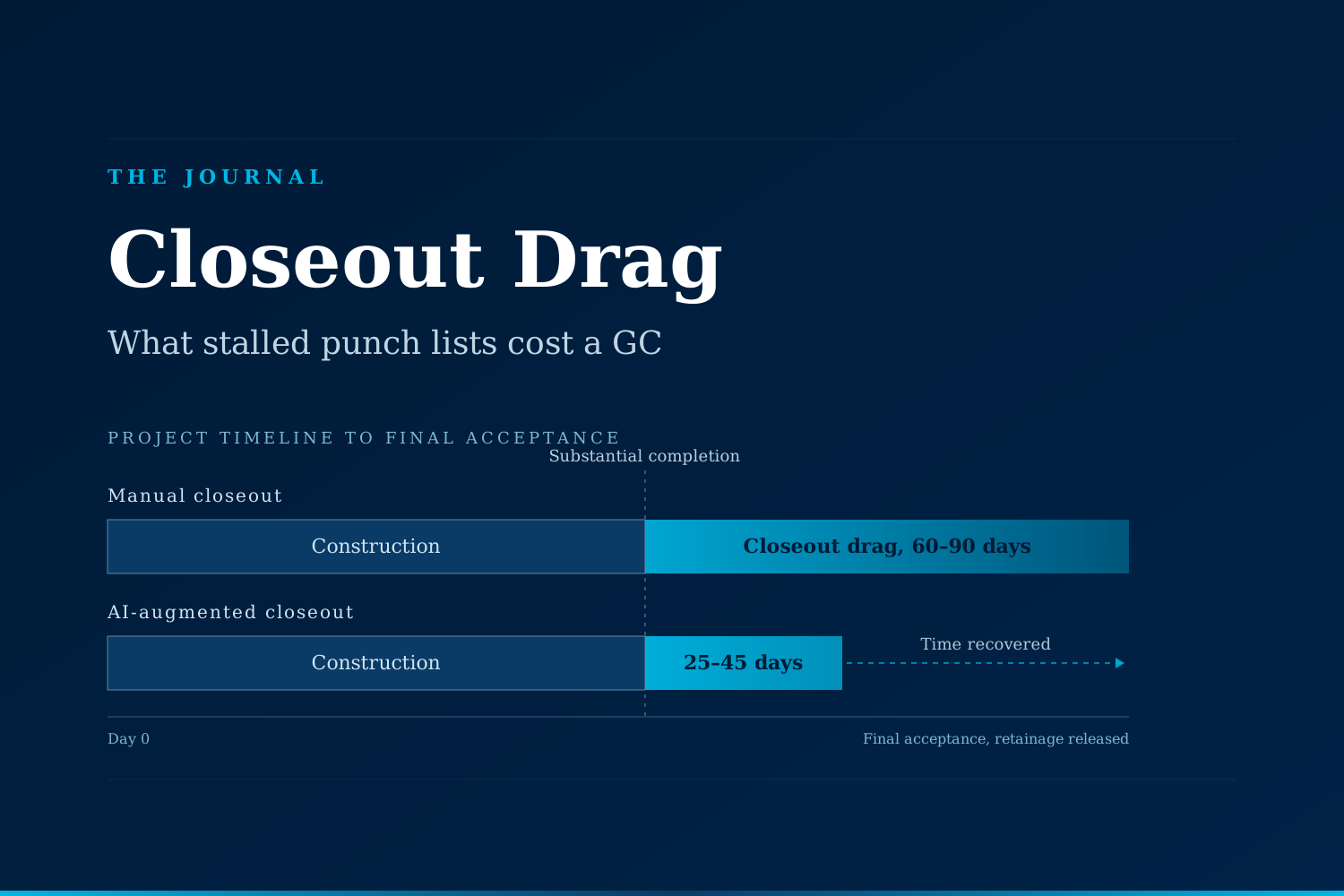
Closeout is where general contractor schedules stretch and margin compresses. The punch list looks small on the cover sheet, but the chase behind it (assigning items, coordinating sub returns, walking the owner through re-inspections, releasing retainage) often consumes the same project manager hours as the entire structural phase did. Adding more PMs is rarely the fix.
This article looks at why closeout drag is one of the more expensive problems on a mid-size general contractor's desk, what the punch list backlog actually costs in cash and goodwill, and what an AI-augmented closeout process changes about the math.
What is closeout drag?
Closeout drag is the gap between substantial completion and final acceptance. On paper, the building is done. In practice, dozens of small open items are still being chased: a missing escutcheon plate in stairwell B, three doors whose closers need adjustment, a janitor's closet missing its label, two fan-coil access panels still on backorder. Each item has an owner (a sub), a deadline, a verification path, and an approval signature attached to it.
Across a typical mid-size commercial GC project, the punch list can run 200–600 items at substantial completion. Some are 30-minute jobs. A handful require new fabrication. The administrative work of tracking them, however, is roughly the same regardless of how trivial each item is.
Why does the punch list take so long to close?
Three structural reasons that have nothing to do with how hard subs work.
Ownership is distributed but accountability sits with the GC. The project manager owns the schedule for items the GC does not actually perform. Each closed item requires a second visit (the sub), a verification (the GC superintendent or PM), and often a sign-off (the architect or owner's rep). One item, three calendars.
Closeout documentation is a parallel project. O&M manuals, as-built drawings, lien waivers, warranties, certificates of occupancy, equipment training records, and substantial completion certificates all need to be collected, formatted, and submitted. Each sub has its own format and its own internal lag. The GC's PM team effectively becomes a documentation chaser for 30 to 90 days.
Retainage holds the leverage on both sides. Owners hold retainage (commonly 5–10% under AGC and AIA standard contract language) until closeout is complete. Subs hold their final productivity until they get paid. The GC sits in the middle, often financing both ends from its own working capital while the chase plays out.
This is the part of the project where industry surveys repeatedly note that the last 5% of work takes longer than anyone planned for. FMI's quarterly nonresidential construction surveys have consistently flagged closeout cycle time as a top cash flow stressor for mid-size GCs, and Dodge Data analyses of project lifecycles have shown closeout durations expanding rather than compressing over the past decade.
What does closeout drag really cost a mid-size GC?
Four cost buckets, all real, and almost never tracked together on the same page.
1. Working capital on retainage. On a $12M project at 7% retainage, $840K is sitting in the owner's account during closeout. Every extra week is a real financing cost. A 60-day closeout costs roughly $14K in carrying cost at 9% APR on that figure alone, before factoring in the sub retainage the GC is holding from its own pocket while owners hold theirs.
2. PM hours. A senior PM at a fully loaded rate of $150–$200 per hour spending 15–25 hours per week on closeout chasing equates to $2,250–$5,000 per project per week. That cost climbs as the project ages, because nothing else moves until closeout closes.
3. Sub goodwill. Subs whose final payment is held up by GC-side documentation delay, or by three other subs that have not closed their own punch items, remember it on the next bid. Repeat-sub pricing is typically 8–12% friendlier than fresh-sub pricing across most trades, and goodwill leaks show up in next quarter's hard-bid pricing rather than in the current project's ledger.
4. Reputation with the owner. The last 30 days of a project shape the owner's reference call. Long closeouts erode the relationship even when the building was delivered well, and many GCs lose repeat business in the closeout phase, not the construction phase.
Here is the same project compared across two operating models.
| Metric | Manual closeout | AI-augmented closeout |
|---|---|---|
| Punch list time-to-close | 60–90 days | 25–45 days |
| PM hours per week on closeout chasing | 15–25 | 4–7 |
| Sub follow-up cycles per item | 3–5 calls or emails | 1–2 (most via auto-status) |
| Owner re-walk inspections | 3–4 | 1–2 |
| Closeout document completion rate at substantial | 30–45% | 75–90% |
| Retainage release lag from substantial | 45–75 days | 20–35 days |
| Cash forecast accuracy at month-end | Soft | Materially tighter |
The shape of the savings is not "do less work." It is "do the same work without the coordination tax sitting on top of every single item."
What changes when AI handles the closeout chase?
The pattern is familiar to anyone who has watched logistics dispatchers move from spreadsheets to a real TMS. The work does not disappear, but the coordination layer falls away.
What changes specifically:
- Punch items get assigned, escalated, and verified without a PM rebuilding the picture every Monday morning.
- Sub status updates flow in continuously (replies, photo confirmations, calendar updates), not on weekly call cadence.
- Closeout documents (lien waivers, warranties, O&M PDFs) are tracked against the schedule of values automatically, so gaps surface before they hold up the AIA G706 release package.
- Owner re-walks are scheduled against verified-ready items rather than optimistic ones, so the second visit does not turn into a third.
- Retainage release packages are assembled as items close, not in a final scramble two days before the owner meeting.
What does not change: the field work itself. A door closer still needs a person with a screwdriver. A missing access panel still needs to be fabricated and installed. The point of automation here is not to do the physical work, it is to make sure the physical work that has already been done actually gets across the line on paper.
What are three signs your closeout is slower than your peers'?
You do not need an external benchmark to know whether closeout is a problem. Three patterns show up consistently in conversations with mid-size GCs.
- The same PM owns closeout for three or more projects at once. This usually means closeout is not a phase, it is a permanent administrative job that just happens to wear different project names. The PM is no longer running construction, they are running a closeout queue.
- The punch list at substantial completion lives in a spreadsheet. Not as a fallback, but as the system of record. Excel is fine for 30 items. A 400-item punch list with cross-sub dependencies, sign-off chains, and photo evidence becomes a coordination job, not a tracking job.
- Retainage release is the recurring surprise on the cash forecast. If finance is regularly missing receivables timing because closeout slipped, the gap between "we are basically done" and "the owner actually pays" is structurally wider than the contract allows.
If any one of these is consistently true across recent projects, the closeout cycle is almost certainly leaking working capital and PM hours at a level worth measuring.
When is the right time to look at closeout automation?
Closeout is one of the better candidates for AI augmentation in a GC's operations, because the work is highly structured (every item has an owner, a status, a deadline, a verification, and a sign-off chain) and the friction is mostly coordination rather than judgment. The judgment calls (is this acceptable to the owner, is this a warranty item versus a punch item, does this affect substantial completion) stay with the PM and the superintendent. The coordination layer, the status chasing, the documentation tracking, and the reminder cadence are where automation pays back fastest.
The right moment to look at it is usually one of three:
- A recent project closed long and finance asked, on the record, why receivables slipped.
- A senior PM left and the closeout knowledge left with them, and the next several projects are now approaching substantial completion without that institutional memory.
- The portfolio is growing faster than the closeout team can scale, and you are about to backfill the coordination role with another hire whose job will mostly be chasing.
If any of those moments are recent, the most useful next step is usually not to commit to a tool. It is to look at one real recent closeout and map where the time and cash actually went, then decide what is worth automating.
Want a second opinion on your closeout cycle?
If closeout drag is showing up on your cash forecast or your PM utilization reports, we run a completely free automation audit for general contractors that maps where time and cash are actually going on a recent closeout, and what AI-augmented closeout would change about the cycle. No commitment, no slide deck, no pressure to move forward. → Book the audit
Sami Raza
Software Developer & Technical Author
Sami Raza builds AI automation for logistics, DTC, and construction operations teams at ApexifyLabs, and writes about the operational failures that automation is actually worth pointing at.