Chargeback Disputes vs Returns: The DTC Margin Story
Returns and chargebacks both end with a refund, but the underlying economics differ sharply. Most DTC ops teams track one cleanly and underprice the other.
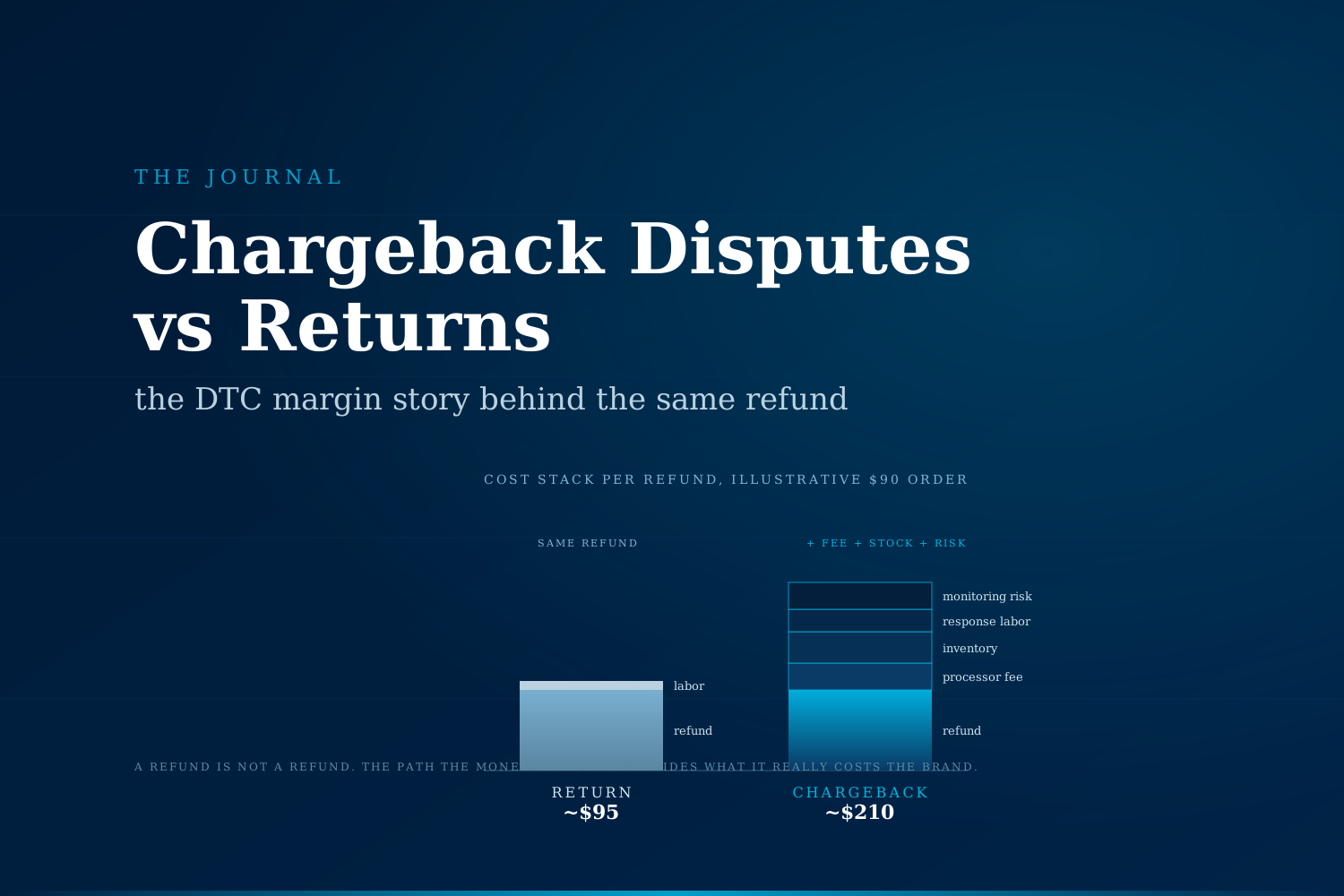
A chargeback is not a return with extra paperwork. When the refund travels back through a customer's card issuer rather than your support portal, the brand pays processor fees, loses the inventory, and runs a strict response clock. For DTC operators, that gap is where margin leaks unnoticed.
What is a chargeback dispute, and how does it differ from a return?
A return is initiated by the customer through the brand's own systems. It follows a predictable path: a portal request, a return label, an inspection, a refund, and usually an item back on a shelf. The brand keeps control of the workflow, and most of the cost is operational.
A chargeback travels the other way around. The customer calls their card issuer (Chase, Capital One, American Express, and so on) and disputes the transaction. The issuer pulls funds out of the brand's account before any investigation, the brand is notified after the fact, and the response window is set by the card network rather than by the brand. Visa and Mastercard publish formal dispute reason codes that define what evidence is acceptable and how long the merchant has to submit it.
The structural difference matters more than the labels. A return is a customer service workflow with a refund attached. A chargeback is a financial dispute with a strict legal and procedural shape, and refunding the customer is only one of several possible outcomes.
Why does a chargeback cost more than the original refund?
The refunded amount is usually the smallest line item. The full cost of a single chargeback for a DTC brand stacks like this:
| Cost component | Typical range per dispute | Why it adds up |
|---|---|---|
| Refunded transaction | Order value | Pulled before investigation |
| Processor chargeback fee | $15 to $100 | Charged by the acquirer per dispute, often non-refundable even on a win (Chargebacks911 Field Report, 2023) |
| Lost inventory | Cost of goods sold | Goods rarely come back when the customer never agreed to return them |
| Response labor | 20 to 90 minutes | Compiling evidence, screenshots, shipping records, communication logs |
| Network monitoring risk | Indirect | Sustained ratios above Visa's 0.9% threshold trigger the Visa Dispute Monitoring Program, which can escalate to higher fees or processor restrictions |
For a $90 average order, a single lost chargeback can cost the brand $150 to $200 once the fee, the inventory write-off, and the labor are stacked. The same refund processed as a return would have cost a fraction of that, and the inventory would likely have come back.
The other quiet cost is the win-rate gap. Industry reporting from Visa and Chargebacks911 has consistently put the average DTC merchant dispute win rate between 12% and 30%, while well-run programs land closer to 50% to 70%. The gap is rarely about evidence quality. It is about the speed and consistency of the response.
What does the chargeback timeline look like inside a DTC ops team?
The clock starts the moment the issuer files. Most card networks give the merchant about 30 days to submit evidence, and some categories run shorter. Inside that window, the brand has to:
- Pull the original order detail (timestamp, IP address, billing and shipping match, customer history).
- Pull the fulfilment record (carrier, tracking, signature if applicable, delivery confirmation).
- Pull the customer communication trail (support tickets, email exchanges, refund policy acknowledgements).
- Match the dispute reason code to the right evidence type.
- Assemble all of it into a single submission inside the processor portal.
- Submit, log the case, and set a follow-up reminder for the issuer's decision.
In a brand running 200 to 500 monthly chargebacks (typical for a $5M to $30M DTC catalogue with a card-not-present mix), that workflow consumes between 80 and 300 hours a month. The work is fiddly, deadline-driven, and skill-dependent. Junior agents miss reason-code nuances; senior agents are too expensive to spend their week on portal screenshots. So disputes pile up, the easy ones get filed late, the complicated ones get conceded, and the win rate drifts downward.
Where do chargebacks accumulate on a $5M to $30M DTC brand?
A few categories absorb most of the volume:
- True fraud. Stolen cards, account takeovers. Usually a quick concede because the evidence works against the brand.
- Friendly fraud. A customer who received the product disputes the charge anyway, by mistake or by design. Industry research from Chargebacks911 and Mastercard estimates this group makes up 60% to 75% of DTC chargebacks. These are the disputes most worth fighting.
- Service disputes. "Item not as described", "service not rendered", subscription cancellations the customer believed they had made. Evidence-heavy, often winnable with the right communication trail.
- Processing errors. Duplicate charges, currency conversions, expired authorisations. Usually preventable upstream rather than fought downstream.
The economics differ by category. Friendly fraud is the highest-leverage bucket because the evidence (delivery confirmation, login records, customer communications) tends to be available, the win rate climbs sharply when the response is fast and consistent, and the cost of conceding includes the lost inventory.
Side by side: return economics vs chargeback economics
| Dimension | Return | Chargeback dispute |
|---|---|---|
| Who initiates | Customer through your portal | Customer through their card issuer |
| Refund flow | You issue the refund | Issuer pulls funds, you respond |
| Inventory | Usually returned | Usually kept by the customer |
| Processor fee | Minimal | $15 to $100 per dispute |
| Time pressure | Days to weeks, brand sets pace | 20 to 30 days, network sets pace |
| Customer relationship | Mostly intact, exchange path open | Often broken, sometimes adversarial |
| Tracking surface | One ops tool | Multiple processors, networks, evidence templates |
| Worst-case risk | Refund-rate metric drift | Network monitoring, merchant account at risk |
The line most operators miss is the last one. Returns hurt margin. Chargebacks at scale put the merchant account itself at risk. Sustained ratios above Visa's 0.9% threshold (Visa Dispute Monitoring Program rules) can move a brand from standard processing terms into restricted-status terms, where reserves, fees, and onboarding friction with new processors climb materially.
How does AI change the dispute workflow?
The shape of the desk changes more than the headcount. The number of disputes does not drop overnight; what changes is how quickly each one moves through the workflow and how consistent the response packets become.
In a manual setup, dispute handling looks like a queue of half-investigated cases competing for the senior team's attention. Reason codes are misread, evidence is assembled inconsistently, and a meaningful share of disputes hits the deadline without a submission at all. The win rate ends up reflecting the response cadence more than the merit of any individual case.
In an AI-augmented setup, three things change. First, the dispute lands inside a workflow that already knows the order, the fulfilment record, the communication history, and the reason code on day one rather than day twelve. Second, the routine evidence assembly (the parts of the packet that are mechanical: order details, delivery proof, customer history) stops absorbing senior-agent hours. Third, the pattern data finally becomes legible: which products, which channels, which payment methods, and which time windows produce the disputes. That last layer is what eventually reduces the inflow, not just the response time.
We are not going to lay out the evidence templates or the integration plumbing here. The brands we work with do not hire us to wire portal scrapers; they hire us to untangle the order-truth question across the storefront, the OMS, the carrier, and the processor, and to agree on what an automated response is allowed to submit without a human in the loop. That is where the work actually is.
Three signs your chargeback load is bigger than your team realises
Three checks any ops leader can run in a single afternoon:
- Pull last quarter's chargeback ratio. If it sits between 0.5% and 0.9% of transactions, the brand is inside Visa's risk band but on the wrong side of margin. Past 0.9%, the merchant account itself is at risk.
- Look at the share of disputes submitted past the deadline. If more than one in ten cases is conceded by default because the response window closed, the win rate is being capped by workflow, not by evidence.
- Track senior-agent time on disputes during product launches and seasonal peaks. If the most experienced support and finance people are spending real hours inside processor portals during a launch week, the dispute desk is starving the work that actually drives revenue.
Any one of these on its own is solvable. The combination is what makes the brand feel like it is paying margin twice for every unhappy customer.
Closing
Returns and chargebacks both end with a refund, but the costs underneath are not the same shape. Most DTC operators we work with already know their return rate inside out and underestimate the dispute economics sitting right next to it. The work is not glamorous, but it is one of the cleaner places to find margin without changing the product or the price.
If your dispute load has grown faster than the team that handles it, we run a completely free automation audit for DTC ops teams that want a second opinion before committing to anything. No slide deck, just a clear read on where the cost is sitting and what is worth automating first. → Book the audit
Sami Raza
Software Developer & Technical Author
Sami Raza builds AI automation for logistics, DTC, and construction operations teams at ApexifyLabs, and writes about the operational failures that automation is actually worth pointing at.