The Cash Flow Cost of Slow Lien Waiver Collection on GCs
Lien waivers that trickle in over weeks delay a general contractor's monthly draw. A look at what slow waiver collection actually costs in working capital, and what changes when the chase runs itself.
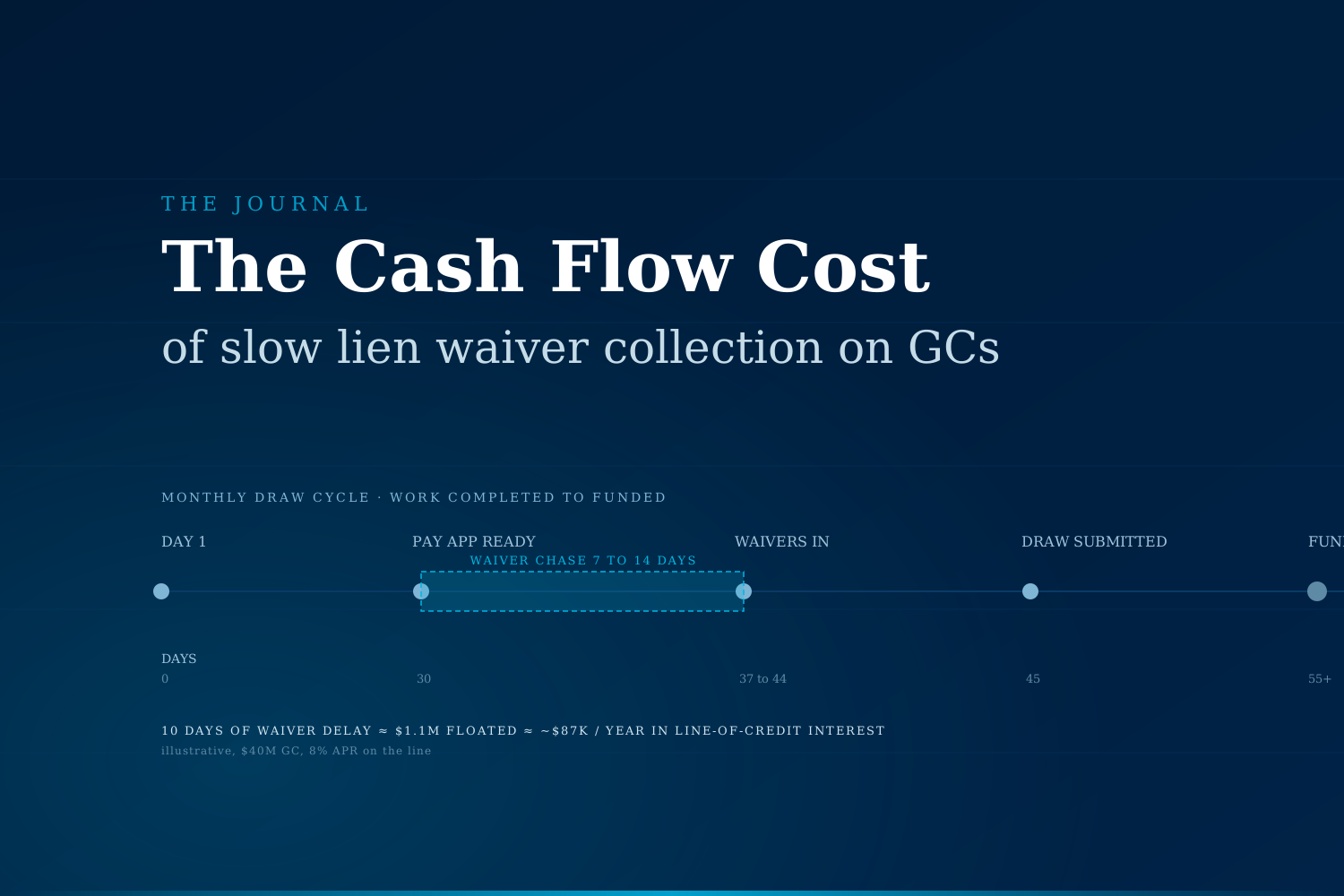
Lien waivers are the paperwork hinge between a general contractor's monthly pay application and the cash that funds it. When conditional waivers from subs and suppliers trickle in over two or three weeks, the entire draw cycle slides with them. The cost is rarely visible on a P&L, but it shows up on the line of credit every month.
This article looks at what lien waivers are doing inside the GC's draw cycle, why they slow it down, what slow collection actually costs a mid-size general contractor in working capital, and what changes when waiver collection runs on a cadence instead of a chase.
What is a lien waiver and why does a GC need it every month?
A lien waiver is a signed statement from a subcontractor or supplier that gives up the right to file a mechanic's lien against the property for work or materials already paid for, or about to be paid for. In most US states, lien rights are statutory, and the waiver is the only document that releases them cleanly. On many commercial projects, the owner's lender will not fund a monthly draw without conditional waivers in hand for the period being billed and unconditional waivers for the period previously paid.
Four document types ride alongside every monthly pay application:
- Conditional progress waivers from every sub and supplier billing on the current draw, scoped to the dollar amount of that draw.
- Unconditional progress waivers covering the prior draw, confirming the sub actually received the money the GC was paid for and routed to them.
- Conditional final waivers at closeout, scoped to the final billing amount.
- Unconditional final waivers released after final payment clears.
In California, Texas, Florida, Arizona, Georgia, and several other states, the statutory waiver form is prescribed by law and cannot be modified without invalidating it. The general contractor is not just collecting signatures. They are reconciling specific dollar amounts, specific billing periods, and specific statutory language for every tier of the payment chain, every single month.
Why does lien waiver collection drag the draw cycle?
The waiver itself is a one-page document. What slows it down is everything around it.
Waivers cannot be generated until the pay application is approved. Subs invoice the GC against a schedule of values. The GC reviews, sometimes negotiates, and approves a dollar figure for the draw. Only then can the GC issue a conditional waiver request to each sub for that exact figure. A draw that takes a week of back-and-forth to lock down is a week that no waiver requests have gone out.
Every sub has a different process. Some subs sign and return the same day from their office manager. Some route through a controller in another state. Some only release waivers after their own lower-tier suppliers have signed, which compounds the wait. A GC with thirty subs on a project is running thirty parallel chases, each with its own bottleneck.
Owners and lenders reject incomplete packages. A monthly draw with twenty-seven of thirty waivers attached is not 90% accepted. It is held. Most owner contracts and construction loan agreements treat the waiver package as binary: complete and funded, or incomplete and parked until the GC closes the gap.
Conditional and unconditional waivers run on different clocks. The conditional waiver for this month's draw and the unconditional waiver for last month's draw both have to land in the same package. A sub that signed conditional waivers promptly but never returns the unconditional version (because the money already arrived and the urgency dropped) can hold up the next draw without anyone realizing where the gap is.
The chase is admin work with no loud deadline. Phone calls and follow-up emails to a sub's office manager compete every day with field issues, RFIs, and submittals. The chase usually wins only after a draw is already late.
The result is a cycle where the draw application could, in principle, go in on day 30, but routinely goes in on day 40 or 45 because the waiver package is still incomplete.
What does slow lien waiver collection actually cost a mid-size GC?
The cost lives in two places: interest on a line of credit, and capacity that gets rationed because cash is tied up.
Consider a general contractor running $40M in annual revenue across eight to ten active projects. Industry surveys from organizations like the Construction Financial Management Association consistently report that contractors finance significant portions of work-in-progress through bank lines or owner-paid retainage, and that delayed draws are a top-three cause of working capital stress for mid-market firms.
| Lever | Value |
|---|---|
| Annual revenue | $40,000,000 |
| Monthly billings (average) | ~$3,300,000 |
| Typical draw cycle | 30 days work, 10 to 15 days to fund |
| Lien waiver delay inside that cycle | 7 to 14 days |
| Working capital floating per day of delay | ~$110,000 |
| Line-of-credit interest, per day of delay (at 8% APR) | ~$24 per $110K per day |
| Annualized interest, 10 days of delay across the year | ~$87,000 |
The $87,000 number is conservative. It assumes only one source of waiver-driven delay per month and a single, stable interest rate. In practice, GCs absorb the cost in three less visible ways at the same time.
The line of credit is the slack variable. When draws fund late, payroll and supplier payments still have to go out on time. The line absorbs the gap, and the GC pays interest on cash that should already be in the operating account.
Bonding capacity shrinks. Surety underwriters look at working capital and current ratio. Cash trapped in slow draws shows up as receivables, and receivables count for less in the bonding calculation than cash does. A GC sitting on stale receivables from waiver delays will see less aggressive surety support when bidding the next big job.
Sub relationships fray. When the GC's draw is late, the GC's payment to subs is late. Subs that get paid slowly raise their bids on the next project, or stop bidding altogether. The cost of waiver delay then shows up as a 1 to 3% premium baked into future subcontractor pricing, which is invisible until someone benchmarks against a peer.
A single month of delayed funding on a single project rarely changes anyone's year. The pattern, repeated every month across every project, reprices the entire business in ways that never get attributed back to the source.
How does manual lien waiver collection compare to AI-assisted collection?
| Dimension | Manual collection | AI-assisted collection |
|---|---|---|
| Waiver generation | Project accountant builds each one after pay app is locked | Generated automatically the moment the schedule of values is approved, with correct dollar amounts and statutory language per state |
| Distribution | Email blast to subs, then case-by-case follow-up | Sent to each sub's preferred channel with reminders on a scheduled cadence |
| Tracking | Spreadsheet of who has signed and who has not | Live dashboard of every waiver, by project, by tier, by status |
| Reconciliation | Match each returned waiver to the pay app line item by eye | Auto-matched against the billing line, mismatches flagged with a clear reason |
| Statutory compliance | Project accountant remembers which states require which form | Form template enforced by jurisdiction, no custom edits silently introduced |
| Escalation | Whoever has bandwidth calls the slow subs | Subs that miss the cadence escalate automatically, with full context |
| Package assembly | Manual compile into a PDF on draw day | Pre-assembled, complete or visibly short, days before submission |
The work itself does not get smaller. It gets ordered, dated, and continuously visible, which is what shrinks the delay between "draw is approved" and "draw is funded."
What changes when waiver collection runs on a cadence instead of a chase?
A general contractor that closes the waiver-driven delay sees four shifts at once.
- Draws fund on the contract clock, not the chase clock. The pay application goes in complete, on the day the contract allows, which moves funding forward by one to two weeks.
- The line of credit is used for opportunity, not for cleanup. Interest expense drops, and the line is available for working capital when the business actually wants to lean on it.
- Subs get paid faster. Pay-when-paid clauses translate the GC's faster draws directly into faster sub payments, which strengthens bid pricing on future work.
- Surety conversations get easier. Cleaner working capital and faster current-asset turnover both read well to the underwriter.
What does not change is the judgment. Whether to accept a partial waiver, when to escalate to the sub's principal, how to handle a tier-two supplier dispute on a private project, all stay with the GC's project accountant and controller. Connecting a GC's pay-app cycle to a continuously current waiver picture also means parsing dozens of statutory forms, reconciling against the schedule of values, and folding the result into the project management and accounting systems the GC already runs. That is the actual build, and the part a GC hands to a partner. We are not going to walk through it here.
Three signs slow lien waivers are dragging your draw cycle
A short diagnostic any GC can run this week, no software required.
- Pull last month's draw on your largest active project. Compare the date the pay application could have been submitted (work completed plus the contract's notice window) to the date it actually was submitted. If the gap is more than five days, waivers are almost certainly part of it.
- Ask your project accountant how many subs they followed up with by phone last month for a waiver. If the number is more than three, the cadence is running on personal effort rather than process.
- Look at the line of credit's average balance over the last six months. If it rises predictably in the days before a draw funds and drops after, the line is silently financing waiver delay.
If any of these rings true, the cost is real, and it compounds every month the pattern continues.
When is the right time to look at automating this?
Waiver collection is one of the cleaner candidates for AI augmentation on a GC's desk because the work is highly structured. Every waiver has a payer, a payee, a dollar amount, a date, a jurisdiction, and a required form. The judgment calls stay human. The generation, the chase cadence, the reconciliation, and the package assembly are where automation pays back fastest.
The right moment is usually one of three:
- A recent draw funded late and the lender or owner traced the delay back to incomplete waivers.
- The portfolio is growing and the project accountant is hitting a ceiling on how many monthly draws one person can shepherd.
- A controller or CFO has asked, on the record, how much the line of credit is actually being used to finance paperwork lag rather than scope.
If any of those is recent, the most useful next step is not to commit to a tool. It is to take one active project, map where waivers stall in the cycle, and decide what that delay is worth at current volume.
Want a read on what your draw cycle is actually costing?
If your monthly draws fund a week or two later than the contract allows and waivers are part of the reason, we run a completely free automation audit for general contractors. We will map where waivers stall in your draw cycle, what closing the gap would be worth at your current revenue, and what continuous tracking would change about your line-of-credit usage. No commitment, no slide deck, no pressure to move forward. → Book the audit
Sami Raza
Software Developer & Technical Author
Sami Raza builds AI automation for logistics, DTC, and construction operations teams at ApexifyLabs, and writes about the operational failures that automation is actually worth pointing at.