As-Built Reconciliation: The Closeout Drag GCs Forget to Price
Why as-built drawing reconciliation is the closeout drag most GCs underbid, and how AI-assisted markup intake shortens days-to-retention-release.
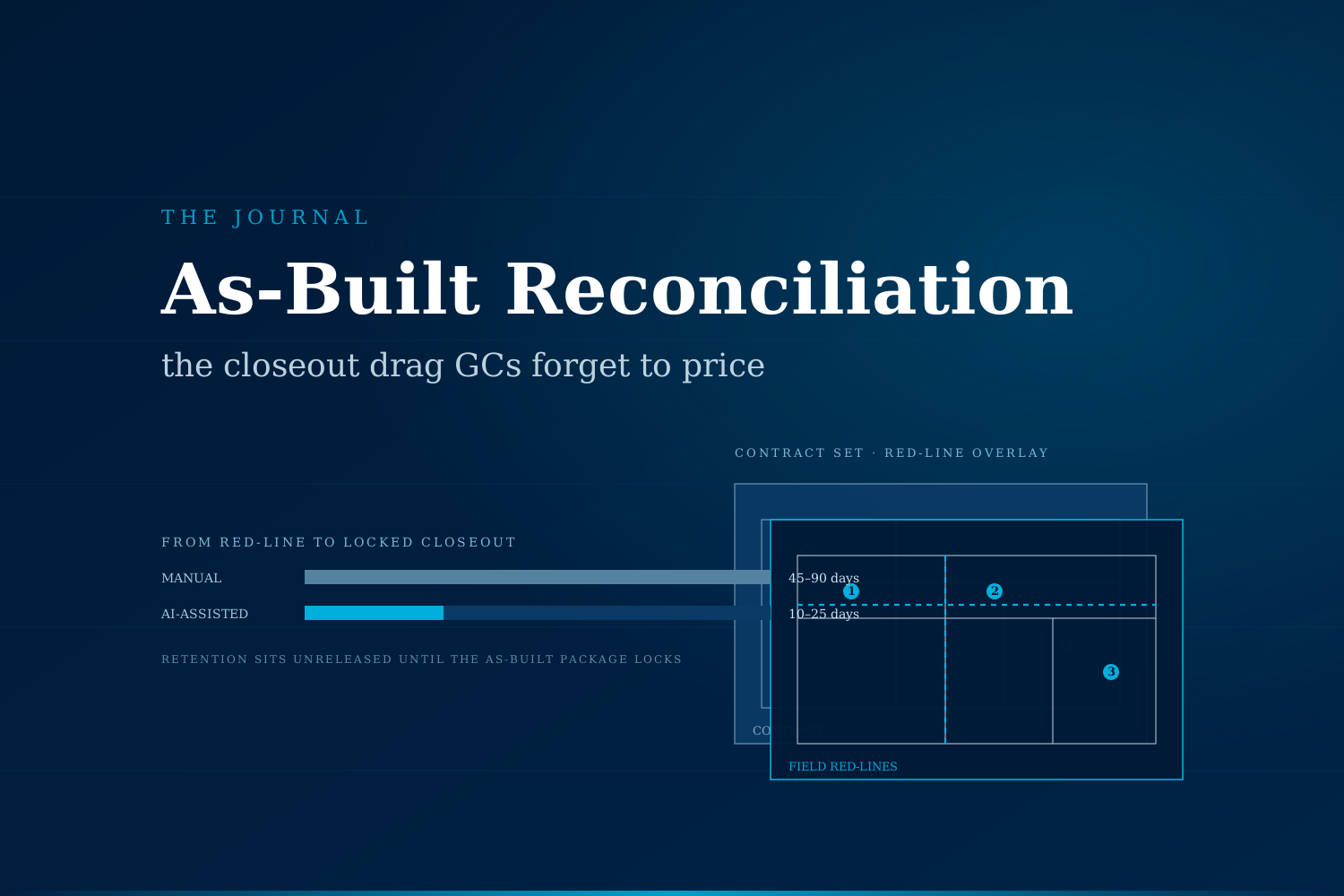
As-built reconciliation is the closeout work most general contractors underbid. Consolidating field red-lines from every trade, overlaying them onto contract drawings, and locking the final O&M binder routinely takes weeks after substantial completion. It sits in general conditions where margin is thin, and it holds back retention release on jobs that are otherwise done.
What is as-built reconciliation, and why does it stall closeout?
Every contract drawing ships with the assumption that the field will install something different. A wall line moves six inches to clear a column. A duct route diverges to avoid a beam. A conduit run picks up an extra junction box. Those changes get red-lined on a working print at the foreman level, then bundled into a markup file and handed back to the GC near substantial completion. The general contractor then has to consolidate every trade's markups into a single coordinated as-built set, reconcile conflicts, secure owner sign-off, and lock the final document into the O&M manual.
Until that package is closed out, the project is not really closed. Retention typically is not released, the owner's facilities team has nothing to operate from, and the closeout team is carrying labor on a job that is no longer billable.
Where does the manual cycle actually break down?
Three places, consistently:
- Collection. Every sub returns red-lines at a different pace and in a different format. Some hand back scanned paper markups, some upload native CAD overlays, some only share Bluebeam sessions. The project engineer ends up chasing markups for weeks after demobilization, often after the original superintendent has rolled to the next job.
- Conflict resolution. The plumber's red-line shows pipe in a chase the electrician's red-line shows conduit in. Someone has to walk both back to the field for a verification photo, ideally before the wall is closed up but usually after. Each conflict adds at least one round trip to the trade.
- Sign-off. The owner's facilities team wants to know what they are actually accepting. If the as-built differs meaningfully from the permitted set, the architect may need to validate. That cycle alone can add weeks, and on institutional or federal work it can add a month.
None of these break down because the PM is bad at the job. They break down because the work is serial, the inputs arrive asynchronously, and the latency between a markup landing in inbox and a question reaching the field is measured in days, not minutes.
What does the manual cycle cost a GC?
Industry surveys consistently put the gap between substantial completion and final project closeout at 60 to 90+ days, with as-built and O&M turnover among the top stalled items. (See, for example, KPMG's Global Construction Survey series and the closeout benchmarks tracked by FMI Corporation.)
The labor cost is the obvious one. A project engineer at $85 to $110 an hour fully loaded, spending two to three days a week for six weeks chasing markups, easily runs $20K to $30K of soft cost per major project. That sits in general conditions where bid margins are already compressed.
The working capital cost is bigger, and it is the one that rarely shows up in the closeout post-mortem. Retention on commercial construction is typically 5% to 10% of contract value, held until the owner accepts the closeout package. On a $12M project with 7% retention, that is roughly $840K parked in the owner's account. At a 9% cost of capital, an extra 45 days of held retention runs about $9K of pure financing cost per job, before counting opportunity cost on the next bid. Multiply across an active pipeline of six to ten jobs in closeout at any time, and the carry runs into six figures.
The third cost is reputational. Owners that have a slow closeout experience are slower to award the next project, even when site execution went well. Owners' facilities teams talk to each other.
Manual reconciliation vs AI-assisted reconciliation
| Step | Manual reconciliation | AI-assisted reconciliation |
|---|---|---|
| Red-line intake | PM emails subs, waits, re-emails | System ingests markups the moment a sub uploads |
| Format normalization | Manual overlay in Bluebeam, person by person | Auto-extracted into a common coordinate set |
| Conflict detection | Found visually during overlay | Flagged automatically when two trades touch the same coordinate |
| Sub follow-up | One-by-one email or phone call | Pre-drafted clarification request with the conflict embedded |
| Owner sign-off package | Assembled at the end of the job | Continuously updated, ready at substantial completion |
| Typical days to lock | 45–90 | 10–25 |
The point of the comparison is not fewer drawings to consolidate. It is the removal of latency between a red-line being uploaded and a question reaching the right person. The PM moves from chase-and-reconcile to review-and-decide.
Why is the punch list not the same problem?
Punch lists and as-builts both stall closeout, but they fail for different reasons. A punch list item is a physical fix with a clean unit of work and a clear closer (the trade that did it). An as-built discrepancy is documentation that has to match the field, and the closer is often not the original installer. Subs demobilize, the foreman who marked the change has rolled to the next job, and verification depends on whether a photo or coordinate is still available.
Closeout teams that confuse the two end up treating both with the same tool (a shared spreadsheet or a punch list app), and neither moves. Punch list software was designed for distinct repeatable tasks. As-builts need a coordination layer.
What changes when an AI layer reads red-lines as they come in?
When a markup lands in the project drive, the system can compare its geometry to the contract set, flag the deltas, cross-check against other trades' open markups in the same area, and pre-draft a verification request before the PM has opened the file. The PM still approves what goes to the field, but the work shifts from data wrangling to decision-making.
Two downstream changes follow:
- The closeout package grows during the job, not in a sprint at the end. That changes the substantial-completion conversation. The owner sees a near-final package on day one of completion, not eight weeks later.
- The handoff to facility operations is cleaner. The NIST 2004 study on interoperability in the US capital facilities industry put the annual cost of inadequate phase-to-phase handoffs at $15.8 billion, with O&M data quality a recurring theme (NIST GCR 04-867). Better as-builts pay forward into the building's operating life, not just the GC's retention release.
Three signs your closeout cycle is at risk
- Average days from substantial completion to retention release is creeping past 60 on more than one job.
- PMs are still chasing red-lines after the trailer is off the site.
- Owner facilities teams are asking the architect to validate as-builts, not just accept them.
If any two are true on more than one active project, the closeout cycle is leaking working capital that no operations dashboard is surfacing.
What an automation layer does not replace
This does not replace PM judgment on field reality. Conflicts that need a site visit still need one. Owners with their own document standards (institutional, federal, healthcare) still drive the final format. The point of the automation layer is to collapse latency between work happening and documentation reflecting it, so the PM spends time on the decisions only a PM can make.
If closeout drag is showing up in your retention aging more than in your operations metrics, that is worth a closer look. We run a completely free automation audit for GCs that want a second opinion on where the closeout cycle actually stalls, before committing to anything. No slide deck, no obligation. → Book the audit
Sami Raza
Software Developer & Technical Author
Sami Raza builds AI automation for logistics, DTC, and construction operations teams at ApexifyLabs, and writes about the operational failures that automation is actually worth pointing at.