Address Errors Are Costing DTC Brands More Than the Reships
Undeliverable DTC orders cost far more than the reship fee. A look at the full cost stack and what shifts when address validation moves to checkout.
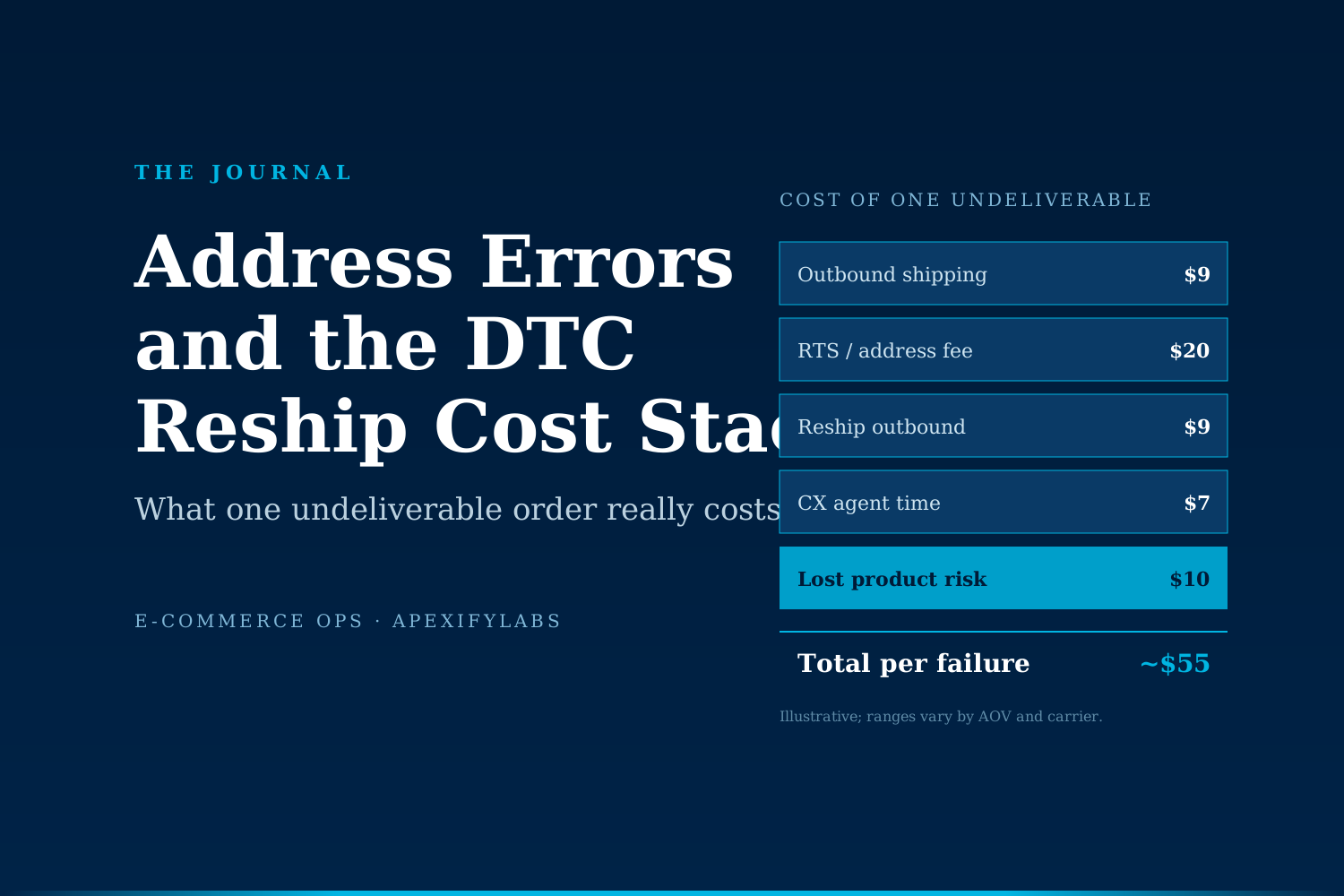
Bad shipping addresses cost DTC brands far more than the reship fee. A single undeliverable order can trigger a customer service ticket, a refund or reship, a return-to-sender charge, lost product, and a damaged review, often eight to fifteen times the original shipping cost. Most of those losses never show up on a shipping invoice.
What is the real cost of an undeliverable DTC package?
Carriers, third-party logistics partners, and DTC ops leaders broadly agree that 3 to 5 percent of US e-commerce parcels have some kind of address problem (USPS Office of Inspector General, audits on Undeliverable As Addressed mail). Some get corrected in transit. Some get reshipped. Some get returned to sender, sit in a 3PL bin, and disappear into "shrinkage" at the next inventory count.
The fully loaded cost of one failed delivery often looks like this:
| Cost line | Typical range | Notes |
|---|---|---|
| Outbound shipping | $7–$15 | Already paid before the address fails |
| Return-to-sender or address correction fee | $15–$25 | Carrier surcharge, paid even if the package never reaches the customer |
| Reship outbound shipping | $7–$15 | Paid a second time |
| CX agent time (refund vs reship decision, address re-confirm) | $4–$10 | 8 to 12 minutes at a typical CX fully-loaded rate |
| Lost product (RTS package mis-shelved or written off) | 10 to 40 percent of orders | Industry surveys put RTS recovery rates at 60 to 90 percent |
| Negative review or refund-with-no-reship requests | Hard to measure | Outsized impact for repeat-purchase brands |
A $40 order with a $9 outbound shipment can easily lose $35 to $55 once the brand chooses to reship and absorb the surcharge. That is not a unit-margin problem. That is a unit loss.
Why do address errors slip through DTC checkout?
Most checkout funnels still accept any string the customer types. A few common patterns drive most failures:
- Apartment, suite, or unit missing. Customer typed
123 Main Stwith noApt 4B. Carrier delivers to the building lobby, package walks off, refund issued. - Typo in the street name or city. Geocoder picks the closest match and ships to the wrong block.
- Old address autofilled by the browser. Customer moved, forgot to update. No flag fires.
- PO Box on a carrier that does not deliver to PO Boxes. Order accepts, fulfillment fails.
- Military APO and FPO formatting. Edge case, but high-cost per failure.
- International address parsed against US schema. Common on brands that flipped on international shipping without revisiting the form.
The interesting pattern is that almost none of these get caught at checkout. They get caught at the carrier scan, three to five days after the order shipped, when the cost to fix is already eight to fifteen times the original shipping invoice.
What does manual vs AI-validated address handling look like, before and after?
Most DTC brands handle bad addresses one of three ways: ignore them and eat the reship cost, ask the CX team to chase corrections after the fact, or pay a 3PL surcharge to "verify" addresses in batches. Each adds cost without reducing failures.
A before-and-after picture, on a brand running roughly 2,500 orders per month:
| Step | Manual address handling | AI-validated checkout |
|---|---|---|
| Catching typos | At carrier scan, 3 to 5 days post-order | At checkout, before the card is charged |
| CX tickets from undeliverables | 60 to 120 per month | 5 to 15 per month |
| Reship cost | $1,800 to $3,600 per month | $150 to $450 per month |
| RTS surcharges | $900 to $2,000 per month | Largely eliminated |
| Customer complaints in reviews | 4 to 8 per month | Sub-1 per month |
| Time to detect a new failure pattern | Weeks (manual sampling) | Hours (drift alerts) |
The dollar story matters, but the operational story is bigger. The CX team stops triaging address tickets. The fulfillment team stops chasing corrections. The data team stops piecing together "where did this package go" reports from carrier portals.
Which DTC brands feel this the most?
The brands that feel undeliverable-address cost the hardest tend to share three traits:
- Average order value under $80. A $35 unit loss on a $40 order is the entire margin. The same loss on a $300 order is a frustration but not a P&L event.
- High repeat-purchase frequency. Subscriptions, replenishables, beauty refills. A single bad delivery experience compounds into a churn event.
- Multi-channel order flow. Site, marketplace, social, and wholesale orders arriving in different formats, often with different validation rules per source.
If two of those three are true, the address-error tax is likely one of the largest unscored costs on the desk.
What changes when address validation moves left in the order pipeline?
The phrase ops teams use for this is "shift left," meaning catch the problem closer to where it was introduced. For DTC orders, that means three things:
- Block bad addresses at checkout. Real-time validation against authoritative carrier data, with suggested corrections shown inline. The customer fixes it before the order is placed.
- Score borderline addresses for review. Not every address is clean or broken. An automated scoring model surfaces the gray-zone orders (low confidence, edge cases, international formatting) before fulfillment, not after.
- Auto-resolve common failure patterns. Missing apartment numbers, swapped state and ZIP, common typos. Many can be corrected without ever asking the customer, by matching against historical delivery data.
This is not a vendor-shopping exercise. The hard part is the orchestration: figuring out which orders need a human eye, which can be auto-corrected, which should pause for confirmation, and how to feed those decisions back into checkout so the same pattern stops repeating next month.
Three signals worth checking on your own data
If you want a quick read on how exposed the brand is, the numbers below are usually easy to pull from a Shopify or 3PL dashboard:
- Percentage of orders with carrier address correction surcharges in the last 90 days. Above 2 percent suggests a checkout problem, not a customer problem.
- CX tickets tagged "where is my order" or "wrong address." If WISMO is the top ticket category and a meaningful slice traces back to undeliverable parcels, the cost is real.
- Inventory variance at the 3PL on RTS-recovered units. If RTS packages are not being received back into stock cleanly, the loss is bigger than the reship line.
None of those three require a new tool to look at. They do require someone to actually look.
A short note on what we do not recommend
Brands sometimes ask for a quick fix: install an address autocomplete widget at checkout, declare victory. That solves about half of the typo class of failures. It does not catch missing unit numbers, old browser autofills, PO Box mismatches, or the orders that flow in from marketplaces and wholesale channels that never touch the website checkout. The work is bigger than the widget.
Where the savings actually land
For a brand running 2,500 orders per month with average address-error costs in the ranges above, the recoverable savings sit in the $25,000 to $50,000 per year range, before counting the CX time freed up and the churn that stops compounding. The cost of staying with the manual flow is rarely zero, even when it feels stable.
If undeliverable parcels are eating margin you cannot reliably tag, we run a completely free automation audit for DTC ops teams that want a second opinion before committing to anything. We look at your last 90 days of shipping data, surface the cost lines you are currently absorbing, and tell you whether automation is the right move, or whether the answer is to fix something simpler upstream. → Book the audit
Sami Raza
Software Developer & Technical Author
Sami Raza builds AI automation for logistics, DTC, and construction operations teams at ApexifyLabs, and writes about the operational failures that automation is actually worth pointing at.